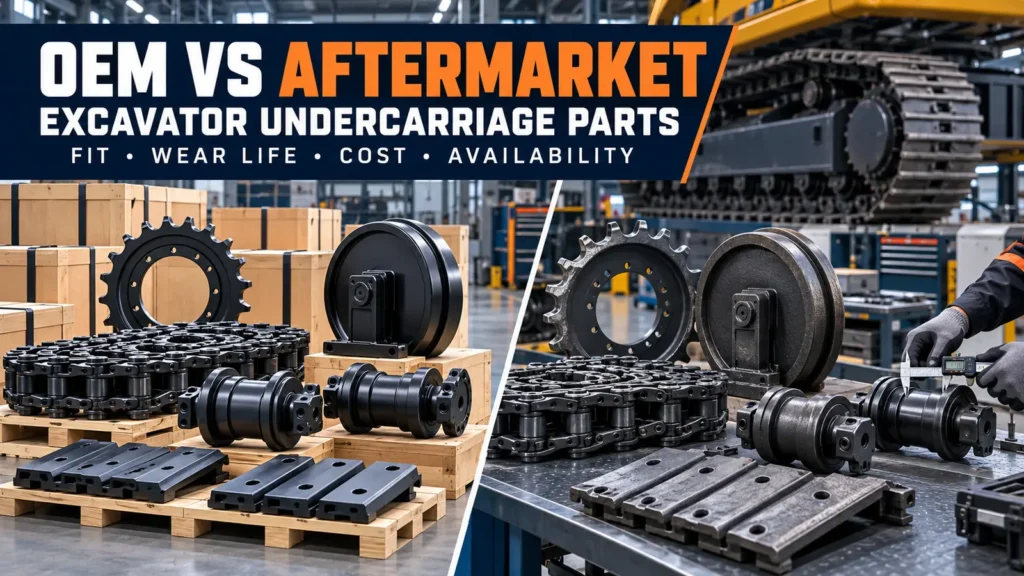
OEM vs Aftermarket Excavator Undercarriage Parts
Choosing between OEM and aftermarket excavator undercarriage parts is not simply a matter of comparing unit prices.
The undercarriage supports the machine’s weight, transfers driving force to the ground and operates continuously in abrasive conditions. Track rollers, carrier rollers, idlers, sprockets, track chains and track shoes wear as an interconnected system. A component that fits physically but does not match the remaining undercarriage can accelerate wear and increase the machine’s cost per operating hour.
For distributors, repair companies, mining contractors and fleet operators, the correct purchasing decision depends on machine value, working conditions, expected service life, availability, maintenance strategy and the reliability of the supplier.
This guide compares OEM and aftermarket excavator undercarriage parts and explains what buyers should verify before placing an order.
What Are Excavator Undercarriage Parts?
The excavator undercarriage is the lower assembly that supports and moves the machine.
Its main wear components include:
- Track rollers or bottom rollers
- Carrier rollers or top rollers
- Front idlers
- Drive sprockets and sprocket segments
- Track chains and link assemblies
- Track shoes
- Track bolts and nuts
- Track adjusters and recoil springs
- Guards and related mounting hardware
These components function together. The track chain travels around the sprocket and idler while the rollers guide and support it. Track shoes provide contact with the ground, while the tensioning system keeps the track adjusted.
Because the parts operate as a system, replacing one component without inspecting the others can produce uneven contact and premature wear.
What Does OEM Mean?
OEM stands for Original Equipment Manufacturer, but the term is used inconsistently in the international parts market.
Buyers may encounter at least three descriptions:
Genuine parts
Genuine parts are sold through the equipment manufacturer’s authorized distribution system and normally carry the equipment brand’s packaging and service part number.
OEM-origin parts
An OEM-origin component may come from a company involved in an original supply chain. However, the buyer should verify whether the supplier is actually authorized to make that claim.
“OEM quality”
“OEM quality” is often a marketing description rather than proof that a product was manufactured for the original equipment company. It may simply mean that the seller believes the replacement meets a comparable specification.
A quotation should state clearly whether the product is genuine, OEM-origin, branded aftermarket or unbranded aftermarket. These terms should not be used interchangeably.
What Are Aftermarket Excavator Undercarriage Parts?
Aftermarket excavator undercarriage parts are replacement components produced outside the equipment manufacturer’s authorized genuine-parts channel.
They may be supplied by:
- Established international aftermarket brands
- Specialized undercarriage manufacturers
- Regional replacement-parts brands
- Contract manufacturers
- Export trading and supply-chain companies
- Unidentified low-cost producers
The aftermarket category covers a wide quality range. Some products are engineered for demanding commercial use and supported by traceable specifications. Others compete mainly on price and provide limited information about materials, heat treatment or compatibility.
Therefore, the correct comparison is not simply “OEM is good and aftermarket is bad.” The meaningful comparison is between a specific genuine or OEM option and a specific aftermarket option with defined specifications and supplier accountability.
OEM vs Aftermarket: Main Differences
| Evaluation area | Genuine/OEM option | Aftermarket option |
|---|---|---|
| Compatibility | Normally tied to the manufacturer’s catalog | Must be verified through part number, model, serial number and dimensions |
| Price | Usually higher | Often lower, with a broad quality range |
| Availability | Depends on dealer inventory and model support | May offer more alternatives, especially for older machines |
| Brand traceability | Generally strong | Varies by manufacturer and supplier |
| Specifications | Based on the original equipment system | May match, improve or fall below the original specification |
| Warranty | Supported by the authorized channel’s terms | Depends on the brand, supplier and contract |
| Packaging | Manufacturer-branded packaging | Branded or neutral export packaging |
| Customization | Usually limited | Labels, packing and consolidated orders may be more flexible |
| Purchasing risk | Lower when bought from an authorized channel | Depends heavily on verification and supplier quality control |
1. Compatibility and Part-Number Accuracy
Compatibility should be the first consideration.
A buyer may request “track rollers for a 20-ton excavator,” but this description is not sufficient. Machines with similar operating weights may use different:
- Roller diameters
- Mounting-hole spacing
- Flange configurations
- Track-chain pitches
- Sprocket teeth
- Idler dimensions
- Shoe widths
- Serial-number applications
OEM parts are generally identified through the manufacturer’s parts catalog and machine serial number. Aftermarket parts require the supplier to cross-reference the original number and confirm the physical application.
For an accurate inquiry, provide:
- Equipment manufacturer
- Complete machine model
- Machine serial number
- Original part number
- Existing-part photographs
- Critical dimensions
- Required quantity
- Delivery destination
If the original part number is unavailable, additional photographs and measurements become essential.
TerraParts Global reviews the available machine, serial-number, part-number and dimensional information before coordinating replacement options.
2. Material and Heat Treatment
Undercarriage parts operate under repeated load, shock and abrasive contact. Material selection and heat treatment therefore influence wear performance.
Important factors can include:
- Steel grade
- Casting or forging quality
- Heat-treatment method
- Surface hardness
- Hardened depth
- Core toughness
- Seal design
- Shaft and bushing materials
- Lubrication and oil retention
A very hard surface is not automatically better. Excessive hardness without adequate core toughness can increase the risk of cracking, while insufficient hardness can cause rapid wear.
When comparing suppliers, do not evaluate only a single advertised hardness number. Ask whether the manufacturer can provide a material or heat-treatment specification appropriate to the product category.
For larger orders, buyers may request:
- Material certificates
- Hardness test records
- Dimensional reports
- Production-batch identification
- Inspection photographs
- Sample approval before mass purchasing
The required level of documentation should reflect the order value, application risk and customer requirements.
3. Expected Wear Life
Genuine undercarriage components are normally engineered as part of a matched system. This can provide predictable performance when the machine is correctly maintained and used in its intended conditions.
Aftermarket service life varies considerably. A well-matched, properly manufactured aftermarket component may provide commercially acceptable service at a lower acquisition cost. A poorly matched component can wear rapidly and damage surrounding parts.
Wear life is affected by more than product quality. Important operating factors include:
- Ground abrasiveness
- Rock and debris
- Moisture and corrosion
- Machine travel distance
- Travel speed
- Track tension
- Side loading
- Operator technique
- Cleaning frequency
- Roller and idler alignment
- Condition of the remaining undercarriage
- Track-shoe width
For example, installing a new sprocket against a severely worn track chain can produce poor engagement and accelerated tooth wear. Similarly, replacing one roller does not correct a damaged frame, incorrect track tension or misalignment.
Reliable suppliers should avoid promising an exact number of service hours without understanding the application.
4. Purchase Price vs Cost Per Hour
Aftermarket excavator undercarriage parts are often selected because of their lower initial purchase price. However, unit price should not be the only calculation.
A more useful comparison is:
Total installed cost ÷ Actual operating hours
Total installed cost may include:
- Product price
- Domestic transport
- International freight
- Import duties
- Customs-clearance charges
- Installation labor
- Machine downtime
- Emergency delivery
- Warranty risk
- Replacement frequency
An OEM part with a higher purchase price may be more economical for a high-utilization machine if it provides longer and more predictable service.
A verified aftermarket option may provide better commercial value for:
- Older excavators
- Machines with lower annual utilization
- Fleets managing strict maintenance budgets
- Markets where genuine parts have long lead times
- Buyers replacing complete undercarriage groups
- Distributors requiring multiple price levels
The buyer should compare expected cost per hour, not simply the invoice price.
5. Availability and Lead Time
Availability can be as important as product price.
An excavator waiting for one undercarriage component may generate no revenue while still creating labor, rental or project-delay costs.
OEM parts may offer strong catalog accuracy but may not always be immediately available, particularly for older machines or less common regional versions.
Aftermarket suppliers may provide:
- Alternative cross-references
- Stock for discontinued machines
- Multiple quality levels
- Flexible order quantities
- Mixed-model order consolidation
- Faster production for common references
However, “in stock” should be verified. Ask whether the product is physically available, waiting for production or sourced after order confirmation.
Before payment, confirm:
- Stock status
- Production lead time
- Inspection time
- Packing time
- Domestic delivery time
- International shipping schedule
TerraParts Global coordinates availability across supply-chain partners and can consolidate different undercarriage products into one export shipment.
6. Warranty and Supplier Responsibility
OEM warranties are usually governed by the authorized dealer or manufacturer’s formal conditions.
Aftermarket warranty terms vary. Buyers should request written clarification covering:
- Warranty period
- Covered defects
- Exclusions
- Required installation records
- Evidence required for a claim
- Responsibility for freight
- Replacement, credit or refund procedure
- Claim-response time
Undercarriage claims can be complex because abnormal wear may result from installation, track tension, machine alignment, working conditions or the condition of adjacent components.
For this reason, buyers should retain:
- Purchase order
- Invoice
- Part labels
- Packaging
- Installation date
- Machine hours
- Photographs before installation
- Photographs of the complete undercarriage
- Maintenance records
- Images and videos of the failure
A professional supplier should review evidence rather than dismissing the claim or automatically promising compensation without investigation.
7. Product Range and Mixed Orders
A genuine-parts dealer may provide strong coverage for one equipment brand. Independent distributors and fleet operators, however, often manage several machine brands.
An aftermarket excavator undercarriage parts supplier may support mixed requirements including:
- Track rollers for one excavator model
- Carrier rollers for another model
- Sprockets for a bulldozer
- Idlers for a mini excavator
- Track chains for several serial ranges
- Track shoes in different widths
- Bolts, nuts and guards
Mixed-order capability can reduce the number of international shipments, but it adds verification complexity.
The supplier must keep every line identifiable through:
- Purchase-order line number
- Part number
- Machine model
- Quantity
- Product label
- Carton or pallet number
- Packing-list reference
TerraParts Global supports mixed-parts order consolidation, reference checking, unified labeling and export packing for B2B buyers.
When Should Buyers Choose OEM Parts?
Genuine or verified OEM parts may be the better choice when:
- The excavator is new or under manufacturer warranty
- The machine operates in a mission-critical application
- Downtime creates exceptionally high losses
- The fleet requires standardized genuine components
- The customer contract specifically requires genuine parts
- The correct aftermarket specification cannot be verified
- A safety or regulatory requirement specifies the original part
- The machine has an unusual configuration
- Dealer technical support is essential
Buyers should obtain the parts through an authorized channel if genuine status is contractually important.
When Can Aftermarket Parts Be a Practical Choice?
A qualified aftermarket option may be appropriate when:
- The machine is outside its original warranty
- Genuine-parts lead time is too long
- The excavator is an older or discontinued model
- The buyer manages multiple brands
- Budget and cost per hour are major considerations
- The supplier can verify compatibility
- Specifications and quality level are clearly documented
- A complete undercarriage group is being replaced
- The buyer requires mixed products in one shipment
- The application does not mandate genuine components
The decision should be based on a defined aftermarket product—not on the word “aftermarket” alone.
How to Evaluate an Aftermarket Undercarriage Supplier
Before approving a new supplier, evaluate the following areas.
Identification capability
Does the supplier ask for the complete machine model, serial number, original reference and photographs?
Product specialization
Can the supplier explain the differences among track rollers, carrier rollers, idlers, sprockets, track chains and track shoes?
Specification transparency
Can the supplier state the product brand, manufacturer, material information and quality level being offered?
Dimensional confirmation
Can critical mounting and interface dimensions be checked when the part number is uncertain?
Inspection process
Does the supplier check references, dimensions, quantity, visible condition, labels and packaging before shipment?
Traceability
Are products identified by order line, part number or production batch?
Export experience
Can the supplier provide accurate packing lists, weights, dimensions and shipping documents?
Claims procedure
Are warranty requirements and claim-handling steps available in writing?
A low quotation has limited value if the supplier cannot explain what is being supplied.
Pre-Order Verification Checklist
Before ordering OEM or aftermarket excavator undercarriage parts, confirm:
- Complete machine model
- Machine serial number
- Original service part number
- Superseded reference, if applicable
- Required component type
- Installation position
- Critical dimensions
- Track-chain pitch
- Link count
- Track-shoe width
- Sprocket teeth
- Roller flange configuration
- Quantity required
- Genuine, OEM-origin or aftermarket status
- Offered product brand
- Warranty terms
- Production or stock lead time
- Packing method
- Delivery destination
- Incoterm
- Pre-shipment inspection requirements
Do not approve an order from a product photograph alone when technical information is available.
Why Complete Undercarriage Inspection Matters
Undercarriage components wear together. Before replacing parts, inspect the complete system.
Look for:
- Uneven roller wear
- Oil leakage
- Damaged flanges
- Sprocket tooth wear
- Stretched track chains
- Worn pins and bushings
- Cracked or bent shoes
- Loose bolts
- Idler damage
- Incorrect track tension
- Frame misalignment
- Accumulated mud or material
Official undercarriage maintenance guidance emphasizes measuring and managing wear to predict replacement timing and control cost per hour.Caterpillar
Replacing components as a planned system can sometimes provide better value than purchasing isolated parts through repeated emergency orders.
How TerraParts Global Supports International Buyers
TerraParts Global is a China-based construction equipment parts sourcing and aftermarket-support partner for:
- Parts distributors
- Heavy equipment dealers
- Repair workshops
- Mining companies
- Construction contractors
- Rental fleets
- International procurement teams
Our service focuses on reducing preventable procurement errors through:
Part-number matching
We review original references, cross-references, machine models and serial-number information.
Compatibility verification
When necessary, we compare photographs, dimensions, mounting details and track-system information.
Quality-option clarification
We distinguish genuine, OEM-origin, branded aftermarket and other replacement options according to the information available.
Product-specific inspection
Inspection requirements are selected according to product type and order specification.
Mixed-order consolidation
Track rollers, idlers, sprockets, track chains, track shoes and other equipment parts can be organized into consolidated shipments.
Packaging and labeling
We coordinate rust protection, export packing, order-line labels and shipping marks.
Global B2B delivery
Packing dimensions, gross weight and export documentation are organized to support international shipment.
TerraParts Global does not present every replacement as “genuine” or claim to manufacture every component. We coordinate suitable supply-chain resources, review the available technical information and help buyers select commercially appropriate options.
Frequently Asked Questions
Are aftermarket excavator undercarriage parts reliable?
Some are reliable, while others are not. Reliability depends on the manufacturer, material, heat treatment, specification, compatibility, inspection and operating conditions. Buyers should evaluate the specific product and supplier rather than the category name alone.
Are OEM parts always better than aftermarket parts?
OEM parts generally provide strong compatibility and brand traceability, but they may cost more or require longer lead times. A verified aftermarket option can provide good commercial value in suitable applications.
Will aftermarket undercarriage parts fit without modification?
They should fit only when the correct reference and application have been confirmed. Check the original part number, machine serial number, dimensions, mounting arrangement and related track components.
Should OEM and aftermarket components be mixed?
Mixing may be possible, but compatibility and wear condition must be assessed. Avoid combining heavily worn components with new parts without inspecting engagement and alignment.
What information is required for a quotation?
Send the machine brand, complete model, serial number, original part number, quantity, destination and clear photographs. Dimensions and track-chain details may be required when references are unavailable.
Can TerraParts Global consolidate multiple machine models?
Yes. We support mixed orders containing undercarriage and other construction equipment parts for different machines, subject to technical and commercial confirmation.
Request an Undercarriage Parts Quotation
To compare OEM and aftermarket excavator undercarriage parts, send TerraParts Global:
- Equipment brand and model
- Machine serial number
- Original part numbers
- Required quantities
- Existing-part photographs
- Critical dimensions
- Preferred quality level
- Delivery country and city
- Required delivery time
Our team will review the information, identify any missing details and coordinate appropriate sourcing options.
