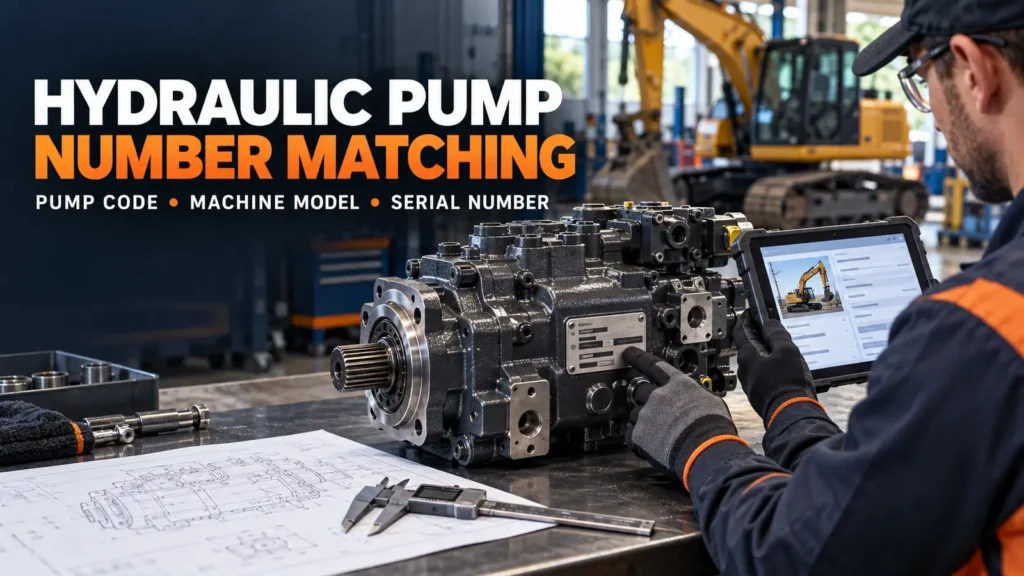
How to Match Hydraulic Pump Numbers and Machine Models
Ordering an excavator hydraulic pump using only the machine model can lead to an expensive compatibility error.
Two excavators carrying the same general model designation may use different pumps because of production year, serial-number range, engine configuration, regional specification or hydraulic-system revision. Pumps with the same basic series number can also differ in shaft, mounting flange, regulator, port arrangement, rotation direction and control settings.
A pump may therefore look correct and even bolt to the machine while still being unsuitable for the hydraulic system.
For equipment-parts distributors, repair workshops, mining companies and fleet operators, the safest identification process combines:
- Machine model
- Machine serial number
- Original equipment part number
- Hydraulic-pump nameplate
- Complete pump model code
- Regulator and sensor configuration
- Shaft and mounting dimensions
- Port arrangement
- Photographs of the existing pump
This guide explains how to match hydraulic pump numbers and machine models before ordering a replacement excavator main pump.
Why the Machine Model Alone Is Not Enough
A purchasing inquiry may say:
Please quote one hydraulic pump for a 20-ton excavator.
This provides only a general equipment class. It does not identify the exact pump.
Even a complete excavator model may cover several hydraulic configurations. Changes can occur because manufacturers:
- Introduce revised pumps during production
- Use different pump manufacturers
- Change regulators or control systems
- Produce regional machine versions
- Use different engines within one model family
- Replace an old pump number with a superseded number
- Offer standard and high-flow configurations
- Modify electronic control requirements
Used machines may also have been repaired or modified. The hydraulic pump currently installed may not be the machine’s original configuration.
For this reason, a professional excavator hydraulic pump supplier should request more than the equipment model before confirming compatibility.
1. Record the Complete Excavator Model
Start by locating the machine identification plate.
Record the model exactly as displayed, including:
- Letters
- Numbers
- Dash series
- Suffixes
- Regional designations
- Configuration codes
Do not shorten the model or rely on a general sales description.
For example, two machines may belong to the same model family but have different dash series or serial-number applications. That small difference can change the hydraulic pump, regulator or mounting arrangement.
Send a clear photograph of the complete machine nameplate rather than only typing the model into an email. This reduces mistakes involving similar letters and numbers.
2. Provide the Machine Serial Number
The machine serial number helps determine the production range.
A manufacturer may introduce a hydraulic-system change without changing the main excavator model name. Parts catalogs may therefore divide the pump application into serial-number ranges.
The serial number may be found:
- On the machine identification plate
- On the main frame
- Inside or near the cab
- In the service records
- In the equipment registration documents
- In a dealer parts quotation
Send the complete serial number, not only the final digits.
If the machine plate is damaged or missing, provide additional information such as the engine model, production year, current pump photographs and previous service records.
3. Locate the Hydraulic-Pump Nameplate
The hydraulic-pump nameplate is normally the most useful identification source.
Depending on the pump design, it may be attached to:
- The main pump housing
- The side of the pump
- The regulator area
- The rear housing
- A metal identification plate
- A machined or engraved surface
Before photographing it:
- Turn off and secure the machine.
- Allow the hydraulic system to cool.
- Clean dirt and oil carefully.
- Use bright, even lighting.
- Take one complete pump photograph.
- Take several close-ups of the nameplate.
- Avoid camera flash reflections.
- Send the original-resolution files.
Do not remove safety guards or work around a pressurized hydraulic system unless the work is performed by qualified personnel.
4. Understand the Different Numbers on a Pump
One hydraulic pump may display several numbers, and they do not all serve the same purpose.
Buyers may find:
Pump series
Examples include families such as K3V, K5V or K7V. The series identifies a general pump design, but it does not confirm the complete configuration.
Displacement class
A number following the series may indicate a displacement category. However, the same displacement class can be offered with different controls, shafts and arrangements.
Complete model code
The extended model code may describe important configuration details. This is usually more useful than the short pump-family name.
Assembly number
The excavator manufacturer may assign its own number to the complete pump assembly.
Regulator number
The regulator may have a separate identification number.
Production or serial number
This identifies a particular production unit or batch and should not automatically be treated as the service part number.
Casting number
A casting number identifies a housing or casting. It may not identify the complete assembled pump.
Previous repairer’s stock number
Rebuilders and distributors may apply internal labels that are not recognized outside their own system.
When requesting a quotation, photograph every visible number and indicate where each one appears.
5. Do Not Match From “K3V112” or “K5V140” Alone
A short description such as “K3V112 pump” is not enough to guarantee interchangeability.
The same general pump family may have different:
- Tandem or single-pump arrangements
- Input shafts
- Splines
- Mounting flanges
- Port positions
- Pilot connections
- Regulators
- Solenoid valves
- Pressure sensors
- Displacement controls
- Rotation directions
- PTO arrangements
- Factory calibration settings
A replacement with the wrong control configuration may create slow operation, excessive engine load, overheating, abnormal pressure or poor multi-function performance.
The complete pump code and machine application should therefore be reviewed together.
TerraParts Global does not treat a general pump-series number as automatic compatibility confirmation.
6. Identify the Original Equipment Part Number
The excavator manufacturer may assign an OEM service number to the complete hydraulic pump.
This number may appear in:
- The machine parts catalog
- Dealer records
- Previous invoices
- Repair orders
- Original packaging
- Fleet-maintenance software
- A manufacturer label
The OEM number is valuable because it links the pump assembly to a defined machine application.
However, check whether the number refers to:
- Complete pump assembly
- Pump without regulator
- Pump with regulator
- Pump group
- Pump housing
- Rotating group
- Regulator assembly
- Seal kit
- Coupling
- Remanufactured exchange unit
Quoting a component number when the buyer requires a complete assembly can cause significant misunderstanding.
7. Check for Superseded Numbers
Manufacturers may replace an older pump part number with a newer service number.
A superseded number may indicate:
- Updated regulator design
- Revised housing
- Improved internal components
- New supplier
- Modified sensor or solenoid
- Consolidated service replacement
- Updated complete assembly
Ask the supplier to clarify whether the proposed number is:
- An exact original match
- An official supersession
- An aftermarket cross-reference
- A rebuilt equivalent
- A replacement requiring transferred components
- A bare pump without controls
The quotation should show both the buyer’s requested reference and the supplier’s offered reference.
8. Compare the Pump Nameplate With the Machine Application
A reliable matching process should use two directions of verification:
Machine-to-pump verification
Starting with the machine model and serial number, determine which pump numbers are listed for the application.
Pump-to-machine verification
Starting with the complete pump number, determine which machines and serial ranges use that configuration.
If both checks lead to the same application, confidence increases.
If they produce conflicting results, do not guess. Possible reasons include:
- The machine was previously modified
- The pump was rebuilt using another housing
- The nameplate belongs to a replaced regulator
- A catalog contains an incomplete cross-reference
- The machine serial number was recorded incorrectly
- The pump is a regional configuration
- The visible number is not the complete assembly number
In these cases, physical and configuration checks become essential.
9. Compare the Input Shaft
The replacement pump must connect correctly to the engine coupling or drive system.
Check:
- Shaft diameter
- Shaft length
- Spline count
- Spline profile
- Keyway, if applicable
- Threaded end
- Direction of installation
- Coupling type
A pump with the correct series and displacement but the wrong shaft cannot be installed correctly.
Take a clear front-facing photograph and measure the shaft where possible. If the pump is still installed, provide photographs of the coupling and any available service information.
10. Verify the Mounting Flange
Compare:
- Flange shape
- Pilot diameter
- Bolt-hole count
- Bolt-hole diameter
- Centre-to-centre spacing
- Mounting depth
- Housing orientation
Do not rely on visual similarity alone. Small dimensional differences can prevent installation or cause misalignment.
Photographs should be taken perpendicular to the mounting face. A ruler or caliper placed in the photograph helps communicate scale.
11. Compare Hydraulic Ports
Check every main, pilot, drain and control connection.
Record:
- Number of ports
- Port position
- Port size
- Thread type
- Flange type
- Hose orientation
- Case-drain location
- Pilot connection
- Suction and pressure-port arrangement
A different port direction can interfere with hoses or the machine frame even when the pump body fits.
Do not modify high-pressure hydraulic connections simply to make an uncertain pump fit. Any required modification should be reviewed by a qualified hydraulic technician.
12. Verify Rotation Direction
Hydraulic pumps are designed for a specified direction of rotation when viewed from a defined end.
Terms such as clockwise and counterclockwise can cause confusion if the viewing direction is not stated.
When confirming rotation, include:
- Required direction
- Viewing position
- Existing pump information
- Engine-drive arrangement
- Nameplate or catalog reference
Installing or operating a pump with an incorrect rotation configuration can cause immediate damage or lack of hydraulic output.
13. Compare the Regulator
The regulator controls pump output in response to the excavator’s hydraulic and engine-load requirements.
Pumps with the same basic hydraulic section may use different regulators depending on:
- Negative flow control
- Positive flow control
- Load-sensing system
- Power-control strategy
- Pilot-pressure range
- Electronic control
- Engine power
- Machine software
- Regional emission configuration
Photograph the regulator from several angles and record:
- Regulator part number
- Solenoid count
- Connector type
- Hose connections
- Adjustment arrangement
- Sensor configuration
If the proposed replacement excludes the regulator, confirm whether the old regulator can be transferred and whether calibration will be required.
14. Check Sensors, Solenoids and Connectors
Modern excavators may use electrical components to control or monitor pump operation.
Compare:
- Connector shape
- Pin count
- Wire orientation
- Sensor location
- Solenoid quantity
- Voltage
- Harness connection
- Mounting bracket
- Controller requirements
Two connectors may look similar while using a different pin layout or signal specification.
Send close photographs of both the component and machine-side connector. Do not identify an electrical configuration using only wire colors, as colors may differ between production batches or previous repairs.
15. Determine What Is Included in the Quotation
The phrase “complete hydraulic pump” does not always mean the same thing.
Ask whether the quotation includes:
- Main pump assembly
- Regulator
- Pilot pump or gear pump
- Solenoid valves
- Pressure sensors
- Coupling
- Mounting flange
- Relief valves
- Pipe fittings
- Seals
- Protective port caps
- Test report
- Installation gasket
The supplier should also state whether the product is:
- Genuine
- OEM-origin
- Branded aftermarket
- Unbranded aftermarket
- Remanufactured
- Rebuilt
- Used
- New replacement
A clear scope prevents disputes after delivery.
16. New, Remanufactured and Rebuilt Pumps
Buyers may encounter several supply options.
New genuine pump
Supplied through the equipment manufacturer’s authorized channel.
New OEM-origin pump
Claimed to originate from an original supply chain; documentation and authorization should be verified.
New aftermarket pump
Manufactured as a replacement outside the genuine-parts channel.
Remanufactured pump
Professionally restored using a defined process, replacement wear components, inspection and testing.
Rebuilt pump
Repaired to restore function, although the scope can vary significantly.
Used pump
Removed from another machine and sold in its existing or inspected condition.
The quotation should clearly state the condition. A painted used pump should never be represented as new.
17. Request Test and Inspection Information
Depending on product value and supply conditions, relevant checks may include:
- Nameplate and part-number verification
- Visual inspection
- Shaft and flange measurement
- Port configuration check
- Regulator comparison
- Sensor and solenoid confirmation
- Rotation check
- Leakage inspection
- Bench or pressure test
- Flow test
- Noise and vibration assessment
- Packaging inspection
Not every supplier can conduct a complete installed-machine simulation. Ask what was actually tested rather than accepting a general statement such as “100% tested.”
Test reports should identify the product and, where possible, the relevant test conditions.
Common Hydraulic Pump Matching Mistakes
Ordering from the excavator model only
The machine model may cover more than one production or hydraulic configuration.
Sending only the short pump series
“K3V112” or “K5V140” describes a pump family or size, not necessarily the complete configuration.
Using the regulator number as the pump number
The regulator may have its own label and part number.
Treating a casting number as the assembly number
The same housing can be used in multiple assemblies.
Ignoring the machine serial number
The pump application may change during the machine’s production life.
Comparing only external appearance
Internally or electronically different pumps can look nearly identical.
Failing to confirm what is included
A quotation may cover a bare pump, while the buyer expects sensors, regulator and pilot pump.
Assuming a rebuilt pump is new
The condition and repair scope must be stated in writing.
Information to Include in a Hydraulic Pump RFQ
A professional RFQ should contain:
- Equipment manufacturer
- Complete machine model
- Machine serial number
- Engine model
- OEM pump part number
- Complete pump nameplate code
- Pump serial number, if visible
- Regulator number
- Existing pump condition
- Required quantity
- New, aftermarket or remanufactured preference
- Photographs of the complete pump
- Nameplate close-ups
- Shaft photograph
- Mounting-flange photograph
- Port arrangement
- Regulator and connector photographs
- Delivery country and city
- Required delivery date
Example:
Please quote one new replacement excavator main pump. Machine model: [model]. Machine serial number: [serial]. OEM pump number: [number]. Pump nameplate code: [complete code]. Please confirm regulator, pilot pump, sensors, shaft, mounting flange and port configuration. Photos are attached. Delivery destination: [city, country].
How TerraParts Global Supports Pump Matching
TerraParts Global supports international buyers sourcing hydraulic and other construction equipment parts.
Our hydraulic-pump inquiry process may include:
- Reviewing the complete machine model.
- Checking the machine serial-number range.
- Recording the OEM pump reference.
- Reviewing the complete nameplate code.
- Comparing regulator and electrical configuration.
- Checking supplied shaft, flange and port details.
- Clarifying whether the quotation covers a complete or partial assembly.
- Coordinating suitable genuine, OEM-origin, aftermarket or remanufactured options where available.
- Organizing product-specific inspection and pre-shipment photographs.
- Consolidating hydraulic pumps with seal kits, filters, undercarriage, engine or electrical parts.
- Preparing export packing and international delivery documentation.
TerraParts Global operates as a construction equipment parts sourcing, verification and export-support partner. We do not claim that every pump comes from one factory or that every replacement is genuine. The offered condition, supply channel and compatibility basis should be clearly stated in the quotation.
Frequently Asked Questions
Can I identify a hydraulic pump using only the machine model?
Sometimes a model narrows the options, but the serial number, OEM reference and pump nameplate provide a more reliable match.
Is K3V112 a complete pump number?
No. It identifies a general pump family and displacement category. Complete configuration details may include additional characters defining the shaft, regulator, arrangement and controls.
Can two pumps with the same main model code be different?
Yes. Regulators, ports, shafts, sensors, solenoids and calibration can differ.
What if the pump nameplate is missing?
Provide the machine model, serial number, OEM part number, full pump photographs, regulator details and physical measurements. Previous invoices or service records may also help.
Can I transfer the old regulator to a replacement pump?
It may be possible in some applications, but compatibility and calibration must be reviewed. Do not assume that regulators are interchangeable.
Is an aftermarket hydraulic pump suitable for an excavator?
A correctly matched and properly manufactured aftermarket pump can be a practical replacement. Buyers should verify its configuration, condition, testing, warranty and supplier support.
Does TerraParts Global provide pump parts and seal kits?
TerraParts Global can coordinate complete pumps, selected hydraulic components, seal kits and related construction equipment parts subject to reference and application confirmation.
Request Hydraulic Pump Matching
To request a quotation, send TerraParts Global:
- Machine model
- Machine serial number
- OEM part number
- Complete pump nameplate
- Regulator number
- Pump and connector photographs
- Required quantity
- Delivery destination
Our team will review the information, identify missing details and coordinate suitable sourcing options.
