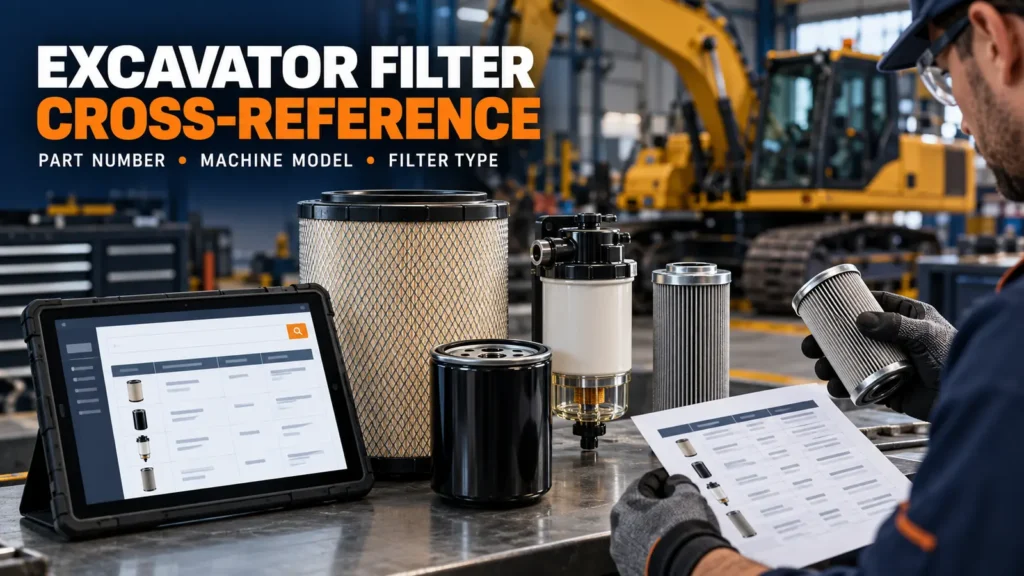
Excavator Filter Cross-Reference Guide
Ordering an excavator filter should be straightforward: identify the number on the old filter, find an equivalent replacement and confirm the quantity. In practice, filter identification is one of the most common sources of wrong-part orders in the construction equipment aftermarket.
A number found in an online cross-reference table may lead to several alternatives. The same excavator model may also use different filters depending on its serial-number range, engine configuration, production year, operating region or previous component replacement. Two filters can have the same thread and similar dimensions while using different filtration media, bypass settings or sealing structures.
For importers, distributors, repair companies and fleet operators, an excavator filter cross reference should therefore be treated as the beginning of the verification process—not as final proof of compatibility.
This guide explains how to cross-reference excavator oil filters, fuel filters, hydraulic filters, air filters and fuel-water separators. It also shows what information buyers should provide before requesting a quotation from an excavator filters supplier in China.
What Is an Excavator Filter Cross Reference?
A filter cross reference connects one part number with potentially compatible alternatives from other manufacturers or aftermarket brands.
For example, a buyer may have:
- An OEM filter number
- A filter manufacturer’s number
- A number printed on an old aftermarket filter
- An excavator model without a readable filter number
- A maintenance list containing superseded numbers
The buyer then searches for an equivalent filter that performs the same function and fits the same filter head or housing.
A professional cross-reference process should confirm more than the outside appearance. It should compare:
- Original part number
- Filter application
- Machine model
- Machine serial number
- Engine or component model
- Overall dimensions
- Thread or sealing structure
- Filtration efficiency
- Media type
- Flow and pressure requirements
If only the printed number is compared, an apparently suitable replacement can still be incorrect.
Why Filter Cross-Reference Errors Happen
One Machine Model Can Have Several Configurations
A model name such as CAT 320, Komatsu PC200, Hitachi ZX200 or Volvo EC210 identifies a machine family rather than every individual configuration.
Machines within the same family may use different engines, hydraulic systems or filter housings. Changes can occur between production generations and serial-number ranges. Equipment originally sold in different markets may also have regional specifications.
This is why an enquiry such as “I need all filters for a PC200” is usually not enough for a reliable quotation.
The supplier should ask for the complete model designation, such as PC200-7, PC200-8 or PC200-10, together with the serial number and engine model.
Numbers Can Be Superseded
OEM manufacturers periodically replace an old part number with a new number. The physical filter may remain similar, but specifications or production details can change.
A buyer working from an old invoice or maintenance sheet may therefore submit a superseded number. The supplier must determine whether:
- The new number directly replaces the old one
- Both numbers remain valid for different applications
- The replacement applies only to certain serial ranges
- A filter-kit number has been confused with an individual element number
A reliable excavator filter part-number lookup should record both the submitted number and the confirmed current reference.
Similar Dimensions Do Not Guarantee Equal Performance
Two spin-on filters may share the same diameter and mounting thread. Two cartridge elements may fit inside the same housing. However, they may not provide the same filtration performance.
Important differences can include:
- Micron rating
- Beta ratio or filtration efficiency
- Dirt-holding capacity
- Cellulose or synthetic media
- Water-separation performance
- Flow resistance
- Bypass-valve setting
- Anti-drainback valve
- Operating pressure
- Seal material
This is especially important when selecting a replacement hydraulic filter element. A low-cost element that fits physically but uses unsuitable media can increase contamination inside an expensive hydraulic system.
Main Types of Excavator Filters
Engine Oil Filters
An engine oil filter removes particles and combustion-related contamination from lubricating oil.
When performing an excavator oil filter cross reference, verify:
- Engine manufacturer and model
- Full-flow or bypass-filter design
- Thread size
- Gasket outside and inside diameter
- Overall height and outside diameter
- Bypass-valve specification
- Anti-drainback requirements
- Recommended service interval
Machine model alone may not be sufficient because the engine could have been replaced or rebuilt.
Fuel Filters
Modern diesel injection systems operate with tight component tolerances. Contaminated fuel can damage pumps and injectors, making filter efficiency and water separation particularly important.
An excavator fuel filter cross reference should distinguish among:
- Primary fuel filter
- Secondary fuel filter
- Fuel-water separator
- Pre-filter
- Final fuel filter
- Spin-on element
- Cartridge element
Buyers should provide photographs of the complete filter assembly when the function of the old element is unclear.
Hydraulic Filters
Excavators may use several hydraulic filtration positions, including:
- Hydraulic return filter
- Pilot filter
- Suction strainer
- Case-drain filter
- Transmission filter
- Servo filter
- Breaker-line return filter
These filters are not automatically interchangeable.
A hydraulic filter cross reference should compare the original number, installation position, dimensions, flow direction, filtration efficiency and operating requirements. For cartridge elements, the end-cap design and seal arrangement must also be checked.
The lowest-priced replacement is not always the lowest-cost option. Hydraulic contamination can contribute to premature wear in pumps, control valves and other high-value components.
Air Filters
An excavator air-cleaner assembly commonly contains:
- Primary or outer air-filter element
- Secondary or inner safety element
The outer and inner elements should not be confused, even when the two numbers appear together in a maintenance list.
For an excavator air filter replacement, confirm:
- Outer diameter
- Inner diameter
- Overall length
- Radial-seal or axial-seal design
- End-cap structure
- Primary or safety-element position
- Dust environment and service conditions
For operations in mining, quarrying and road construction, dust-loading capacity can be as important as basic fitment.
Fuel-Water Separators
A fuel-water separator removes water and contaminants before fuel reaches sensitive injection components.
The cross-reference check should include:
- Bowl or bowl-less design
- Water-sensor connection
- Drain-valve arrangement
- Thread size
- Filter-media performance
- Overall assembly clearance
Two separator elements may look similar while using different sensors or lower-bowl connections.
Information Required for Accurate Filter Matching
1. Original Filter Number
Photograph the complete number printed, stamped or engraved on the old filter.
Send both close-up and full-product photographs. A partial number can produce incorrect results, especially when letters, dashes or leading zeros are missing.
It is helpful to search and record both formats when relevant. For example, a number containing a dash may also appear in databases without the dash.
2. Excavator Brand and Full Model
Do not provide only the general machine series.
Instead of:
“Komatsu PC200 filter”
Provide:
“Komatsu PC200-8 excavator filter, engine model SAA6D107E.”
The complete model helps separate different generations and engine configurations.
3. Machine Serial Number
The serial number is often the key to separating filters used before and after a production change.
It also helps confirm the machine’s regional version. When requesting a filter kit for an excavator, include a clear photo of the machine nameplate whenever possible.
4. Engine or Component Model
For engine oil and fuel filters, provide the engine model.
For hydraulic filters, identify the component or installation position. If the hydraulic pump, engine or filter housing has been replaced, the installed component information may be more reliable than the original machine model.
5. Filter Position
State exactly where the filter is installed:
- Engine oil system
- Primary fuel system
- Secondary fuel system
- Fuel-water separator
- Hydraulic return circuit
- Pilot circuit
- Case-drain line
- Air-intake system
The same machine can contain multiple filters with similar appearances.
6. Dimensions
When no readable part number is available, measure the old filter.
For a spin-on filter, record:
- Overall height
- Outside diameter
- Thread diameter
- Thread pitch
- Gasket outside diameter
- Gasket inside diameter
For a cartridge filter, record:
- Overall length
- Maximum outside diameter
- Minimum inside diameter
- End-cap type
- Seal position
For an air filter, measure the outer diameter, inner diameter, total length and sealing structure.
Measurements should preferably be provided in millimetres. Include photographs showing the caliper or ruler against the filter.
7. Required Brand Level
Tell the supplier whether you need:
- Genuine OEM filters
- Recognized international filter brands
- Verified aftermarket filters
- Private-label filters
- Mixed-brand alternatives at different price levels
“Aftermarket” is not a single quality grade. Buyers should compare specifications, production consistency, test documentation and traceability rather than price alone.
A Practical Excavator Filter Cross-Reference Process
Step 1: Normalize the Submitted Number
The supplier should check the number with and without spaces, dashes and common prefix variations.
For example, an old label may be damaged, or one character may have been confused with another. “0” and “O,” or “1” and “I,” are common sources of error.
Step 2: Identify the Number’s Origin
Determine whether the submitted number belongs to:
- The excavator manufacturer
- The engine manufacturer
- A filtration brand
- An aftermarket supplier
- A complete filter assembly
- A replaceable element
- A maintenance kit
This prevents a kit number from being quoted as a single filter.
Step 3: Review Cross-Reference Sources
Professional matching should compare more than one source when possible, including manufacturer catalogues, established filter databases, supplier records and physical specifications.
Common buyer searches include:
- CAT excavator filter cross reference
- Komatsu filter cross reference
- Donaldson filter cross reference
- Fleetguard filter cross reference
- Baldwin filter cross reference
- Sakura filter cross reference
A cross-reference result should remain provisional until the application and specifications are checked.
Step 4: Confirm Machine and Serial Range
Compare the proposed filter with the complete machine model, engine model and serial-number range.
If these details conflict with the filter number, the supplier should stop and request additional photos instead of assuming that the database is correct.
Step 5: Compare Physical Specifications
Confirm the filter style, size, thread, gasket, seal and end-cap structure.
A photograph of the old and proposed filters placed side by side can help the buyer review the match before shipment.
Step 6: Confirm Performance Requirements
For critical oil, fuel and hydraulic applications, compare filtration specifications—not only dimensions.
The supplier should confirm the appropriate media and efficiency level for the intended system and operating conditions.
Step 7: Prepare a Final Matching Record
A useful quotation should show:
- Customer’s submitted number
- Confirmed cross-reference number
- Product description
- Machine application
- Filter position
- Brand or quality level
- Quantity
- Product photo
- Packing details
- Any unresolved matching conditions
This creates a clear record for purchasing, warehouse receiving and future reorders.
Common Mistakes Buyers Should Avoid
Ordering by Machine Model Only
“I need a filter for a CAT 320D” is not a complete filter enquiry. The serial number, engine configuration and required filter position are still needed.
Assuming Every Online Cross Reference Is Verified
Public databases can contain old, incomplete or broadly grouped information. Treat an online result as a lead that requires technical confirmation.
Comparing Only the Thread
A matching thread does not confirm the correct filtration grade, gasket location, flow capacity or bypass setting.
Ignoring the Old Filter
Used machines are frequently repaired or modified. The filter actually installed on the equipment may differ from the original configuration.
When the machine data and old filter disagree, send photographs of both.
Buying a Complete Filter Kit Without a Verified List
A maintenance filter kit may be missing an element or may include filters for another machine generation.
Before placing a bulk order, request an itemized kit list containing individual part numbers and quantities.
Selecting by Price Alone
For distributors, one incorrect filter can create more cost than the price difference between two suppliers. Returns, customer complaints, emergency freight and equipment downtime can quickly eliminate the original saving.
Buying Excavator Filters from China
Buyers searching for an excavator filters supplier in China should evaluate more than catalogue size.
Important supplier capabilities include:
- Multi-brand part-number matching
- Machine-model and serial-number verification
- Technical specification comparison
- Product photography before shipment
- Mixed-item order consolidation
- Private-label and neutral packing options
- Pre-shipment quantity and appearance inspection
- Export packing and carton labeling
- International logistics coordination
- Clear handling of uncertain applications
For construction machinery filters wholesale orders, ask the supplier to prepare a consolidated matching sheet before confirming production or stock collection.
This is particularly valuable when an order includes oil filters, fuel filters, air filters, hydraulic elements and seal kits for several excavator brands.
How TerraParts Global Supports Filter Buyers
TerraParts Global supports distributors, equipment dealers, repair networks, mining companies and fleet operators that need to source mixed construction equipment parts from China.
We do not rely on a model name alone. Our filter-matching workflow can review:
- OEM and aftermarket part numbers
- Machine and engine models
- Serial-number information
- Filter-position details
- Old-filter photographs
- Physical dimensions
- Required brands or quality levels
- Target quantities and destination
For mixed orders, our team can coordinate products from multiple qualified supply sources, organize the order into one purchasing list and arrange consolidated inspection and shipment.
Depending on the project requirements, our service can include:
- Part-number normalization
- Cross-reference checking
- Machine-application review
- Supplier and product comparison
- Sample or pre-production confirmation
- Product and packing photography
- Quantity and appearance inspection
- Mixed-parts consolidation
- Export packing
- Global B2B delivery coordination
When compatibility cannot be confirmed from the available information, we identify the missing data instead of presenting an uncertain reference as a guaranteed match.
Excavator Filter RFQ Checklist
To receive a more accurate quotation, include the following information:
- Original filter number
- Required replacement brand or quality level
- Excavator manufacturer
- Complete machine model
- Machine serial number
- Engine model
- Filter type and installation position
- Photographs of the old filter
- Filter dimensions
- Required quantity
- Packing or private-label requirements
- Delivery country or destination port
For a multi-item enquiry, send an Excel list with one product per row. Photographs should be named according to the corresponding part number.
Frequently Asked Questions
Can I cross-reference an excavator filter using only the OEM number?
The OEM number is the best starting point, but it should still be checked against the machine model, serial number, filter position and technical specifications. Superseded numbers and modified equipment can create exceptions.
Can two different brands replace the same excavator filter?
Yes, several manufacturers may offer filters for the same application. However, physical fit does not automatically confirm equal filtration efficiency, media quality or service performance.
What if the number on the old filter is unreadable?
Provide the machine nameplate, engine model, filter position, complete product photographs and accurate dimensions. The filter housing and connection structure may also help identification.
Should I replace the outer and inner air filters together?
Follow the equipment maintenance instructions and operating conditions. When requesting a quotation, identify the primary and safety elements separately so that the correct pair can be confirmed.
Can TerraParts supply mixed filter kits for several excavator models?
Yes. Mixed-model and mixed-category orders can be organized into a consolidated purchasing list. Compatibility should be verified line by line before the order is finalized.
Can aftermarket excavator filters be supplied with private-label packing?
Private-label options depend on quantity, product type and supplier capability. Buyers should provide their logo, carton requirements, label content and target order quantity for evaluation.
Conclusion
An excavator filter cross reference is not simply a list of interchangeable numbers. Reliable matching requires the original filter number, machine model, serial number, engine or component information, physical dimensions and filtration requirements to agree.
For buyers managing several brands or mixed fleets, a documented verification process reduces wrong-part orders, emergency replacements and unnecessary freight costs.
Send TerraParts Global your filter numbers, machine information, old-filter photos and required quantities. Our team will organize the details, identify missing information and support the sourcing, inspection, consolidation and international delivery of your construction equipment filter order.
