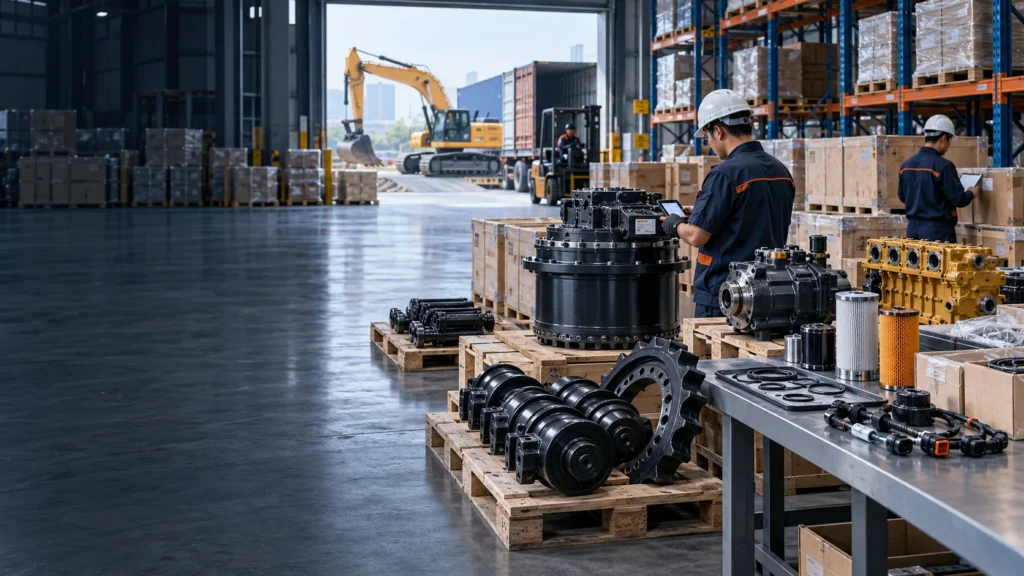
How to Source Mixed Construction Equipment Parts from China
Importers rarely need only one type of construction equipment part.
A typical purchasing list may include excavator undercarriage parts, hydraulic pumps, filters, seal kits, engine components, sensors, electrical switches and maintenance items for several machine brands. These products are often manufactured by different specialist suppliers, use different minimum order quantities and require different compatibility checks.
This makes mixed construction equipment parts sourcing significantly more complicated than purchasing one standardized product from one factory.
The main challenge is not simply finding low prices in China. It is coordinating multiple suppliers while maintaining correct part identification, consistent quality, realistic delivery schedules, export-ready packaging and complete shipment documentation.
This guide explains how construction equipment parts importers, distributors, equipment dealers, repair companies, mining businesses and rental fleets can manage a mixed-parts purchasing program from China.
Why Mixed Parts Orders Are Difficult to Manage
China has an extensive supply network for aftermarket construction equipment parts. However, the market is highly specialized.
A supplier that produces strong excavator undercarriage parts may not manufacture hydraulic pumps. A filter manufacturer may have no experience with engine overhaul kits. An electrical-parts supplier may source controllers, sensors and wiring components from several different factories.
Attempting to buy every category from a single general supplier can create several risks:
- Limited technical knowledge in some categories
- Unclear original manufacturing sources
- Inconsistent quality levels
- Incorrect part-number cross-references
- Products quoted under different conditions
- Uncoordinated production schedules
- Duplicate domestic freight charges
- Incompatible export packaging
- Missing items during container loading
- Complicated warranty responsibility
The correct solution is normally not to force one factory to supply everything. A more reliable approach is to identify appropriate specialist suppliers and manage them through one coordinated sourcing, verification, inspection and consolidation process.
1. Convert the Parts List into a Structured RFQ
Mixed sourcing should begin with a structured request for quotation rather than a collection of messages, screenshots and photographs.
Create a spreadsheet with one line for each requested component. Recommended fields include:
| Required information | Purpose |
|---|---|
| Item number | Tracks each line of the RFQ |
| Part name | Identifies the product category |
| Original part number | Supports catalogue and cross-reference checks |
| Machine manufacturer | Identifies the equipment brand |
| Machine model | Narrows the application |
| Machine serial number | Identifies production variations |
| Engine or component model | Required for engine, hydraulic and electrical parts |
| Required quantity | Determines price and MOQ |
| Quality requirement | Genuine, OEM, premium aftermarket or standard aftermarket |
| Photos | Supports identification |
| Dimensions | Helps confirm physical compatibility |
| Delivery destination | Supports freight planning |
| Special requirements | Labels, packaging, warranty or inspection |
Do not combine several unrelated products into one RFQ line. “Excavator hydraulic parts” or “engine repair kit” is too general for a reliable quotation.
Assigning each item a unique line number also prevents confusion when suppliers use different product descriptions.
2. Divide the Order by Product Category
After organizing the RFQ, separate products into technical categories.
A typical mixed construction equipment parts order may contain:
Undercarriage parts
- Track rollers
- Carrier rollers
- Front idlers
- Sprockets
- Track chains
- Track shoes
- Track adjuster assemblies
Hydraulic parts
- Main hydraulic pumps
- Pump regulators
- Final drives
- Travel motors
- Swing motors
- Main control valves
- Solenoid valves
- Hydraulic cylinders
Engine parts
- Pistons
- Liners
- Bearings
- Gasket kits
- Fuel injectors
- Turbochargers
- Water pumps
- Oil pumps
- Overhaul kits
Filters and maintenance parts
- Engine oil filters
- Fuel filters
- Air filters
- Hydraulic filters
- Pilot filters
- Water separators
- Maintenance kits
Seal kits
- Boom cylinder seal kits
- Arm cylinder seal kits
- Bucket cylinder seal kits
- Hydraulic pump seal kits
- Control valve seal kits
- Breaker seal kits
Electrical parts
- Sensors
- Solenoid valves
- Controllers
- Monitors
- Wiring harnesses
- Switches
- Relays
- Starter motors and alternators
This classification makes it easier to identify which products require specialist suppliers and which items can reasonably be grouped together.
3. Confirm Compatibility Before Comparing Prices
A low price has no value if the part does not fit the machine.
Before selecting a supplier, confirm as much of the following as possible:
- Complete original part number
- Machine manufacturer and model
- Machine serial number or PIN
- Engine model and serial number
- Component manufacturer and model
- Nameplate information
- Mounting dimensions
- Hydraulic-port configuration
- Electrical connector and pin layout
- Voltage or pressure requirement
- Old and superseded part numbers
- Photographs from multiple angles
For used equipment, the installed component may differ from the original factory configuration because of previous repairs or modifications. In these cases, the component nameplate and physical interface may be as important as the machine model.
Higher-value products such as hydraulic pumps, final drives, travel motors, controllers and engine assemblies require more detailed machine compatibility verification than simple maintenance items.
Buyers should avoid approving a quotation that contains vague statements such as “suitable for PC200” without a part number, serial-number range or component specification.
4. Define the Required Quality Level
The Chinese construction machinery parts market offers several quality and price levels.
These may include:
- Genuine branded parts
- Verified OEM components
- Premium aftermarket parts
- Standard aftermarket parts
- Economical replacement parts
- Remanufactured assemblies
- Tested used components
These descriptions are not interchangeable.
For each important RFQ item, state the acceptable quality level. If several options are acceptable, request separate quotations rather than allowing suppliers to choose without explanation.
A quotation should clearly identify:
- Product condition
- Manufacturer or brand
- Country of origin where relevant
- Warranty
- Packaging
- Included accessories
- Whether the product is a complete assembly
- Whether installation or programming is required
For example, an “excavator final drive” quotation could refer to a complete final-drive assembly, travel motor only, reduction gearbox only, rebuilt unit or tested used unit. Prices cannot be compared until the supply scope is normalized.
5. Select Suppliers by Capability, Not Catalogue Size
A supplier displaying thousands of products is not necessarily the manufacturer or technical specialist for every item.
Evaluate potential suppliers according to the category being purchased.
Useful questions include:
- Which products are manufactured internally?
- Which products are sourced from partner factories?
- How long has the supplier handled this category?
- Which machine brands and models are regularly supplied?
- Can the supplier provide drawings or dimensions?
- How are part numbers cross-referenced?
- What incoming and outgoing inspections are performed?
- Are batch and supplier records maintained?
- What warranty and claim process applies?
- Can the supplier provide export packaging?
- Is private labeling available?
- Can pre-shipment inspection be arranged?
Supplier qualification should verify whether the supplier’s actual capabilities match the purchasing requirement. A general supplier may be useful for coordination, but the underlying manufacturing source and quality responsibilities should remain clear.
6. Normalize Quotations Before Making a Decision
Mixed-order quotations often appear competitive because they are based on different assumptions.
Before comparing prices, confirm that every quotation uses the same:
- Part number
- Quality level
- Product condition
- Quantity
- Included accessories
- Packaging standard
- Warranty
- Incoterm
- Currency
- Lead time
- Inspection requirement
Create a quotation comparison sheet with one row per item and separate columns for each supplier.
Mark every quotation as:
- Technically confirmed
- Awaiting customer information
- Alternative part proposed
- Not available
- MOQ not reached
- Sample recommended
This prevents unconfirmed products from being included in the final order simply because they have the lowest price.
Total purchasing cost should also include domestic Chinese freight, inspection fees, export packaging, consolidation costs, international freight, customs charges and the potential cost of incorrect parts.
7. Manage Different MOQs
Mixed parts orders often contain items with very different minimum order quantities.
A hydraulic pump supplier may accept one unit, while a filter factory may require several hundred pieces per reference. Custom packaging can create a separate MOQ even when the product itself is available in small quantities.
Possible solutions include:
- Using neutral packaging for small orders
- Combining several filter references into one production order
- Purchasing stock products rather than custom production
- Negotiating trial quantities
- Selecting a distributor for small volumes
- Reserving customized packaging for repeat orders
- Consolidating products over a planned purchasing period
Buyers should not focus only on reducing MOQ. Extremely small production quantities can increase prices and reduce control over batch consistency.
For regular importers, a forecast covering three to six months may improve supplier negotiations and stock planning.
8. Coordinate Lead Times
Different product categories rarely become ready on the same date.
Common lead-time differences may include:
- Stock filters and seals: relatively short
- Standard undercarriage parts: stock or scheduled production
- Hydraulic assemblies: stock, assembly or testing required
- Engine repair components: dependent on exact model and supplier
- Electrical controllers: programming or configuration may be required
- Private-label packaging: additional printing time
Create a master production schedule showing:
- Purchase-order date
- Deposit date
- Material or production status
- Estimated completion
- Inspection date
- Arrival at consolidation warehouse
- Final packing date
- Planned shipment
The international shipment should not be booked based only on the fastest supplier’s lead time.
Ask suppliers to report delays early. A single missing high-value component can hold an entire mixed container if the order is not planned carefully.
9. Use Product-Specific Quality Inspection
One generic inspection checklist cannot effectively cover every type of construction equipment spare part.
Inspection requirements should reflect the product’s function and risk.
Undercarriage inspection
Depending on the product and purchase specification, checks may cover:
- Dimensions
- Bolt-hole spacing
- Surface condition
- Welding appearance
- Hardness or material documentation
- Product weight
- Assembly movement
- Part identification
Hydraulic-component inspection
Checks may include:
- Part number and nameplate
- Mounting flange
- Shaft and spline
- Port layout
- Connector configuration
- Appearance and cleanliness
- Rotation
- Test documentation where applicable
- Included accessories and plugs
Filter inspection
Checks may include:
- External dimensions
- Thread specification
- Gasket
- Media and construction
- Printing and label
- Packaging
- Cross-reference number
Seal-kit inspection
Checks may include:
- Kit contents
- Seal quantity
- Profile
- Dimensions
- Material identification
- Packaging and part label
Electrical-part inspection
Checks may include:
- Voltage
- Connector
- Pin count and layout
- Part label
- Housing
- Functional test or supplier test record
- Programming status
Inspection depth should be agreed before order placement. Buyers should understand whether the inspection covers appearance and quantity only or includes dimensional, material and functional requirements.
10. Consolidate Products in One Warehouse
Spare parts consolidation in China can reduce the complexity of receiving shipments from several suppliers.
Instead of each factory shipping internationally, suppliers deliver their completed products to one consolidation warehouse.
The consolidation process should include:
- Receiving each supplier’s shipment
- Checking cartons against the packing list
- Recording shortages or damage
- Separating products by purchase-order line
- Performing the agreed inspections
- Repacking unsuitable cartons
- Applying required labels
- Combining products into export packages
- Preparing a consolidated packing list
- Loading the final shipment
Each received package should be connected to the relevant supplier and RFQ line. This traceability becomes important if a shortage, defect or warranty claim occurs later.
Photographs should document the products, labels, cartons, pallets and container-loading process.
11. Design Packaging for Mixed Parts
A mixed equipment parts order may contain a lightweight sensor and a final drive weighing hundreds of kilograms. These products cannot use the same packaging method.
Packaging plans may include:
- Reinforced export cartons
- Inner partitions
- Moisture-resistant plastic bags
- Rust-prevention treatment
- Protective caps for hydraulic ports
- Foam protection for electrical products
- Pallets
- Plywood cases
- Steel frames
- Product and carton labels
Heavy products must be secured so they cannot shift and damage smaller parts during transportation.
Wooden packaging should comply with the destination market’s import requirements. Buyers should also confirm lifting points, package weight and handling marks for heavy assemblies.
Customized cartons can improve brand presentation, but they should not delay trial orders unnecessarily. Neutral export packaging with applied labels may be more practical for early shipments.
12. Prepare Accurate Shipping Documents
Mixed construction equipment parts may require several product descriptions and customs classifications.
Common export documents include:
- Commercial invoice
- Packing list
- Bill of lading or airway bill
- Certificate of origin when required
- Product-specific documents requested by the buyer
- Insurance documents
- Inspection report
- Fumigation or packaging documentation where applicable
The commercial invoice should use accurate descriptions. Avoid describing an entire shipment only as “machine parts” if customs authorities require more detail.
Possible descriptions include:
- Excavator undercarriage parts
- Hydraulic pump assemblies
- Diesel engine spare parts
- Oil and fuel filters
- Hydraulic cylinder seal kits
- Electrical sensors for construction machinery
The importer or customs broker should confirm HS classifications and local import requirements. The Chinese supplier can provide product information, but the importer remains responsible for compliance in the destination country.
13. Choose the Appropriate Shipping Method
The best shipping method depends on weight, volume, urgency and destination.
Courier or express service
Suitable for samples, sensors, seal kits and small urgent orders. Heavy components can become expensive.
Air freight
Suitable for urgent, higher-value parts when equipment downtime is costly.
Less-than-container-load shipping
Suitable for mixed orders that do not fill a container. Packaging and handling protection are especially important because cargo may be transferred several times.
Full-container-load shipping
Suitable for larger orders, heavy undercarriage products or planned inventory replenishment.
The lowest freight quotation is not always the best choice. Buyers should consider transit time, handling points, destination fees, cargo protection and customs support.
14. Establish a Clear Warranty Process
Managing warranty claims becomes more difficult when products originate from several suppliers.
Before shipment, establish:
- Warranty period
- Warranty starting point
- Evidence required for a claim
- Installation requirements
- Exclusions
- Response time
- Replacement or credit method
- Responsibility for international freight
- Procedure for returning high-value parts
If a component fails, useful evidence may include:
- Part number and batch
- Machine model and serial number
- Installation date
- Working hours
- Failure description
- Photos and videos
- Oil or contamination information
- Technician’s inspection report
A sourcing partner should maintain supplier traceability so the correct manufacturer can be contacted without requiring the overseas buyer to restart the investigation.
A Practical Mixed-Parts Sourcing Workflow
A structured sourcing project can follow these stages:
Step 1: Submit the parts list
The buyer provides part numbers, machine details, quantities, photographs and quality requirements.
Step 2: Review missing information
Unclear or incomplete items are marked for confirmation before sourcing proceeds.
Step 3: Match specialist suppliers
Each product category is assigned to suppliers with relevant capabilities and suitable quality levels.
Step 4: Normalize quotations
Prices, scope, condition, packaging, warranty, MOQ and lead time are compared under consistent terms.
Step 5: Confirm compatibility
Part numbers, serial numbers, nameplates, dimensions and interfaces are reviewed before approval.
Step 6: Place and monitor orders
Production and delivery schedules are tracked across the different suppliers.
Step 7: Receive and inspect
Products arrive at the consolidation warehouse and undergo the agreed checks.
Step 8: Repack and consolidate
Approved products are labeled, protected and combined into export-ready packages.
Step 9: Prepare documents and ship
A consolidated packing list and commercial documentation are prepared for the selected shipping method.
Step 10: Maintain after-sales traceability
Purchase records, supplier information, inspection results and product batches are retained for reorder and warranty support.
How TerraParts Supports Mixed Parts Orders
TerraParts Global helps international B2B buyers source and coordinate mixed construction equipment parts from China.
Our customers include spare-parts distributors, equipment dealers, repair networks, mining companies and fleet operators.
Our role is not to claim that every product comes from one TerraParts factory. Construction machinery parts are highly specialized, and different manufacturing resources are suitable for different categories.
TerraParts supports buyers through:
Part-number matching
We organize and review the customer’s requested references, machine information and component details.
Machine compatibility verification
When the machine model is insufficient, we request serial numbers, nameplates, dimensions, connectors, hydraulic ports or additional photographs.
Supplier selection
We match different product categories with appropriate manufacturing and supply resources rather than treating all suppliers as interchangeable.
Quotation coordination
We help normalize quotations across part numbers, quality levels, supply scope, MOQ, packaging, lead time and warranty.
Quality inspection
Inspection requirements are selected according to product type and customer specification.
Mixed-parts consolidation
Products from multiple approved suppliers can be collected, checked, labeled, repacked and prepared for one international shipment.
Export coordination
We support packing-list preparation, export packaging, shipment coordination and document collection based on the agreed order.
Reorder records
Organized part-number and supplier records can make repeat orders more efficient and reduce the risk of changing specifications without approval.
Frequently Asked Questions
Can I buy different construction equipment parts in one order?
Yes. A mixed order can contain undercarriage, hydraulic, engine, filter, seal and electrical products. However, these products may come from several specialist suppliers and should be managed through a coordinated consolidation process.
What information is required for a mixed spare-parts quotation?
Provide the original part number, part name, machine model, serial number, required quantity, preferred quality level, photographs and delivery destination whenever available.
Can all products use the same MOQ?
No. MOQ depends on the product, manufacturer, stock status and packaging requirement. Hydraulic assemblies may be available individually, while customized filters or packaging may require larger quantities.
How do I verify an excavator parts supplier in China?
Evaluate product specialization, company information, technical response, traceability, inspection process, warranty, export experience and ability to explain whether products are manufactured internally or sourced.
Can several Chinese suppliers ship in one container?
Yes. Products can be delivered to a consolidation warehouse, checked, repacked and combined into one LCL or FCL shipment.
Does consolidation always reduce costs?
It can reduce repeated international freight and administration, but consolidation also involves domestic freight, warehouse handling and inspection costs. Buyers should compare total landed cost rather than freight alone.
Can TerraParts supply genuine and aftermarket parts?
Availability depends on the product and requested brand. TerraParts can review genuine, verified OEM and aftermarket options where available and clearly identify the proposed quality level.
How are incorrect parts prevented?
Risk is reduced by checking the original part number, machine serial number, component nameplate, dimensions, interfaces and customer approval before shipment. No compatibility decision should rely only on appearance.
Build a More Reliable China Parts Supply Chain
Successful mixed construction equipment parts sourcing requires more than collecting quotations from several factories.
The process must connect accurate parts identification, specialist supplier selection, consistent quotation comparison, product-specific inspection, warehouse consolidation, export packaging and after-sales traceability.
When these steps are coordinated properly, importers can reduce supplier-management work, combine several categories into one shipment and build a more stable replacement-parts program.
TerraParts Global supports international buyers throughout this process—from the initial mixed parts list to compatibility review, supplier coordination, inspection, consolidation and global delivery.
