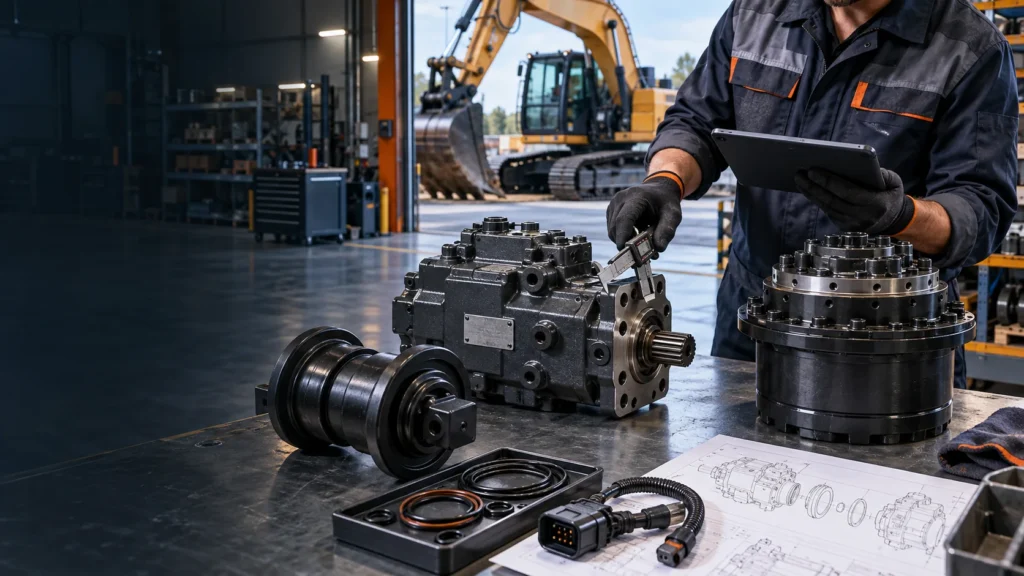
How to Verify Excavator Parts Compatibility Before Ordering
Ordering the wrong excavator part creates more than a product-return problem.
For an international buyer, an incorrect hydraulic pump, final drive, controller, seal kit or undercarriage component can result in machine downtime, repeated freight charges, customs expenses, installation delays and disputes with the end customer.
Many purchasing errors occur because a part is selected using only the excavator model. A buyer may request “a hydraulic pump for a 20-ton excavator” or provide a model such as PC200, EX200 or EC210 without the complete machine serial number, component nameplate or original part number.
That information is often insufficient.
The same excavator model can use different components depending on production year, serial-number range, engine specification, hydraulic configuration and target market. Parts may look almost identical while differing in mounting dimensions, ports, connectors, pressure settings, gear ratios or internal specifications.
This guide explains how importers, distributors, repair companies and fleet operators can verify excavator parts compatibility before placing an order.
Why the Excavator Model Is Not Always Enough
A machine model identifies a product family, but it does not necessarily identify every component installed on a particular machine.
During the production life of an excavator, the manufacturer may:
- Change the hydraulic pump manufacturer
- Introduce a new final-drive design
- Modify an electrical connector
- Replace an engine version
- Change the number of mounting holes
- Update a controller or sensor
- Introduce a new part number
- Use different components in different markets
Previous repairs can create additional uncertainty. A used machine may no longer have its original engine, hydraulic pump, travel motor or electrical system.
This is why reliable excavator parts identification normally requires several pieces of information rather than one model name.
The strongest compatibility check combines:
- Machine manufacturer and model
- Complete machine serial number
- Original part number
- Component manufacturer and model
- Clear nameplate photographs
- Product dimensions and interface details
- Application and operating information
The more expensive or technically sensitive the component, the more complete the verification should be.
1. Confirm the Complete Machine Model
Start with the full model exactly as shown on the machine identification plate.
Do not remove letters, suffixes or series information. Similar designations may represent different machine generations.
For example, a base model and a later “B,” “C,” “D” or regional version may use different:
- Engines
- Hydraulic systems
- Controllers
- Wiring harnesses
- Final drives
- Filters
- Cooling components
Avoid relying exclusively on a handwritten model description, equipment nickname or sales invoice. Request a clear photograph of the machine identification plate whenever possible.
For mixed-brand fleets, maintain a machine record containing the manufacturer, complete model, serial number, engine model and installed component numbers. This makes future construction equipment spare parts procurement much faster.
2. Record the Machine Serial Number or PIN
The machine serial number is one of the most important elements in excavator parts compatibility verification.
Manufacturers commonly introduce engineering changes at specific serial-number breakpoints. A component used before a certain serial number may not fit machines produced after that number, even though the model name remains unchanged.
The serial number helps determine:
- Production period
- Machine series
- Regional configuration
- Applicable parts-book version
- Engineering changes
- Correct replacement or superseded number
Ask the customer to photograph the complete machine plate rather than manually typing the number. Characters such as 0 and O, 1 and I, or 5 and S can easily be confused.
The serial number should be checked against the relevant parts catalogue or technical database. However, it should still be combined with information from the installed component—especially when the machine is used or has been repaired previously.
3. Identify the Original Part Number
The original reference number is usually the fastest route to identifying heavy equipment replacement parts.
Look for the number on:
- The removed component
- Original packaging
- A parts book
- A repair invoice
- A dealer quotation
- An equipment maintenance record
- A metal plate, label or casting
Provide the complete number, including prefixes, suffixes, spaces and hyphens.
A partial number may produce several possible matches. Similarly, a casting number is not always the orderable part number. One housing may be used in several assemblies with different internal configurations.
When requesting excavator parts by part number, tell the supplier where the number was found. This helps distinguish among:
- OEM order numbers
- Component manufacturer numbers
- Casting numbers
- Assembly numbers
- Individual repair-part numbers
- Old and superseded numbers
A professional part-number cross-reference should show how the proposed number relates to the original reference. It should not be based solely on similar-looking products.
4. Check for Superseded Part Numbers
Equipment manufacturers periodically replace older part numbers with new numbers.
A supersession may represent:
- A numbering-system update
- A new supplier
- A revised material
- A design improvement
- A complete replacement kit
- A component requiring related parts
An old number and a new number may be interchangeable, but this should be confirmed before ordering.
Ask the supplier to state clearly:
- The number requested
- The number quoted
- Whether the number has been superseded
- Whether the new part directly replaces the old one
- Whether additional fittings or modifications are required
Do not assume that every cross-reference found online is accurate. Cross-reference information should be checked against the machine serial number and physical configuration.
5. Photograph the Component Nameplate
For hydraulic pumps, travel motors, final drives, swing motors, engines, injectors and electrical components, the component’s own nameplate may be more useful than the excavator model.
A useful nameplate photograph should clearly show:
- Component manufacturer
- Complete model code
- Serial number
- Assembly number
- Specification code
- Rotation or displacement information
- Electrical voltage where applicable
Clean the plate carefully before taking the photograph. Use sufficient lighting and take one close-up image plus one wider image showing where the plate is located.
Do not edit, crop or compress the photograph so heavily that small characters become unreadable.
If the plate is missing, provide photographs from several angles and measure the relevant mounting and interface points.
6. Verify Physical Dimensions
Dimensions are particularly important when the part number cannot be confirmed or when comparing aftermarket excavator parts.
The required measurements depend on the component.
Hydraulic pumps
Check:
- Mounting flange
- Pilot diameter
- Shaft diameter and spline count
- Suction and pressure port positions
- Control-valve arrangement
- Rotation direction
- Overall length
- Regulator configuration
Two pumps from the same series can have different regulators or shaft specifications.
Final drives and travel motors
Check:
- Number of frame-mounting holes
- Bolt-circle diameter
- Number of sprocket-mounting holes
- Pilot diameter
- Hydraulic-port quantity
- Port size and position
- Overall width
- Flange dimensions
- Two-speed connection
- Gear ratio when available
Minor design differences may prevent installation even when the travel motor looks similar.
Undercarriage parts
For excavator undercarriage parts, confirm:
- Link pitch
- Shoe width
- Number of links
- Roller dimensions
- Bolt-hole spacing
- Sprocket segments or tooth count
- Idler mounting dimensions
- Machine weight class
The machine model alone may not identify the installed track configuration.
Seal kits
For excavator seal kits, confirm the cylinder or component number rather than ordering only by the machine model.
The boom, arm and bucket cylinders can have different bore sizes, rod diameters and seal profiles. A kit containing a similar number of seals may still be incorrect.
7. Verify Hydraulic Specifications
Physical fit does not guarantee functional compatibility.
A hydraulic pump or travel motor may bolt onto the machine but still be unsuitable because of differences in:
- Displacement
- Working pressure
- Control system
- Rotation direction
- Pilot-pressure requirements
- Port arrangement
- Speed sensor
- Regulator setting
- Gear ratio
Installing an incorrectly configured hydraulic component can produce weak operation, overheating, abnormal noise, excessive pressure or premature failure.
Before ordering a hydraulic pump for an excavator, ask whether the quotation covers:
- A complete pump assembly
- Pump without regulator
- Regulator only
- Main pump and pilot pump
- New, remanufactured or used condition
These options should not be compared as though they are the same product.
8. Check Electrical Voltage, Connector and Pin Layout
Excavator electrical parts require more than a visual comparison.
Controllers, monitors, solenoid valves, sensors, throttle motors, switches and wiring components may differ by:
- Voltage
- Connector shape
- Number of pins
- Pin arrangement
- Communication protocol
- Software version
- Calibration
- Machine serial-number range
Request close-up photographs of both the component and connector. If possible, compare the label, socket shape, locating tabs and pin layout.
A controller with the correct housing may still require programming. Buyers should confirm whether the supplied unit is:
- New and programmed
- New but unprogrammed
- Repaired
- Tested used
- Plug-and-play
- Subject to on-machine calibration
This information should be established before shipment.
9. Confirm the Engine Model and Arrangement
Excavator engine parts should normally be matched using the engine identification plate.
The excavator model may have been supplied with different engines or engine arrangements. Engine components can also vary by emission standard and destination market.
For injectors, turbochargers, fuel pumps, pistons, liners, cylinder heads and overhaul kits, provide:
- Engine manufacturer
- Complete engine model
- Engine serial number
- Arrangement or specification number
- Original component number
- Photographs of the old part
Emission-related components require particular care because electronic and mechanical specifications can differ across regions.
10. Compare Photographs Correctly
Photographs are valuable, but they should support—not replace—technical identification.
Send:
- Front view
- Rear view
- Left and right sides
- Top and bottom
- Nameplate close-up
- Connector close-up
- Mounting surface
- Hydraulic ports
- Old and new parts side by side when available
Place a ruler or caliper next to important dimensions. Avoid photographing a dirty part from a distance or sending screenshots copied from another supplier.
A photograph may reveal an obvious mismatch, but similar appearance alone does not prove compatibility.
11. Confirm the Part’s Condition and Supply Scope
Compatibility also depends on what is included in the quotation.
A buyer requesting an excavator final drive may receive quotations for:
- Complete final-drive assembly
- Travel motor only
- Reduction gearbox only
- Final drive without sprocket
- Remanufactured assembly
- Tested used assembly
Likewise, a hydraulic pump quotation may or may not include the regulator, solenoid valve, coupling or pilot pump.
The purchase order should state:
- Product name
- Part number
- Machine application
- New, aftermarket, OEM, genuine or remanufactured condition
- Included accessories
- Required quantity
- Inspection requirements
- Packaging requirements
- Warranty terms
Clear scope prevents price comparisons between fundamentally different products.
12. Approve a Compatibility Confirmation Sheet
For higher-value products, ask the supplier to prepare a written compatibility confirmation before payment or production.
The sheet can include:
| Verification item | Information confirmed |
|---|---|
| Machine brand | Customer-provided information |
| Machine model | Complete model |
| Serial number | Full serial or PIN |
| Requested part | Product description |
| Original part number | Customer reference |
| Proposed part number | Supplier’s reference |
| Component model | Nameplate information |
| Critical dimensions | Confirmed values |
| Connector or port details | Photo or drawing confirmation |
| Product condition | New/OEM/aftermarket/remanufactured |
| Customer approval | Name and date |
This creates a clear technical record for both parties. It is especially useful for importers ordering products for resale rather than installing them on their own machines.
Compatibility Requirements by Product Category
| Product category | Minimum information recommended |
|---|---|
| Hydraulic pump | Machine model, serial number, pump plate, part number, regulator and port photos |
| Final drive | Machine model, serial number, motor plate, mounting holes, sprocket pattern and ports |
| Swing motor | Part number, plate, mounting flange, ports and gearbox information |
| Engine parts | Engine model, serial number, arrangement number and original part number |
| Electrical parts | Part number, voltage, connector, pin layout and controller/software information |
| Undercarriage parts | Machine model, serial number, pitch, width, link count and measurements |
| Seal kits | Cylinder or component number, bore, rod size and old-seal profile |
| Filters | OEM number, dimensions, thread, gasket and filtration application |
Common Ordering Mistakes
Ordering only by machine tonnage
“Parts for a 20-ton excavator” is not an adequate identification. Many unrelated machines fall within the same weight class.
Relying on one unclear photograph
A distant image cannot confirm a label, connector, port or mounting pattern.
Treating casting numbers as order numbers
Casting numbers may identify only the housing rather than the complete assembly.
Ignoring serial-number breaks
The same excavator model may use different components across its production life.
Assuming similar appearance means compatibility
Internal displacement, pressure, voltage or gear ratio may differ even when housings look alike.
Choosing only by price
A very low quotation may exclude required accessories or represent a used, rebuilt or lower-grade product.
Approving before technical questions are resolved
Uncertainty should be recorded and resolved before payment and shipment.
How TerraParts Global Verifies Excavator Parts
TerraParts Global supports international distributors, equipment dealers, repair companies, mining businesses and fleet operators sourcing excavator spare parts from China.
We do not treat compatibility as a simple model-name search.
Our verification process may include:
1. Information collection
We request the available part number, machine model, serial number, component plate, photographs, dimensions, quantity and delivery destination.
2. Part-number cross-reference
We compare the customer’s reference with available catalogue, manufacturer and supplier information. Where a superseded number exists, we explain the proposed relationship.
3. Supplier matching
Different suppliers specialize in different categories. We select suitable supply resources for hydraulic parts, undercarriage components, filters, seal kits, engine parts or electrical components instead of assuming one source is equally strong in every category.
4. Technical confirmation
For sensitive components, we compare nameplates, mounting points, ports, connectors, dimensions and other available specifications.
5. Customer approval
If the supplied information leaves uncertainty, we request additional evidence before confirming the order. We do not recommend proceeding on an unsupported assumption.
6. Inspection and packaging
Inspection requirements are selected according to the product. They may include part-number verification, appearance, dimensions, interfaces, labels, quantity, packaging and functional sampling where applicable.
7. Mixed-parts consolidation
For orders containing products from several suppliers, TerraParts can coordinate collection, inspection, export packaging and consolidated shipment.
This process helps buyers reduce communication complexity and improve visibility across multi-category orders.
What Information Should You Send for a Quotation?
For faster machine compatibility verification, send as much of the following information as possible:
- Complete excavator manufacturer and model
- Machine serial number or PIN
- Original part number
- Part name
- Component manufacturer and model
- Nameplate photographs
- Photographs from several angles
- Connector or hydraulic-port photographs
- Critical dimensions
- Required quantity
- Genuine, OEM or aftermarket preference
- Delivery country
- Special packaging or labeling requirements
If a part number is unavailable, photographs and measurements may help, but the final identification will depend on the product category and quality of the supplied information.
Frequently Asked Questions
How do I find the correct part number for my excavator?
Check the machine parts book, dealer records, removed component, original packaging or component nameplate. Use the complete machine model and serial number when searching an excavator parts catalogue.
Can I order excavator parts using only the machine model?
Simple maintenance parts may sometimes be identified by model, but the serial number is strongly recommended. Hydraulic, engine and electrical parts normally require additional component information.
Why does one excavator model have different part numbers?
Manufacturers may change suppliers, designs or specifications during production. Different markets and emission standards can also result in different components.
How do I verify an aftermarket excavator part?
Compare the original number, machine application, component model, dimensions, interfaces and functional specifications. Also verify the supplier’s quality level, inspection process, warranty and traceability.
What if the original component has no readable nameplate?
Provide photographs from all sides, measurements, machine serial number and any visible casting or reference numbers. The supplier may request additional information before confirming compatibility.
Is a part-number cross-reference enough?
Not always. Cross-reference information should be checked against the machine serial number and installed component, particularly for used or modified machines.
Can TerraParts verify parts from photographs?
Photographs can support identification, but they may not be sufficient for every component. TerraParts will explain what additional information is required before confirming the proposed match.
Verify Before You Order
Correct excavator parts sourcing starts with accurate information.
The safest purchasing decision combines the machine model, serial number, original part number, component nameplate, photographs and critical technical specifications. For higher-value hydraulic, engine and electrical components, a written compatibility confirmation should be completed before payment and shipment.
TerraParts Global helps international B2B buyers organize this process through part-number matching, machine compatibility verification, specialized supplier selection, inspection, mixed-parts consolidation and export coordination.
Send us your part number, machine model, serial number and component photos. Our team will review the available information and advise what else is needed before quotation.
