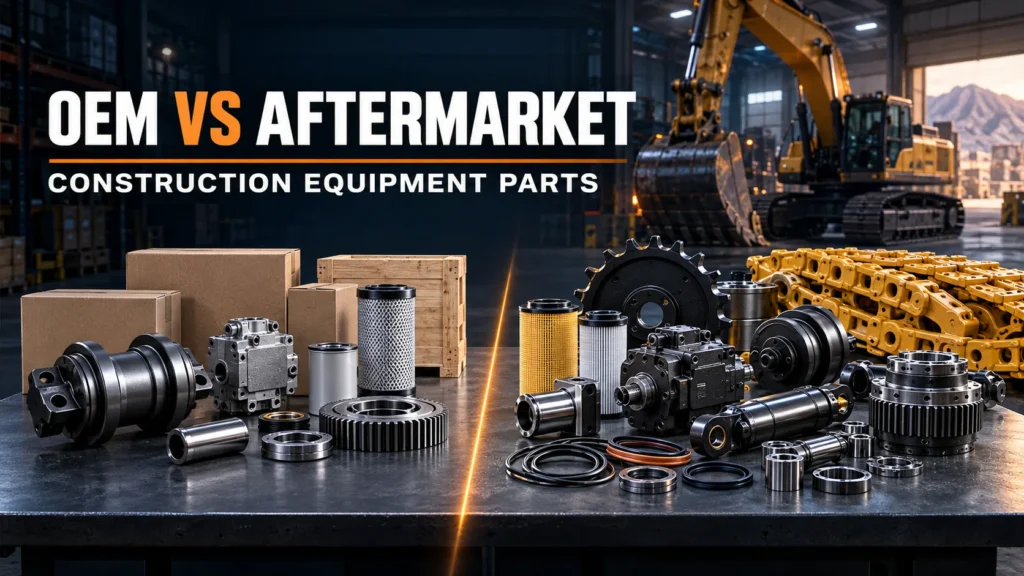
When an excavator, wheel loader or bulldozer stops working, the cheapest quotation is rarely the lowest-cost decision. A part that arrives late, does not match the machine serial number or fails before the expected service interval can cost far more in downtime than the amount saved on the purchase price.
That is why professional buyers do not treat the OEM vs aftermarket construction equipment parts question as a simple choice between “expensive” and “cheap.” The right decision depends on the component, the machine’s age, the operating environment, required delivery time, warranty conditions and the reliability of the supplier.
For construction equipment dealers, spare-parts distributors, repair workshops, mining contractors and rental fleets, a practical sourcing strategy usually includes both OEM and qualified aftermarket parts. This guide explains where each option makes sense, how to evaluate quality and how to reduce compatibility risks when importing construction machinery parts from China.
What Do OEM, Genuine and Aftermarket Actually Mean?
These terms are often used loosely in quotations, so buyers should define them before comparing prices.
Genuine parts are sold in the equipment manufacturer’s brand and official packaging through its authorized supply chain. They are developed for specific machines and are normally supported by the manufacturer or dealer network.
OEM parts are produced by an original equipment manufacturer. In the market, however, “OEM” may be used in several ways. A supplier might mean the original producer of a component, a part made to an equipment manufacturer’s drawing, or simply a product with equivalent dimensions. Buyers should never rely on the word OEM alone. Ask who manufactured the part, whose brand appears on it and what documentation supports the claim.
Aftermarket parts are replacement parts sold outside the machine manufacturer’s official branded channel. Their quality ranges from premium, application-engineered products to low-cost copies with limited traceability. “Aftermarket” therefore describes a sales channel, not a single quality grade.
Terms such as OEM quality, OEM standard and genuine replacement are not proof that a product is an original branded part. A responsible supplier should state clearly whether the quotation is genuine, OEM-origin, branded aftermarket or unbranded aftermarket.
OEM vs Aftermarket Parts: Quick Comparison
| Buying factor | OEM or genuine parts | Qualified aftermarket parts |
|---|---|---|
| Fit and compatibility | Usually straightforward when the correct machine serial number is supplied | Reliable when the OEM number, model, serial range and dimensions are verified |
| Purchase price | Usually higher | Often more competitive, with multiple quality levels available |
| Availability | Strong dealer support, but some parts may have long lead times or regional restrictions | Broader sourcing options and often faster supply for common replacement parts |
| Product selection | Designed around the manufacturer’s equipment range | Can cover multiple brands, old models and discontinued applications |
| Warranty | Normally supported through the official channel, subject to its terms | Depends on the supplier, manufacturer and product category |
| Packaging and branding | Official branded packaging | Supplier brand, manufacturer brand or neutral packaging |
| Best use | New machines, warranty-sensitive repairs and highly integrated components | Mature equipment, wear parts, planned maintenance and cost-controlled fleet operations |
Official Caterpillar resources, for example, allow users to identify publications and parts information by serial-number prefix or sales model, illustrating why machine identity matters in any parts decision. Regardless of channel, fitment should be confirmed before shipment rather than inferred from appearance alone.
When OEM Construction Equipment Parts Make Sense
OEM or genuine parts can be the better commercial choice in several situations.
1. The machine is new or under warranty
If equipment remains under a manufacturer or dealer warranty, using non-approved components may complicate a future claim. Buyers should review the warranty terms and obtain written guidance from the authorized dealer before substituting critical parts.
2. The component is safety-critical or electronically integrated
Electronic control units, sensors, braking components, emissions-system parts and software-dependent modules can require exact calibration or programming. When the technical consequence of a mismatch is high, the additional traceability and support of the official channel may justify the price.
3. No reliable cross-reference is available
The same machine model may use different components across serial-number ranges, production years or regional specifications. If the old part number is superseded and no verified cross-reference exists, OEM documentation can be the safest starting point.
4. The customer contract specifies genuine parts
Government, mining and infrastructure contracts sometimes require genuine components or an approved brand list. A lower-cost alternative has no value if it fails the project’s procurement requirements.
In these cases, buyers are paying not only for the component but also for documentation, channel accountability and reduced approval risk.
When Quality Aftermarket Parts Are the Better Choice
Qualified aftermarket parts can improve both availability and total maintenance cost when selected correctly.
1. The fleet contains mature or high-hour machines
Owners often need to control repair costs as equipment ages. Premium aftermarket products can keep older machines productive without applying new-machine parts pricing to every repair.
2. The part is a predictable wear or maintenance item
Filters, seal kits, bucket pins and bushings, track rollers, carrier rollers, sprockets, idlers and track shoes are replaced repeatedly. These are common areas for fleet operators and excavator spare parts wholesalers to build approved aftermarket programs.
3. OEM delivery time would create excessive downtime
A machine cannot generate revenue while waiting for a component. If a verified aftermarket excavator parts supplier can ship the correct part significantly sooner, the avoided downtime may outweigh any difference in purchase price.
4. The original part is discontinued or difficult to obtain
Aftermarket manufacturers often continue serving older Caterpillar, Komatsu, Hitachi, Volvo, Kobelco, Hyundai and Develon applications. Brand names and OEM numbers should be used only for identification and compatibility; they do not imply affiliation or authorization.
5. A distributor needs a wider, consolidated product range
An importer may need undercarriage parts, filters, seal kits, hydraulic components and engine parts in one shipment. A capable sourcing partner can coordinate several specialized manufacturers, inspect the goods and consolidate them into one export order.
The key phrase is quality aftermarket. A low price without material specifications, test records, fitment confirmation or warranty terms is not a sourcing advantage.
The Right Choice Depends on the Product Category
Undercarriage parts
For track rollers, carrier rollers, idlers, sprockets, track chains and track shoes, buyers should compare steel grade, forging or casting process, heat-treatment depth, surface hardness, seal design and dimensional tolerances. Operating conditions also matter: quarry rock, sand, mud and general construction create different wear patterns.
A professional excavator undercarriage parts supplier should ask for the machine model, serial number, OEM part number and, where necessary, key dimensions or photos of the old component.
Filters
Oil, fuel, air and hydraulic filters may look interchangeable while using different media, bypass valves, seals or filtration efficiency. Request product specifications and application references. Filters are inexpensive compared with the hydraulic pump, injectors or engine components they protect.
Seal kits
For boom, arm, bucket, center-joint, swing-motor and hydraulic-pump seal kits, correct material selection is essential. Temperature, pressure, fluid compatibility and installation quality affect service life. The quotation should identify the application and kit contents, not merely state that it “fits the model.”
Hydraulic pumps, final drives and swing motors
Hydraulic components carry a higher technical and financial risk. Buyers should confirm whether the offer is a complete assembly, remanufactured unit or replacement parts. Ask about test procedures, pressure or leakage testing, core conditions, installation requirements and warranty exclusions. A contaminated hydraulic system can damage a new component, so the maintenance process is as important as the part itself.
Engine and electrical parts
Engine parts require precise engine-model and serial-number matching. Electrical parts may require voltage, connector, software or calibration confirmation. For these categories, never place an order using the excavator model alone.
Eight Checks Before Approving an Aftermarket Supplier
Whether you are searching for a heavy equipment parts supplier, an earthmoving spare parts supplier or a specialist hydraulic pump parts supplier, use a structured approval process.
- Verify the complete machine identity. Record the brand, model, serial number, engine model and equipment configuration.
- Confirm the OEM reference number. Check whether the number has been replaced or superseded and whether left/right or front/rear variants exist.
- Compare technical specifications. Dimensions, materials, hardness, thread, voltage, pressure rating and connector type may all be relevant.
- Identify the actual quality level. Ask whether the part is genuine, OEM-origin, premium aftermarket, economy aftermarket or remanufactured.
- Review manufacturer traceability. The supplier should know where the product is made and be able to manage batch or production records where appropriate.
- Define inspection and testing. Agree on visual, dimensional, functional and packaging checks before shipment.
- Put warranty terms in writing. Clarify the warranty period, evidence required for a claim and whether labor, freight or consequential loss is excluded.
- Evaluate export execution. Correct labels, corrosion protection, reinforced packaging, accurate documents and mixed-order consolidation all affect the landed result.
If a seller cannot explain the product’s origin or confirm compatibility beyond “it should fit,” the apparent saving is not worth the risk.
Compare Total Cost, Not Unit Price
Professional procurement teams evaluate total cost of ownership:
Total sourcing cost = part price + freight + import charges + installation + expected downtime + failure risk + claim-handling cost
Consider two quotations for an excavator final drive. Supplier A is cheaper but cannot confirm the motor number, offers no test report and needs the buyer to pay return freight for any claim. Supplier B verifies the plate, supplies dimensional confirmation, tests the assembly and provides written warranty terms. Supplier B may have the lower total cost even with a higher unit price.
The same principle applies to high-volume maintenance parts. A small difference in filter or seal-kit price can become meaningful across a fleet, but only after service interval, rejection rate and equipment protection are considered.
A Smarter Sourcing Strategy for Importers and Distributors
The strongest procurement model is not “OEM only” or “aftermarket only.” It is a risk-based product matrix.
- Use genuine or approved OEM parts where warranty, safety, electronics or contract compliance requires them.
- Approve premium aftermarket products for high-volume maintenance and wear categories.
- Keep at least two qualified sources for operationally critical items.
- Build a database connecting OEM numbers, machine models, serial ranges and purchase history.
- Start new suppliers with samples or a controlled trial order.
- Track field performance, claims and repeat purchases by SKU and batch.
- Consolidate products only after each item has passed category-specific checks.
For a distributor, this approach also creates clearer market positioning. Instead of offering an unexplained cheap alternative, the sales team can present documented options: genuine, premium aftermarket and value aftermarket, each with an appropriate warranty and application.
How TerraParts Global Supports Parts Buyers
TerraParts Global operates as an independent construction equipment spare-parts sourcing and supply-chain partner. We do not describe every product as OEM and we do not force one quality level into every application. Our role is to help B2B buyers identify the correct part, select an appropriate supply route and manage the order from quotation through export.
Our typical process includes:
- Application review: We collect the machine brand, model, serial number, OEM part number, quantity and photos or nameplate details when required.
- Cross-reference and compatibility check: We compare available references and flag incomplete or conflicting information before confirming an order.
- Supplier and grade selection: We source through a verified network of specialized Chinese manufacturers and suppliers, matching the quality level to the buyer’s market and application.
- Transparent quotation: The offer identifies the part description, reference number, condition or quality category, lead time, packaging and warranty basis.
- Product-specific quality control: Inspection can cover quantity, appearance, dimensions, labeling, packaging and available functional or test documentation according to the component.
- Mixed-parts consolidation: Buyers can combine undercarriage parts, filters, seal kits, hydraulic parts, engine parts and electrical components from multiple sources into a coordinated shipment.
- Export and follow-up: We support commercial documentation, packaging coordination, international delivery and claim communication.
This service is designed for construction equipment parts distributors, equipment dealers, repair companies, mining operations, rental fleets and importers that want access to China’s supply base without managing every factory separately.
Common Red Flags in Construction Parts Quotations
Be cautious when a quotation:
- uses “genuine,” “OEM” and “aftermarket” as interchangeable terms;
- confirms fit using only the machine model;
- omits the manufacturer, brand or quality grade;
- offers no drawings, dimensions or application details for an uncertain match;
- provides a warranty without a written claim procedure;
- is far below the normal market range without explaining material or specification differences;
- uses copied branded packaging or trademarks without authorization;
- cannot provide clear packing, lead-time or export information.
Good sourcing is built on accurate information. A dependable supplier will sometimes delay a quotation to request another photo, number or dimension. That is a sign of risk control, not poor service.
Frequently Asked Questions
Are aftermarket construction equipment parts as good as OEM parts?
Some premium aftermarket parts can deliver reliable performance, but quality varies widely. Evaluate the manufacturer, material, specifications, testing, application record and warranty rather than judging the entire aftermarket category as one level.
Are OEM parts always made by the equipment brand itself?
Not necessarily. Equipment manufacturers may produce components internally or source them from specialist manufacturers. However, genuine parts sold through the authorized channel carry the equipment brand’s identification and support. Ask suppliers to clarify exactly what “OEM” means in each quotation.
What information is needed to quote excavator spare parts?
Provide the machine brand and model, full serial number, OEM part number, required quantity and destination country. For hydraulic, engine and electrical components, include the component nameplate, engine number, photos and key dimensions when available.
Can OEM and aftermarket parts be combined in one order?
Yes. Many importers use genuine parts for selected critical applications and approved aftermarket parts for maintenance and wear items. TerraParts Global can coordinate multiple product categories and consolidate qualified goods into one shipment.
How can buyers reduce the risk of receiving the wrong part?
Use the OEM number together with the machine serial number, verify supersessions and compare photos, nameplates or dimensions for uncertain applications. The purchase order should record the agreed reference and specification.
Final Recommendation
OEM parts offer clear advantages when manufacturer approval, warranty protection, software integration or critical-component traceability is required. Qualified aftermarket parts can provide stronger pricing, availability and coverage for wear items, mature machines and multi-brand fleets.
The best choice is the option that delivers the correct fit, documented quality, acceptable lead time and lowest total operating risk—not simply the lowest line-item price.
Need help sourcing OEM-reference and aftermarket construction equipment parts? Send TerraParts Global your machine model, serial number, part number, quantity and destination. Our team will review compatibility, propose suitable supply options and prepare a clear B2B quotation.
Request a Parts Quotation →
Editor Notes (Do Not Publish as Article Body)
- Add one original comparison graphic under the quick-comparison table.
- Add one close-up image each for undercarriage, filters/seals and hydraulics; use descriptive WebP filenames and alt text.
- Recommended featured-image filename:
oem-vs-aftermarket-construction-equipment-parts.webp - Recommended featured-image alt text:
OEM vs aftermarket construction equipment parts sourcing comparison - Link “official Caterpillar resources” to:
https://publications.cat.com/ - Add Article schema plus the five FAQ items in FAQPage schema only if the answers remain visible on the page.
- Include an independent-supplier trademark disclaimer in the footer or article: “All manufacturers’ names, symbols and descriptions are used for reference purposes only. TerraParts Global is an independent supplier and is not affiliated with the referenced equipment manufacturers unless expressly stated.”
- Suggested CTA button URL:
/request-a-quote/
