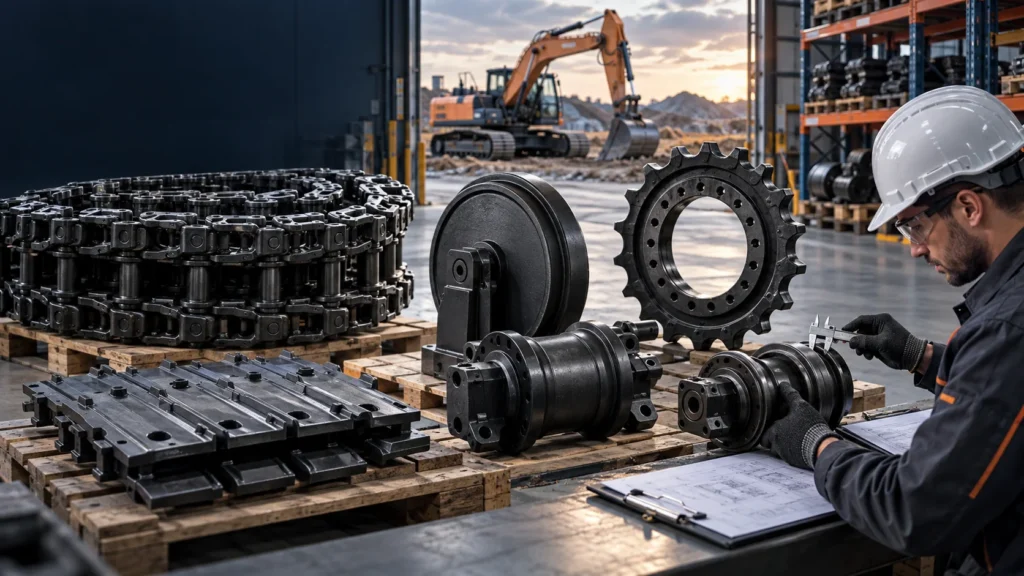
Excavator Undercarriage Parts Buying Guide
The undercarriage is one of the hardest-working systems on a crawler excavator. It supports the machine’s weight, transfers engine power to the ground and keeps the excavator stable while digging, lifting and travelling across uneven surfaces.
It is also one of the most expensive systems to maintain.
For importers, equipment dealers, repair workshops and fleet operators, purchasing excavator undercarriage parts is not simply a matter of comparing unit prices. A low quotation has little value if the track roller dimensions are incorrect, the sprocket does not engage properly with the track chain, or the material and heat treatment cannot withstand the intended working conditions.
This excavator undercarriage parts buying guide explains the main components, compatibility information, quality requirements and supplier checks buyers should complete before placing an order.
What Parts Are Included in an Excavator Undercarriage?
An excavator undercarriage contains several components that work together as one wear system. The main replacement parts include:
- Track rollers or bottom rollers
- Carrier rollers or top rollers
- Front idlers
- Sprockets and sprocket segments
- Track chains and track link assemblies
- Track shoes
- Track bolts and nuts
- Track adjusters
- Recoil springs
- Track guards
- Idler yokes and related hardware
The undercarriage frame supports and connects the tracks, rollers, idlers, sprockets and travel system. Because the components operate together, wear or dimensional errors in one part can accelerate wear in other parts.
For example, a worn sprocket may not engage correctly with a new track chain. Similarly, incorrect track tension can increase wear on bushings, rollers and idlers. Buyers should therefore evaluate the complete undercarriage condition instead of replacing an isolated component without investigating the cause of failure.
1. Excavator Track Rollers
The excavator track roller supports the weight of the machine and guides the track chain along the lower part of the track frame. Depending on the excavator model and track-frame configuration, several rollers may be installed on each side.
Track rollers operate under high radial loads and are continuously exposed to mud, sand, stones and water. Their quality depends on several factors:
- Shell material
- Heat-treatment depth
- Surface hardness
- Shaft strength
- Bushing quality
- Floating-seal performance
- Lubricant quality
- Dimensional accuracy
When requesting an excavator track roller quotation, buyers should provide the machine model, part number and clear photos. Important measurements may include mounting-hole spacing, flange diameter, roller width, overall length and bolt-hole dimensions.
A roller that looks similar in a catalogue photo may still have a different mounting configuration.
2. Carrier Rollers
Carrier rollers support the upper section of the track chain and help maintain its alignment. They are sometimes called top rollers or upper rollers.
Although carrier rollers carry less machine weight than bottom rollers, poor sealing, incorrect dimensions or insufficient surface hardness can still cause premature failure.
Buyers searching for an excavator carrier roller supplier should verify:
- Machine model and serial-number range
- OEM reference number
- Single-flange or double-flange design
- Mounting type
- Shaft and bracket dimensions
- Seal construction
- Oil-leakage inspection
- Applicable working environment
If an existing roller is available, photos showing the complete roller, mounting surface and identifying marks can help confirm the correct replacement.
3. Front Idlers
The excavator front idler guides the track chain at the front of the undercarriage. It works with the track adjuster and recoil mechanism to maintain alignment and absorb impact.
A suitable idler should have accurate running surfaces, dependable seals and sufficient resistance to impact and abrasive wear. Common idler problems include:
- Oil leakage
- Cracked or damaged flanges
- Uneven running-surface wear
- Excessive side movement
- Shaft or bushing damage
- Incorrect alignment with the track chain
When sourcing excavator idlers from China, do not rely on the machine brand alone. The same excavator series may use different idlers according to machine generation, manufacturing location or serial-number range.
Provide the full model designation and, whenever possible, the original part number.
4. Excavator Sprockets and Segments
The excavator sprocket transfers travel-motor power to the track chain. Its teeth engage with the track-chain bushings and move the excavator forward or backward.
For larger machines, the drive system may use separate sprocket segments rather than a one-piece sprocket. Segment construction simplifies replacement because individual sections can be removed without disassembling the entire track chain.
Important sprocket and segment specifications include:
- Number of teeth
- Outside diameter
- Pitch-circle dimensions
- Bolt-hole quantity
- Bolt-hole diameter
- Centre-hole diameter
- Mounting thickness
- Applicable track-chain pitch
- Material and heat-treatment specifications
Sprocket teeth and track-chain bushings form a matched wear pair. Installing a new chain on a severely worn sprocket—or a new sprocket with a badly worn chain—can create poor engagement and accelerate wear.
A professional excavator undercarriage parts supplier should ask about the condition of both components before recommending a replacement plan.
5. Track Chains and Track Link Assemblies
The excavator track chain, also called a track link assembly, forms the moving foundation of the crawler system. Pins and bushings connect the links, allowing the chain to articulate around the sprocket and idler.
Track-chain selection requires careful verification because small differences in pitch, link dimensions or pin and bushing sizes can make a chain unsuitable for the machine.
Buyers should confirm:
- Machine make and model
- Serial number
- Original part number
- Track-chain pitch
- Number of links
- Link height and width
- Pin diameter
- Bushing outside diameter
- Master-link type
- Lubricated or sealed configuration
- Required track-shoe width
Searches such as “excavator track chain supplier,” “track chain assembly wholesale” and “aftermarket excavator track links” commonly come from buyers with strong commercial intent. However, the lowest-priced chain is not always the lowest-cost solution.
Material consistency, forging quality, pin and bushing treatment, assembly accuracy and seal performance all affect service life.
6. Excavator Track Shoes
Track shoes are bolted to the track links and create the ground-contact surface. Shoe width, plate thickness and grouser design should be selected according to the machine and application.
Common configurations include:
- Single-grouser track shoes
- Double-grouser track shoes
- Triple-grouser track shoes
- Flat track shoes
- Rubber pads attached to steel shoes
- Road-liner pads
- Wide shoes for low-ground-pressure applications
A wider shoe can improve flotation on soft ground, but it can also increase leverage and stress on the track links, rollers and other undercarriage components. The widest available shoe is therefore not automatically the best choice.
The working environment must be considered, including:
- Rock or quarry operations
- General construction
- Muddy or soft ground
- Sand and highly abrasive soil
- Demolition sites
- Urban roadwork
- Forestry applications
- Mining operations
Correct shoe selection improves traction while helping control undercarriage stress and wear.
Why the Machine Model Alone Is Not Enough
One of the most common mistakes in wholesale excavator parts purchasing is ordering only by a general model name.
For example, two machines carrying a similar model designation may have different:
- Production years
- Serial-number ranges
- Track gauges
- Roller mounting dimensions
- Chain pitches
- Shoe widths
- Undercarriage configurations
- Regional specifications
A reliable compatibility check should use several identifiers instead of only one.
Information Buyers Should Submit
For accurate excavator parts matching, send as much of the following information as possible:
- Equipment manufacturer
- Complete machine model
- Machine serial number
- OEM or reference part number
- Quantity required
- Photos of the existing part
- Photos of the machine nameplate
- Critical measurements
- Left-hand or right-hand position, when applicable
- Working conditions and expected application
- Delivery destination
- Required delivery date
For bulk orders containing several models, prepare a spreadsheet with one line for each item. This reduces misunderstandings and makes quotation comparison easier.
At TerraParts Global, we organize this information into a matching file before confirming the supply option. Where a reference number is unavailable, we compare the machine details, photos and dimensions with supplier records.
OEM, Genuine and Aftermarket Undercarriage Parts
Buyers generally encounter three supply categories.
Genuine Parts
Genuine parts are supplied through the equipment manufacturer’s authorized system. They normally offer clear traceability and assured compatibility, but their pricing and lead time may be higher.
They can be appropriate for machines under warranty, critical applications or customers who specifically require genuine packaging and documentation.
OEM-Supply Parts
The term “OEM” is often used inconsistently in the international parts market. Some sellers use it for parts made by an original production supplier, while others use it loosely to describe any replacement part made to comparable dimensions.
Buyers should not accept an OEM claim without supporting information. Ask who produced the part, what specifications are controlled and what documentation is available.
Aftermarket Excavator Parts
Aftermarket excavator parts are made by independent manufacturers for replacement use. Quality can range from basic economical products to premium components designed for demanding applications.
A professional supplier should not describe every aftermarket product as being equal to a genuine part. Instead, the supplier should explain:
- Product quality level
- Intended operating environment
- Available material information
- Inspection procedures
- Warranty terms
- Packaging standard
- Traceability method
- Expected price and lead-time position
The correct choice depends on the machine’s age, daily operating hours, jobsite conditions, maintenance strategy and customer budget.
Material and Heat Treatment
Undercarriage parts are exposed to repeated impact, heavy loads and abrasive materials. Suitable steel selection and controlled heat treatment are therefore essential.
However, a high hardness number by itself does not guarantee a good component. A part that is excessively hard may become brittle, while insufficient hardness can lead to rapid wear.
Buyers should assess the combination of:
- Base material
- Forging or casting quality
- Heat-treatment process
- Surface hardness
- Effective hardened depth
- Core toughness
- Dimensional stability
- Crack control
- Batch consistency
For critical or large-volume orders, inspection can include hardness testing, dimensional reports, material certificates or sample evaluation, depending on the product and commercial requirements.
Seals and Lubrication
Rollers and idlers depend heavily on sealing and internal lubrication. A strong roller shell cannot deliver acceptable service life if contamination enters through the seal or lubricant escapes during operation.
Ask the supplier how it controls:
- Floating-seal contact surfaces
- Seal-ring material
- O-ring quality
- Shaft finish
- Lubricant filling
- Leakage testing
- Assembly cleanliness
Visible oil leakage, damaged sealing surfaces or contamination inside a component can quickly lead to bearing, shaft and bushing damage.
For this reason, TerraParts Global includes appearance and leakage checks in the inspection plan for applicable undercarriage components.
Dimensional Inspection and Trial Assembly
Compatibility problems often result from small dimensional differences rather than obvious manufacturing defects.
Depending on the item, inspection points may include:
- Mounting-hole spacing
- Flange position
- Overall width
- Shaft diameter
- Roller diameter
- Sprocket tooth profile
- Pitch dimensions
- Link dimensions
- Bolt-hole alignment
- Shoe width and thickness
For repeat orders, approved samples and previous inspection records can be used as reference standards. For new projects, buyers should consider sample validation before a large production order, especially when the original part number cannot be confirmed.
How to Compare Supplier Quotations
A meaningful quotation comparison should cover more than the unit price.
| Quotation item | What the buyer should check |
|---|---|
| Part identification | Model, serial range and reference number |
| Product description | Exact component and specification |
| Quality level | Genuine, verified OEM supply or aftermarket |
| Material | Declared steel or controlled specification |
| Heat treatment | Surface and core requirements |
| Unit price | EXW, FOB, CIF or other Incoterm |
| Packaging | Pallet, plywood case, carton or customized packing |
| MOQ | Per item and total mixed-order requirement |
| Lead time | Stock, production and inspection time |
| Warranty | Coverage, period and claim procedure |
| Documents | Packing list, invoice, certificate or inspection report |
| Freight | Weight, dimensions and destination costs |
A quote that omits the part number, quality level or packaging method may appear cheaper but creates uncertainty. Ask suppliers to quote against the same specification before making a final comparison.
Mixed-Parts Consolidation for Importers
Many excavator parts distributors do not need a full container of one track roller or one sprocket. They may need hundreds of different items across several brands and models.
This creates several purchasing challenges:
- Different supplier MOQs
- Multiple production schedules
- Inconsistent labelling
- Repeated domestic freight charges
- Difficult packing-list control
- Greater risk of missing or mixed items
- Higher communication workload
TerraParts Global supports mixed construction equipment parts consolidation. We can coordinate compatible products from selected suppliers, receive them at a consolidation point, check item identification and quantities, combine the shipment and prepare a unified packing list.
This service is particularly useful for distributors and repair networks buying:
- Undercarriage parts
- Hydraulic parts
- Filters
- Seal kits
- Engine parts
- Electrical components
- Ground-engaging tools
Consolidation does not remove the need for product-level verification. Each item should remain traceable to its purchase requirement, supplier and inspection record.
Packaging and Export Protection
Excavator undercarriage parts are heavy and can damage themselves or other cargo if packed incorrectly.
Export packaging should consider:
- Individual part weight
- Sharp edges and tooth profiles
- Rust prevention
- Moisture protection
- Pallet load limits
- Forklift access
- Internal blocking and reinforcement
- Container weight distribution
- Destination handling conditions
Sprockets, rollers and track links may require reinforced pallets or plywood cases. Track shoes and chains must be secured to prevent movement during transportation.
Labels should clearly show the part number, machine model, quantity, package number and purchase-order reference. For mixed shipments, an accurate packing list is essential for warehouse receiving and customer distribution.
Common Buying Mistakes
Ordering from photos only
Photos are useful, but perspective can hide dimensional differences. Combine photos with part numbers and measurements.
Treating every OEM claim as equivalent
Ask for clarification and evidence. “OEM quality” is a marketing phrase unless supported by controlled specifications and traceability.
Mixing new and severely worn components
A new sprocket operating with a worn chain—or the reverse—may experience accelerated wear.
Ignoring operating conditions
A component suitable for moderate construction work may not be the best option for quarry, demolition or mining applications.
Choosing only by price
Unexpected replacement labour, machine downtime and a second freight charge can cost far more than the initial price difference.
Buying without a claim procedure
Confirm what evidence is needed for warranty review, such as installation records, photos, operating hours and damaged-part measurements.
Excavator Undercarriage Parts Supplier Checklist
Before selecting an excavator undercarriage parts supplier in China, ask:
- Can the supplier match parts using the model, serial number and part number?
- Does it explain the difference between genuine, OEM-supply and aftermarket options?
- Can it provide critical dimensions before shipment?
- Are inspection photos or reports available?
- Can it manage mixed-model and mixed-category orders?
- Are packaging and labels suitable for international distribution?
- Are delivery schedules confirmed in writing?
- Is there a documented warranty and claim process?
- Can the supplier consolidate parts from more than one approved source?
- Does it communicate openly when compatibility is uncertain?
A responsible supplier should sometimes pause an order and request more information. Shipping an unverified component quickly is not better than taking additional time to confirm the correct part.
How TerraParts Global Supports Buyers
TerraParts Global serves construction-equipment parts distributors, equipment dealers, repair companies, rental fleets, mining operators and international importers.
We are a sourcing and supply-chain partner rather than claiming that every product comes from one factory. This allows us to select suitable manufacturing resources according to product category, technical requirements, order volume and target market.
Our support process includes:
- Reviewing part numbers and machine information
- Identifying missing compatibility details
- Comparing available supply options
- Confirming critical dimensions and specifications
- Coordinating samples when required
- Inspecting quantities, appearance, labelling and agreed checkpoints
- Consolidating mixed parts orders
- Preparing export packaging and shipment documents
- Supporting post-shipment traceability and claim communication
This process is designed to reduce wrong-part risk, simplify multi-supplier purchasing and give professional buyers clearer control over their orders.
Request an Excavator Undercarriage Parts Quotation
To request a quotation, send us:
- Excavator brand and complete model
- Serial number
- Required part numbers
- Product descriptions
- Quantities
- Existing-part and nameplate photos
- Delivery country or port
- Required quality level
- Preferred trade terms
If you do not have a confirmed part number, send clear photos and measurements. Our team will review the available information before recommending a supply option.
Whether you are looking for an excavator track roller supplier, wholesale track chains, sprockets, carrier rollers, front idlers or a mixed shipment of heavy equipment spare parts, TerraParts Global can help coordinate compatibility verification, sourcing, inspection, consolidation and international delivery.
Frequently Asked Questions
What are the main excavator undercarriage replacement parts?
The most frequently replaced parts include track rollers, carrier rollers, front idlers, sprockets, track chains, track shoes, bolts, nuts, track adjusters and recoil components.
Can I order excavator parts using only the machine model?
Sometimes, but it is not recommended. The same model family may contain different specifications. A serial number, OEM part number, photos and critical measurements improve matching accuracy.
Should sprockets and track chains be replaced together?
Their wear conditions should be evaluated together because they operate as a matched system. A new component paired with a severely worn mating component may wear prematurely.
Do you supply aftermarket excavator undercarriage parts?
Yes. TerraParts Global coordinates aftermarket supply options according to the buyer’s application, target quality, quantity and budget. Product positioning and available inspection requirements are confirmed before ordering.
Can different excavator parts be combined in one shipment?
Yes. Mixed-parts consolidation can include undercarriage, hydraulic, filtration, sealing, engine and electrical parts, subject to product availability and shipping requirements.
