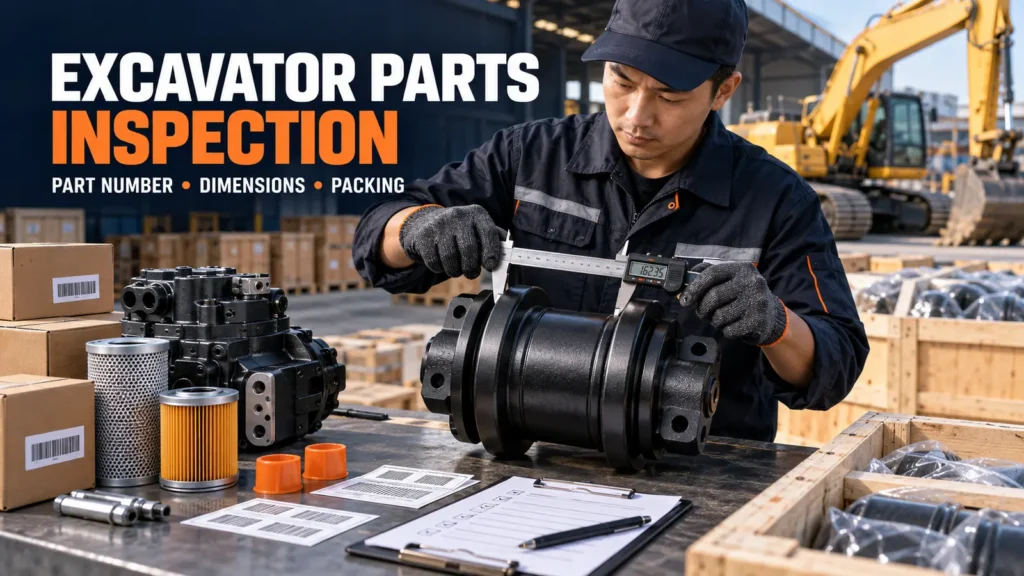
How to Inspect Excavator Parts Before Shipment
For an international buyer, an excavator part is not truly ready for shipment simply because production is complete or the supplier says it is in stock. Before the goods leave China, the buyer still needs confirmation that the correct parts have been prepared, the quantities match the purchase order, critical dimensions are within the agreed specifications and the packing can protect the products during international transportation.
This is particularly important for mixed excavator spare-parts orders. A single shipment may include track rollers, filters, seal kits, hydraulic components, engine parts and electrical parts sourced from different suppliers. Each category has different inspection priorities, and an inspection checklist designed for one product cannot automatically be applied to another.
A structured excavator parts pre-shipment inspection helps importers, distributors, repair companies, mining operators and fleet managers identify problems while correction is still practical. Once the shipment has arrived in another country, even a small discrepancy can result in customer complaints, emergency air freight, installation delays and avoidable downtime.
This guide explains how to inspect excavator parts before shipment and what evidence buyers should request before authorizing delivery.
Why Pre-Shipment Inspection Matters
Excavator components are frequently purchased using part numbers, machine models, serial numbers, drawings or samples. Errors can occur at several points in the purchasing process:
- The submitted part number may be incomplete or superseded.
- The supplier may select a visually similar component.
- The product may fit another serial-number range.
- A dimension may be outside the required tolerance.
- The quantity may not match the purchase order.
- Mixed parts may be labeled incorrectly.
- Surface protection may be insufficient.
- Heavy components may be packed in weak cartons.
- Small accessories may be missing.
- Different quality levels may be mixed in one batch.
A professional excavator parts inspection is intended to find these problems before shipment—not after installation.
Pre-shipment inspection should not be presented as a guarantee that a part will never fail. Its purpose is to verify the agreed inspection scope, record the condition of the order and reduce identifiable purchasing risks.
Define the Inspection Standard Before Ordering
One of the most common purchasing mistakes is discussing inspection only after the parts are ready.
Before confirming an order, the buyer and supplier should agree on:
- Confirmed part numbers
- Machine applications
- Technical drawings or reference dimensions
- Material or hardness requirements
- Surface-treatment requirements
- Brand or aftermarket quality level
- Approved sample, when applicable
- Product marking
- Packaging method
- Inspection quantity
- Acceptable and unacceptable defects
- Required photographs, videos and reports
Without an agreed specification, an inspector can confirm that a part looks acceptable but may not be able to determine whether it meets the buyer’s actual application requirements.
For high-value or customized components, attach the inspection criteria to the purchase order.
1. Verify the Purchase Order and Packing List
The inspection should begin with documents rather than products.
Compare the supplier’s packing list with the approved purchase order line by line. Confirm:
- Buyer’s item number
- OEM or reference part number
- Product description
- Machine model
- Required quantity
- Unit packing
- Total carton or case quantity
- Net and gross weight
- Shipping marks
- Special labeling instructions
For a mixed excavator parts order, use one identification code for each purchase-order line. The same code should appear on the product label, inner box, outer carton, packing list and inspection photographs.
This traceability makes warehouse receiving easier and reduces the risk that similar parts will be confused.
2. Confirm Part Numbers and Product Identity
Part-number verification is the first physical checkpoint.
The inspector should compare the number shown on the product or label with:
- Customer’s original enquiry
- Approved quotation
- Purchase order
- Supplier confirmation
- Reference catalogue or drawing
- Approved sample, if available
Check whether the number contains the correct letters, dashes, spaces, prefixes and suffixes. A missing suffix can indicate a different configuration, material, voltage, seal arrangement or machine application.
Photograph the complete product together with its label. Close-up photographs should make the part number and batch information readable.
If the product does not carry a permanent part number, the supplier should use a durable label or individual packaging identification. Unmarked products create unnecessary receiving and after-sales problems for distributors.
3. Recheck Machine Compatibility
A correct-looking number does not always establish compatibility.
Before shipment, review the matching information used during quotation:
- Equipment manufacturer
- Complete machine model
- Machine serial number
- Engine model
- Component model
- Original part number
- Existing-part photographs
- Connector or mounting details
- Key dimensions
Used excavators may contain replacement engines, pumps, controllers or modified assemblies. If the machine data conflicts with the number found on the removed part, the conflict should be resolved before shipping.
For critical components, include the confirmed machine application in the inspection report.
4. Count Products and Accessories
Quantity verification should cover more than the number of cartons.
The inspector should count:
- Finished products
- Units inside sampled cartons
- Left-hand and right-hand parts
- Inner and outer filter elements
- O-rings and backup rings
- Bolts, nuts and washers
- Sensors and electrical accessories
- Installation hardware
- Instruction sheets
- Spare accessories
- Individual labels
A complete hydraulic component may require plugs, fittings, seals or mounting hardware. A seal kit may contain dozens of small pieces. A track-chain order may require master pins or master links.
The main part can be correct while the order remains unusable because an accessory is missing.
5. Carry Out Dimensional Inspection
Dimensional inspection is essential for excavator parts that depend on mounting, interface or clearance.
Measurements should be taken using suitable calibrated tools, such as:
- Vernier calipers
- Outside micrometers
- Thread gauges
- Height gauges
- Bore gauges
- Measuring tapes
- Hardness testers, when required
- Surface-roughness instruments, when specified
The inspection report should record the nominal requirement, measured result and permitted tolerance. A photograph of a caliper without a readable display is weak evidence; the measuring position and result should both be visible.
Do not select dimensions randomly. Identify the measurements that determine installation and function.
Typical Undercarriage Measurements
For track rollers, carrier rollers, idlers, sprockets and track-chain components, inspection points may include:
- Overall width
- Flange diameter
- Flange spacing
- Shaft or bore size
- Mounting-hole distance
- Bolt-hole diameter
- Track pitch
- Link height
- Shoe width
- Sprocket tooth profile
- Seal position
Undercarriage parts are heavy and often appear similar across neighboring machine models. Dimensional comparison is therefore important even when the part number matches.
Typical Hydraulic-Part Measurements
For pumps, motors, valves, cylinders and related components, check:
- Mounting flange
- Pilot diameter
- Shaft diameter
- Shaft spline or keyway
- Bolt-hole pattern
- Port position
- Port thread
- Rotation direction
- Connector position
- Overall envelope dimensions
Hydraulic ports should be protected from dirt and moisture immediately after inspection.
Typical Seal-Kit Measurements
Where a seal kit is checked against a sample or specification, confirm:
- Inside diameter
- Outside diameter
- Cross-section
- Profile
- Material identification
- Hardness, if specified
- Piece count
- Individual-bag labeling
Similar-looking seals can use different materials for oil, pressure and temperature conditions. Visual inspection alone cannot confirm material performance.
6. Inspect Materials and Hardness Where Required
Not every order requires laboratory testing, but material requirements should not be ignored.
Depending on the product, buyers may request:
- Material certificate
- Chemical-composition report
- Hardness result
- Heat-treatment record
- Coating specification
- Rubber-material declaration
- Filter-media specification
- Electrical-component specification
For wear parts and undercarriage components, hardness should be checked at the agreed location because surface and core requirements may differ.
A portable hardness reading can support pre-shipment verification, but it does not replace a complete metallurgical or laboratory report when the purchase contract requires one.
Do not claim that a product has passed a material test when only its appearance has been checked.
7. Check Workmanship and Surface Condition
Visual workmanship inspection should be performed under adequate lighting and from several angles.
Possible defects include:
- Cracks
- Porosity
- Burrs
- Sharp edges
- Rust
- Oil leakage
- Damaged threads
- Distorted holes
- Poor machining
- Uneven coating
- Paint runs
- Missing paint
- Contamination
- Damaged seals
- Loose connectors
- Incorrect markings
- Mixed colors or finishes
For machined interfaces, check for dents and scratches that could affect sealing or installation. For threaded openings, confirm that protective plugs are installed where required.
Photographs should include both the overall product and close-ups of important surfaces.
8. Apply Category-Specific Inspection Checks
A useful excavator parts QC checklist must change according to the product category.
Undercarriage Parts Inspection
For track rollers, carrier rollers, idlers, sprockets, track chains and track shoes, check:
- Correct model and part number
- Key dimensions
- Casting or forging condition
- Machined surfaces
- Weld quality where applicable
- Oil leakage
- Roller rotation
- Plug installation
- Hardness documentation
- Paint coverage
- Packing strength
- Protection between heavy parts
Track rollers should rotate smoothly according to their design. Leakage, damaged sealing areas and rough rotation require investigation before shipment.
Filter Inspection
For oil, fuel, air and hydraulic filters, check:
- Cross-reference number
- Filter type and application
- Thread or end-cap structure
- Gasket dimensions
- Element dimensions
- Filter-media condition
- Housing deformation
- Cleanliness
- Individual packaging
- Carton labels
A dimensionally similar filter may use different filtration media or efficiency. Product specification must therefore be reviewed in addition to appearance.
Seal-Kit Inspection
For excavator seal kits, check:
- Kit part number
- Application
- Total piece count
- Seal profiles
- Sizes
- Material or color coding
- Cleanliness
- Individual separation
- Label accuracy
- Bag sealing
The contents of a seal kit should be photographed in an organized layout so the buyer can review the quantity and profiles.
Hydraulic Parts Inspection
For hydraulic pumps, motors, valves and cylinders, check:
- Nameplate and part number
- Component model
- Mounting interface
- Shaft and spline
- Port layout
- Connector type
- Rotation information
- Cleanliness
- Protective plugs
- Oil leakage
- Surface damage
- Test report, when agreed
- Wooden-case protection
Functional or pressure testing should follow an agreed procedure. An external visual inspection cannot replace bench testing.
Engine Parts Inspection
For engine components, check:
- Engine application
- Part number
- Casting and machining
- Critical dimensions
- Threads
- Oil passages
- Sealing surfaces
- Included gaskets or hardware
- Corrosion protection
- Packing cleanliness
Precision components should be protected against dust, moisture and impact.
Electrical Parts Inspection
For sensors, solenoids, controllers, switches and wiring components, check:
- Part number
- Required voltage
- Connector shape
- Pin count and arrangement
- Cable length
- Mounting interface
- Label information
- Terminal condition
- Electrical readings or functional results when specified
- Anti-static or moisture-protective packing where appropriate
Two sensors may have the same housing but different internal specifications. Part number, voltage and connector pinout should all be confirmed.
9. Review Sampling and Defect Classification
Small orders or high-value parts may justify 100% checks for identity, quantity and visible condition. Larger standardized orders may use sampling.
Before inspection, define:
- Lot size
- Sample size
- Sampling method
- Critical defects
- Major defects
- Minor defects
- Acceptance limits
- Reinspection procedure
A critical defect may create a safety risk or make the part completely unsuitable. A major defect may affect installation, performance or saleability. A minor defect may be cosmetic and not affect normal use.
Standard AQL sampling can be useful for repetitive products, but it should not be applied mechanically to every excavator component. Critical interfaces or high-value items may still require 100% verification.
10. Inspect Product Marking and Labels
Each product or inner package should be traceable.
Depending on the order, labels may include:
- Buyer’s item number
- Reference part number
- Product description
- Machine application
- Quantity
- Batch number
- Country of origin
- Barcode
- Carton number
- Gross and net weight
- Handling symbols
Labels should be readable, securely attached and consistent with the packing list.
Private-label packaging should be compared with the approved artwork before mass packing. Check spelling, barcode data, product claims and contact information.
11. Inspect Export Packaging
Excavator parts vary greatly in size and weight. Packaging must be selected according to the actual product rather than using one standard carton for everything.
Inspection points include:
- Inner bag or wrapping
- Rust-prevention oil
- Moisture barrier
- Desiccant
- Protective plugs
- Foam or separators
- Carton strength
- Reinforced corners
- Strapping
- Wooden cases or pallets
- Product immobilization
- Protection between metal parts
- Shipping marks
- Case dimensions and weight
Heavy undercarriage and hydraulic parts should not move freely inside their cases. Machined surfaces, shafts, connectors and hydraulic ports need additional protection.
If wooden packing is used for international transport, confirm destination requirements and applicable wood-packaging treatment or marking.
12. Check Mixed-Order Consolidation
When several suppliers deliver goods to one consolidation warehouse, perform an inbound check before final packing.
Verify:
- Supplier name
- Purchase-order line
- Received quantity
- Visible condition
- Product identity
- Label format
- Missing documents
- Packaging suitability
After all goods arrive, prepare a master packing list and reorganize the shipment to prevent heavy parts from damaging filters, seals or electrical components.
Mixed construction equipment parts should be separated by product category and purchase-order line. Small items should not be placed loose inside large wooden cases.
13. Request Useful Inspection Evidence
An inspection report should help the buyer make a shipment decision.
Request:
- Order summary
- Inspection date and location
- Product and supplier identification
- Sample size
- Quantity results
- Part-number photographs
- Dimensional results
- Workmanship findings
- Functional-test evidence where applicable
- Packing photographs
- Carton or case markings
- Defect photographs
- Corrective-action status
- Final conclusion
Videos are useful for rotation, movement, operation or packing demonstrations, but they should supplement rather than replace recorded measurements and photographs.
The report should clearly separate facts from assumptions. If a specification cannot be verified, mark it as pending instead of recording “passed.”
14. Resolve Defects Before Shipment Approval
When a problem is found, establish a corrective-action process:
- Record the defect.
- Identify affected quantities or batches.
- Determine the cause.
- Agree on repair, replacement or sorting.
- Complete corrective work.
- Reinspect the affected items.
- Update the report.
- Obtain buyer approval before shipment.
Do not rely only on a message saying that the issue has been corrected. Request updated photographs, measurements or reinspection evidence.
Common Inspection Mistakes
Inspecting Appearance Only
A clean finish cannot confirm dimensions, material, internal performance or compatibility.
Inspecting Without an Approved Specification
If no drawing, reference sample or inspection standard exists, pass/fail decisions become subjective.
Using One Checklist for Every Product
Track rollers, filters, hydraulic pumps, seals and controllers require different checkpoints.
Checking Packing After Everything Is Sealed
Important product details and accessories can no longer be inspected easily once all wooden cases have been closed.
Accepting Photographs Without Traceability
Photographs should connect the inspected product to the purchase-order line, part number or batch.
Treating PSI as a Laboratory Test
Pre-shipment inspection can verify many physical and documentary requirements, but it cannot replace material analysis, endurance testing or specialized performance testing when these are required.
How TerraParts Global Supports Buyers
TerraParts Global supports B2B buyers sourcing aftermarket construction equipment parts from China. Our role is to coordinate product identification, qualified sourcing, inspection requirements, mixed-order consolidation and international delivery.
Before quotation or ordering, buyers can send:
- Reference part numbers
- Equipment brands and models
- Serial numbers
- Existing-part photos
- Nameplate photos
- Drawings or dimensions
- Required quantities
- Quality level
- Packing instructions
- Delivery destination
Based on the available information, we organize the matching requirements and identify missing details before order confirmation.
For an agreed inspection scope, TerraParts can coordinate:
- Part-number and label verification
- Quantity checking
- Key dimensional inspection
- Visual workmanship checks
- Product and packing photographs
- Category-specific checkpoints
- Mixed-order receiving and consolidation
- Shipping-mark verification
- Corrective-action follow-up
- Pre-shipment documentation
Where specialized material, hardness, performance or laboratory testing is required, the test method and responsibility should be confirmed separately before ordering.
We do not treat a general visual check as proof of every technical specification. Our objective is to create a documented purchasing process that helps distributors, equipment dealers, repair companies, mining operators and fleet owners reduce preventable wrong-part and shipment problems.
Excavator Parts Pre-Shipment Inspection Checklist
Before approving shipment, confirm that:
- Purchase-order details match the packing list.
- Part numbers and product labels are correct.
- Machine compatibility information has been reviewed.
- Quantities and accessories are complete.
- Critical dimensions meet the agreed requirements.
- Materials and hardness documents are available where required.
- Surfaces, threads, seals and interfaces are undamaged.
- Category-specific checks have been completed.
- Functional-test evidence is available where agreed.
- Product markings and private labels are correct.
- Export packing is suitable for the weight and product type.
- Hydraulic ports and machined surfaces are protected.
- Mixed-order items are clearly separated and identified.
- Defects have been corrected and rechecked.
- Final packing and shipping marks have been photographed.
- The buyer has received the inspection report before shipment approval.
Frequently Asked Questions
When should excavator parts be inspected?
Final inspection should be performed when the order is sufficiently complete for representative checking and before the goods are released for shipment. For customized or high-risk components, inspections may also be required during production.
Should every excavator part be inspected?
Identity, quantity and visible condition can often be checked for every high-value item. Large repetitive orders may use sampling for certain workmanship checks. The inspection level should be defined according to product risk, value and order size.
Can a pre-shipment inspection confirm part compatibility?
It can confirm that the shipped part matches the approved number, dimensions and reference information. Compatibility still depends on the accuracy of the machine, serial-number and application data supplied during matching.
What information should buyers provide for inspection?
Provide the purchase order, part numbers, machine applications, drawings, approved samples, dimensions, material requirements, packing instructions and defect criteria.
Is a supplier’s internal inspection sufficient?
Internal inspection can be appropriate for routine orders when the scope and evidence are clear. Buyers may request independent third-party inspection for higher-risk, higher-value or first-time orders.
Can TerraParts inspect products sourced from several suppliers?
TerraParts can coordinate agreed receiving checks, identification, quantity verification, consolidation and final packing for mixed-parts orders. The detailed scope should be confirmed before suppliers dispatch goods to the consolidation location.
Conclusion
Effective excavator parts quality control begins before the order is placed. Buyers and suppliers need to agree on part numbers, machine applications, critical specifications, inspection methods and packaging requirements in advance.
Before shipment, verify product identity, quantity, dimensions, workmanship, category-specific requirements, labels and export packing. Record the results with traceable photographs and reports, and resolve any defects before the goods leave China.
If you are preparing a mixed excavator parts order, send TerraParts Global your part-number list, machine details, photos, quantities and inspection requirements. Our team can help organize the matching, sourcing, inspection coordination, consolidation and global B2B shipment process.
