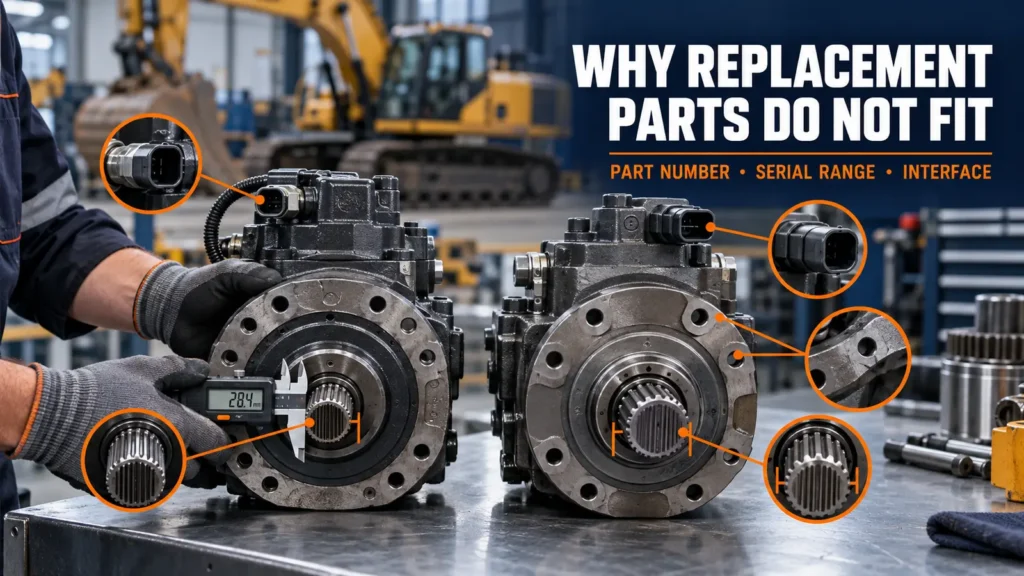
Common Reasons Excavator Replacement Parts Do Not Fit
A replacement excavator part can look correct in a catalogue, carry a familiar description and even be listed for the same machine model—yet still fail to install when it reaches the workshop.
The bolt holes may not align. A hydraulic-pump shaft may use a different spline. A sensor may have the wrong connector. A track roller may be several millimetres too wide. A seal kit may contain the correct number of pieces but use different profiles. A filter may have the right thread but the wrong gasket or filtration specification.
These problems are often described simply as “the part does not fit.” However, the actual cause may be incorrect machine information, a production change, a superseded reference, a replaced assembly or an incomplete compatibility check.
For importers, excavator parts distributors, repair companies, mining operators and equipment fleets, wrong-part orders create more than a return problem. They can cause machine downtime, installation delays, additional freight charges and lost customer confidence.
This guide explains the most common reasons excavator replacement parts do not fit and what buyers should verify before placing an order.
1. The Machine Model Is Incomplete
One of the most common enquiries received by an excavator parts supplier is:
“I need a hydraulic pump for a PC200.”
PC200 identifies a machine family, not a complete configuration. Depending on the generation, the machine may be identified as PC200-6, PC200-7, PC200-8, PC200-10 or another variant. These versions can use different engines, hydraulic systems, electrical components and mounting interfaces.
The same problem occurs with model families such as:
- CAT 320
- Hitachi ZX200
- Volvo EC210
- Hyundai R220
- Doosan DX225
- Kobelco SK200
- SANY SY215
A supplier cannot reliably confirm compatibility from the basic model family alone.
Buyers should provide:
- Equipment manufacturer
- Complete model designation
- Machine serial number
- Production year, if known
- Operating region
- Engine model
- Original component information
Instead of requesting “a filter for a CAT 320,” provide the complete model and serial information together with the filter number or photographs.
2. The Serial Number Falls on the Other Side of a Production Change
Manufacturers may modify a component during the production life of one machine model. This creates a serial-number break.
Two excavators with the same model designation can therefore require different:
- Track rollers
- Hydraulic pumps
- Control valves
- Sensors
- Engine parts
- Filters
- Seal kits
- Wiring components
The catalogue may state that one part applies “up to” a certain serial number and another applies “from” the next serial range.
If the buyer provides only the machine model, the supplier may select a part that belongs to the wrong production range.
Before ordering, photograph the complete machine nameplate. Do not type the number from memory, because one incorrect character can change the result.
Also distinguish between:
- Machine serial number
- Engine serial number
- Hydraulic-pump serial number
- Component assembly number
These numbers identify different things and should not be substituted for one another.
3. The Part Number Is Incomplete or Incorrectly Read
Excavator part numbers frequently contain:
- Dashes
- Spaces
- Letters
- Leading zeros
- Suffixes
- Revision codes
- Assembly indicators
A damaged label may make 0 look like O, 1 like I, or 5 like S. One missing digit can lead to a completely different product.
A number may also identify:
- A complete assembly
- A subcomponent
- A repair kit
- A seal kit
- A housing
- An individual internal part
For example, the number on a hydraulic-pump nameplate may identify the complete pump assembly, while the buyer actually needs the regulator, solenoid, rotating group or seal kit. Searching the complete pump number as though it were the internal-part number can produce an unsuitable replacement.
Send a clear, straight-on photograph of the entire nameplate. Include a wider photo showing where the plate is installed so the supplier can identify the component.
4. The Original Part Number Has Been Superseded
Manufacturers sometimes replace an older part number with a newer reference. This is called a supersession.
A superseded number may indicate:
- A direct replacement
- A revised design
- A replacement requiring additional hardware
- A new assembly that is not interchangeable at subcomponent level
- A change applying only to selected serial ranges
The existence of a new number does not automatically mean that every old and new component can be mixed.
For example, a revised component may require a matching connector, bracket, gear, hose or controller. Ordering only the main component may result in an installation problem.
When a supplier proposes a superseding number, ask for:
- Old reference
- New reference
- Interchangeability confirmation
- Required additional parts
- Applicable machine and serial range
- Product photographs
- Critical dimensional comparison
5. The Excavator Has Been Modified or Rebuilt
Used equipment is not always in its original configuration.
During its service life, an excavator may receive:
- A replacement engine
- A rebuilt hydraulic pump
- A different control valve
- An updated monitor
- A locally produced wiring harness
- A replacement undercarriage assembly
- A modified attachment
- A non-original filter housing
In this situation, the machine serial number identifies the original factory configuration, but the currently installed component may be different.
If the excavator has been repaired or imported as used equipment, verify both the machine nameplate and the component nameplate.
The part removed from the machine may be a more reliable reference than the original machine catalogue—provided that the removed part was functioning correctly and was not itself an incorrect previous installation.
6. The Supplier Matched by Appearance Instead of Interface
Many excavator parts look similar across models. Product appearance is useful for screening, but it is not enough to confirm fitment.
A replacement component must match the interfaces connecting it to the machine.
Depending on the product, these may include:
- Mounting-hole pattern
- Pilot diameter
- Shaft diameter
- Spline count
- Keyway size
- Flange design
- Port threads
- Port positions
- Hose connections
- Electrical connectors
- Pin layout
- Seal grooves
- Overall clearance
A hydraulic pump may look almost identical but have a different mounting flange or shaft. A track roller may have the same general shape but a different bolt-hole spacing. A sensor may share the same body while using a different connector or voltage.
“Almost the same” is not a valid fitment standard.
7. Critical Dimensions Were Not Checked
Part numbers and machine information should normally lead the matching process, but measurements provide an important additional verification layer.
This is particularly useful when:
- The number is unreadable.
- The component has been replaced previously.
- Multiple references appear in catalogues.
- The supplier proposes an aftermarket equivalent.
- The machine is an uncommon regional version.
- A physical sample is available.
Measurements for Undercarriage Parts
For track rollers, carrier rollers, idlers, sprockets and track chains, check dimensions such as:
- Overall width
- Flange diameter
- Flange spacing
- Mounting-hole distance
- Bolt-hole diameter
- Shaft or bore size
- Track pitch
- Link width
- Link height
- Shoe width
- Tooth number and tooth profile
A small dimensional difference can prevent installation or cause abnormal contact and premature wear.
Measurements for Hydraulic Components
For pumps, motors and valves, check:
- Mounting flange
- Pilot diameter
- Shaft type
- Shaft diameter
- Spline count
- Bolt pattern
- Port size
- Port position
- Rotation direction
- Control type
- Connector arrangement
Measurements for Pins and Bushings
Check:
- Pin diameter
- Pin length
- Bushing outside diameter
- Bushing inside diameter
- Bushing length
- Groove position
- Lubrication-hole position
Measurements should be taken with appropriate tools and shown clearly in photographs. A ruler placed beside a part may be suitable for an overall dimension, but precision interfaces usually require a caliper or micrometer.
8. Left-Hand and Right-Hand Versions Were Confused
Some excavator components are handed. A left-hand part may not install in the right-hand position even when the general shape and application appear correct.
Possible handed components include:
- Travel motor pipes
- Guards
- Brackets
- Doors and panels
- Wiring harnesses
- Hydraulic lines
- Track-related mounting components
- Cab components
The purchase order should state left or right from a defined viewpoint. Photographs should show the installation position.
Do not rely only on the words “left” and “right” without confirming the viewing direction used in the catalogue or workshop.
9. The Engine or Hydraulic Component Model Was Not Provided
Machine model and component model are not always interchangeable.
One excavator model may use more than one:
- Engine model
- Hydraulic-pump model
- Swing motor
- Travel motor
- Control valve
- Controller
For engine parts, provide the engine model and engine serial number whenever possible.
For hydraulic-pump parts, provide:
- Pump manufacturer
- Complete pump model
- Nameplate code
- Machine model
- Machine serial number
- Clear photos of the complete pump
- Shaft and flange information
- Regulator and solenoid photos
An internal pump part matched only by excavator model has a higher risk of error because rebuilt pumps may contain mixed or revised assemblies.
10. The Electrical Connector or Voltage Is Different
Electronic components create a particular compatibility risk because two items can appear identical from the outside.
Before ordering a sensor, solenoid, controller, switch, monitor or wiring component, verify:
- Complete part number
- Operating voltage
- Connector shape
- Number of pins
- Pin arrangement
- Keying position
- Cable length
- Mounting interface
- Software or calibration requirements
- Machine serial range
Never force a connector or modify a harness simply because the part body looks correct. A wrong electrical specification may prevent operation or damage the replacement component and machine circuit.
Close-up photographs should show both the component connector and the mating connector on the machine.
11. The Seal Kit Matches the Component Family but Not the Exact Assembly
Excavator seal kits contain small parts that can look similar while having different profiles, materials and dimensions.
A seal kit listed broadly for a machine model may not match the exact:
- Hydraulic cylinder
- Hydraulic pump
- Travel motor
- Swing motor
- Control valve
- Center joint
- Tensioner assembly
For a cylinder seal kit, identify whether it is for the boom, arm or bucket cylinder. Provide the cylinder number or measure the rod and bore when the label is missing.
For pump and motor seal kits, use the component nameplate rather than only the machine model.
Buyers should also confirm whether the kit is:
- A complete overhaul kit
- A shaft-seal kit
- A regulator seal kit
- A control-valve kit
- A partial repair kit
The number of pieces alone does not confirm compatibility.
12. An Aftermarket Cross Reference Was Treated as a Guarantee
An aftermarket cross reference indicates a possible equivalent. It is not always final proof that the part matches every version of the application.
Cross-reference databases may differ because of:
- Old catalogue information
- Broad machine-family listings
- Regional configurations
- Superseded references
- Data-entry errors
- Different performance grades
- Incomplete serial-range information
Filters are a useful example. Two filters may have the same mounting thread and similar dimensions but use different media, bypass settings, gasket locations or water-separation capabilities.
Similarly, a hydraulic replacement may fit physically while using a different control configuration.
A professional supplier should combine the cross-reference result with machine information, physical specifications and application details.
13. The Wrong Product Quality Level Was Selected
Fitment and quality are related but separate questions.
A correctly sized part can still perform poorly if its:
- Material is unsuitable
- Hardness is incorrect
- Heat treatment is inconsistent
- Seal material is unsuitable
- Filtration specification is too low
- Electrical resistance is incorrect
- Machining tolerance is uncontrolled
Likewise, a high-quality part designed for another configuration will still not fit.
Buyers should specify whether they require:
- Genuine OEM
- Recognized branded replacement
- Verified aftermarket
- Remanufactured component
- Economy replacement
- Private-label product
“Aftermarket” covers a wide range of suppliers and quality levels. Price alone should not be used to determine compatibility or expected service performance.
14. The Product Was Labeled or Packed Incorrectly
Sometimes the correct parts are produced, but the wrong label is attached or similar products are mixed during packing.
This is especially possible when a shipment contains:
- Several machine models
- Left- and right-hand parts
- Multiple seal kits
- Similar sensors
- Different voltage versions
- Several filter references
- Mixed supplier deliveries
Before shipment, the inspection should compare:
- Product
- Individual label
- Inner packaging
- Outer carton
- Packing list
- Purchase-order line
For mixed excavator spare-parts orders, assign one traceable code to each product line and use that code in the inspection photographs.
15. The Buyer and Supplier Used Different Definitions
Product terminology varies among markets, suppliers and repair technicians.
Examples include:
- Track roller versus bottom roller
- Carrier roller versus upper roller
- Final drive versus travel motor assembly
- Hydraulic pump versus pump assembly
- Center joint versus swivel joint
- Seal kit versus repair kit
- Controller versus monitor
A buyer may request a “final drive” intending to purchase the complete travel device, while the supplier quotes only the travel gearbox or motor.
A quotation should clearly state what is included. Product photographs and an itemized description reduce misunderstandings.
What to Do When a Replacement Part Does Not Fit
Do not grind, drill, weld, modify wiring or force the part into position before the mismatch is investigated. Modification can remove evidence and make return or technical review more difficult.
Follow this process:
1. Stop Installation
Avoid damaging the replacement part or the machine.
2. Photograph the Problem
Take clear photos of:
- Complete replacement part
- Original removed part
- Both parts side by side
- Product labels
- Machine nameplate
- Component nameplate
- Mounting position
- Mismatched interface
- Packaging labels
3. Record Measurements
Measure the specific location causing the problem, such as:
- Hole spacing
- Shaft diameter
- Flange diameter
- Overall width
- Pin diameter
- Connector size
- Thread dimensions
4. Preserve Packing and Labels
Do not discard the carton, bag, barcode or supplier label. They help trace the order and batch.
5. Send the Original Order Information
Provide the purchase order, quoted part number, machine data and earlier confirmation records.
6. Ask for a Technical Comparison
The supplier should compare the original and supplied components and identify whether the problem resulted from matching, labeling, production or machine modification.
Information Buyers Should Send Before Ordering
A high-quality RFQ should include as much of the following information as possible:
- Reference part number
- Excavator manufacturer
- Complete machine model
- Machine serial number
- Production year, if known
- Engine model and serial number
- Component model or nameplate
- Existing-part photographs
- Installation-position photographs
- Critical dimensions
- Required quantity
- Genuine, branded or aftermarket preference
- Delivery destination
For a multi-item enquiry, use an Excel list with one part per row. Name each photograph according to the corresponding item number or part number.
A Practical Compatibility Verification Process
A structured matching process can reduce wrong-part orders:
- Normalize the submitted part number.
- Identify whether it represents an assembly, kit or individual component.
- Confirm the complete machine model.
- Review the machine serial range.
- Check engine or component information.
- Compare original-part photographs.
- Verify critical interfaces and dimensions.
- Review any supersession.
- Confirm left/right position and configuration.
- Compare the proposed product photo.
- Record unresolved information.
- Complete pre-shipment part-number and label checks.
When information is insufficient, the supplier should request additional details rather than presenting an uncertain match as guaranteed compatibility.
How TerraParts Global Supports Parts Matching
TerraParts Global supports B2B buyers sourcing aftermarket construction equipment parts from China. Our customers include parts distributors, equipment dealers, repair companies, mining operators and fleet-service businesses.
Our matching process can review:
- Reference and OEM part numbers
- Complete machine models
- Machine serial numbers
- Engine and component nameplates
- Existing-part photographs
- Interface and connector details
- Critical dimensions
- Required quality level
- Packing and labeling requirements
Depending on the product and available information, our team can coordinate:
- Part-number cross-reference review
- Compatibility-information collection
- Supplier and product comparison
- Product-photo confirmation
- Dimensional checks
- Part-number and label inspection
- Mixed-order consolidation
- Packing verification
- International B2B shipment coordination
TerraParts is a sourcing and supply-chain partner rather than the manufacturer of every component offered. We coordinate with category-appropriate suppliers according to the product, specification, quantity and order requirements.
When compatibility cannot be established from the information supplied, we identify the missing details before the order proceeds.
Frequently Asked Questions
Can an excavator part have the correct number and still not fit?
Yes. Possible causes include serial-number changes, supersessions, modified equipment, incorrect labeling or differences within a component assembly. The number should be checked together with machine and component information.
Is the excavator model enough to order replacement parts?
Usually not. Provide the complete model, machine serial number, reference number and existing-part photographs. Engine or component nameplates may also be required.
Why do two excavators with the same model use different parts?
Manufacturers may update designs during production, use different engines or components, or build regional configurations. Serial-number ranges help identify these changes.
Can photos confirm excavator parts compatibility?
Photos are valuable but cannot confirm every internal specification. Combine photographs with part numbers, serial numbers, nameplates and measurements.
Can aftermarket excavator parts fit like OEM parts?
A properly matched and controlled aftermarket part can fit the intended application. However, aftermarket quality and catalogue accuracy vary, so the supplier must verify both compatibility and specification.
What should I measure when a track roller does not fit?
Compare mounting-hole spacing, bolt-hole diameter, overall width, flange dimensions and the relationship with the track link or frame. Also verify the machine serial number and roller position.
What should I send if the part number is unreadable?
Send the machine nameplate, component nameplate if available, complete product photographs, installation-position photos and critical measurements.
Should I modify a part that almost fits?
Do not modify it until the mismatch has been reviewed. Drilling, grinding, welding or rewiring can create safety and performance risks and may prevent a proper claim investigation.
Conclusion
Excavator replacement parts usually fail to fit because the matching process relied on incomplete information. A general machine model, one catalogue number or a visually similar photograph may not identify the exact configuration.
Reliable compatibility verification combines the part number with the complete machine model, serial number, engine or component information, interface details, dimensions and clear photographs.
If you need help identifying aftermarket excavator parts, send TerraParts Global your part-number list, machine information, nameplate photos and existing-part images. Our team can organize the matching information, coordinate supplier verification, arrange agreed pre-shipment checks and consolidate mixed construction equipment parts for international delivery.
