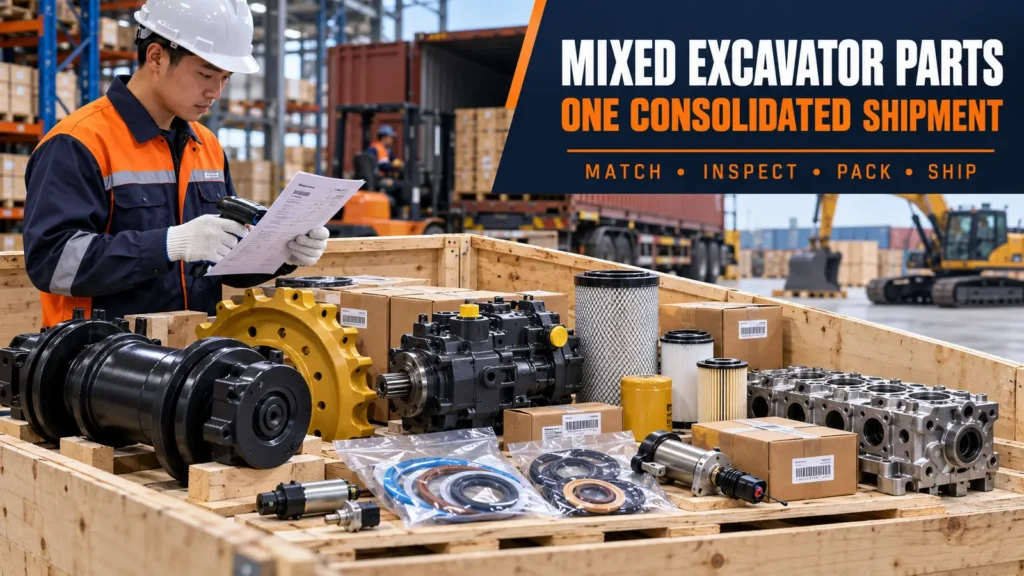
How to Consolidate Mixed Excavator Parts in One Shipment
Ordering one type of excavator part is usually straightforward. The process becomes much more complicated when a distributor, repair company or equipment dealer needs undercarriage components, filters, seal kits, hydraulic parts, engine parts and electrical components in the same purchase.
These items may come from different production sources, use different packing methods and require different verification procedures. They may also have different production lead times, minimum order quantities and shipping risks.
If each supplier sends its goods separately, the buyer may face multiple freight charges, repeated customs documents, inconsistent carton markings and limited visibility over the complete order. A properly managed consolidation project can turn these fragmented purchases into one controlled shipment.
However, consolidation should not mean simply collecting cartons in one warehouse. Effective excavator-parts consolidation requires part-number verification, supplier coordination, incoming inspection, packing control, shipment planning and complete documentation.
This guide explains how professional buyers can consolidate mixed excavator parts from China while reducing wrong-part risk, freight waste and receiving problems.
What Is Mixed Excavator Parts Consolidation?
Mixed excavator parts consolidation is the process of purchasing several types of components—sometimes from several suppliers—and combining them into one coordinated export shipment.
A typical consolidated order may include:
- Track rollers, carrier rollers, idlers and sprockets
- Oil filters, fuel filters, air filters and hydraulic filters
- Hydraulic cylinder seal kits and pump seal kits
- Hydraulic pumps, control valves and travel motors
- Engine overhaul kits, pistons, liners and gaskets
- Sensors, solenoids, controllers and wiring components
- Pins, bushings, couplings, hoses and maintenance parts
The products may be transported to a consolidation point, checked against the purchase order, repacked where necessary and prepared for one LCL or FCL shipment.
For the buyer, the objective is not only to reduce freight cost. A well-managed consolidation project should also produce:
- One consolidated packing list
- Consistent carton and pallet markings
- Clear part-number traceability
- Controlled packing quality
- Fewer destination-handling procedures
- Better visibility over shortages and discrepancies
A buyer’s consolidation service normally combines shipments from different suppliers for one consignee before export. Depending on total volume, the consolidated cargo may then move as LCL or as a dedicated FCL shipment. Ocean Freight
Why Mixed Excavator Parts Orders Are Difficult to Manage
Excavator parts are not uniform products. A small electrical sensor and a heavy track roller cannot be inspected, packed or handled in the same way.
Several complications commonly occur.
Different identification requirements
An oil filter may be identified through an OEM reference or cross-reference number. A hydraulic pump may require a complete nameplate, pump code, regulator code, mounting flange and shaft specification. A seal kit may depend on the cylinder number rather than the excavator model alone.
Using only a general machine description such as “pump for PC200 excavator” is rarely sufficient.
Different production schedules
Filters and standard undercarriage parts may be available from stock, while hydraulic assemblies or less common engine components may require production. If shipment dates are not coordinated, completed goods can remain in storage while the buyer waits for the final supplier.
Inconsistent supplier packing
One supplier may use export-grade plywood cases, while another uses thin cartons without moisture protection. Labels may contain different model descriptions, languages or internal codes.
Without repacking and unified labeling, the importer’s warehouse team may struggle to identify the products after arrival.
Different risk levels
A filter with the wrong thread size, a pump with an incompatible spline and a track roller with incorrect mounting dimensions create very different technical and financial risks.
The consolidation process must therefore include category-specific inspection instead of treating every carton as ordinary cargo.
Step 1: Build a Structured Master Parts List
The first requirement is a complete master parts list. Avoid managing a mixed order through scattered WhatsApp messages, photographs and separate supplier quotations.
Create one spreadsheet with a separate line for every requested item.
Recommended fields include:
| Field | Information required |
|---|---|
| Buyer item number | Buyer’s internal SKU or reference |
| Part description | Standard English product name |
| OEM/reference number | Complete number, including prefixes and suffixes |
| Machine brand | Equipment manufacturer |
| Machine model | Full model designation |
| Serial number | Machine serial number or applicable range |
| Component number | Pump, engine, cylinder or valve number |
| Required quantity | Order quantity for each item |
| Supplier | Selected production source |
| Verification status | Confirmed, pending or insufficient information |
| Packing requirement | Carton, pallet or plywood case |
| Inspection requirement | Visual, dimensional, functional or documentation check |
| Target completion date | Required warehouse delivery date |
This master list becomes the control document for quotation, purchasing, inspection, packing and export documentation.
If one item cannot be positively identified, mark it as pending instead of allowing it to enter production based on an assumption.
Step 2: Verify Compatibility Before Purchasing
Consolidation cannot solve a compatibility error that began during quotation. Every high-risk part should be verified before the order is placed.
The information required depends on the product category.
Undercarriage parts
For track rollers, idlers, sprockets and track chains, confirm:
- Machine model
- Machine serial number
- Part number
- Mounting dimensions
- Bolt-hole spacing
- Track-chain pitch
- Number of teeth or links
- Photographs of the existing component
A model name alone may cover several undercarriage configurations.
Filters
For excavator filters, confirm:
- OEM filter number
- Cross-reference number
- Thread size
- Outer and inner diameter
- Overall height
- Gasket dimensions
- Filtration application
- Photograph of the existing label
A filter may look correct but still have the wrong thread, seal diameter or bypass specification.
Seal kits
For hydraulic seal kits, collect:
- Machine model
- Cylinder or hydraulic component number
- Seal-kit reference
- Rod diameter
- Bore diameter
- Existing seal photographs
- Application position
“Boom cylinder seal kit” is not a complete identification because the same machine series may use different cylinder suppliers.
Hydraulic parts
For hydraulic pumps, motors and control valves, confirm:
- Complete nameplate
- Pump or motor model code
- Regulator code
- Mounting flange
- Shaft type and spline count
- Port position
- Connector type
- Rotation direction
- Machine model and serial number
High-value hydraulic parts should never be selected from appearance alone.
Engine and electrical parts
Engine components may require the engine model, arrangement number and component reference. Electrical parts may also require voltage, connector shape, pin arrangement and controller number.
TerraParts Global uses the available part number, machine information, nameplate details, dimensions and photographs to create a verification record before the order is released.
Step 3: Select Suppliers by Product Capability
The lowest quotation is not always the best source for a consolidated order.
A supplier should be evaluated according to the specific product category, quality level, technical response and delivery reliability.
Important questions include:
- Does the supplier specialize in this category?
- Can it verify the reference number and application?
- Can it provide dimensions or specification drawings?
- Is the quoted product OEM, genuine or aftermarket?
- Can it maintain consistent quality for repeat orders?
- Can it follow the requested labels and packing?
- Can it deliver to the consolidation point on schedule?
- Will it support inspection before final acceptance?
A trading and supply-chain partner can be valuable because a mixed order rarely fits the capability of one factory. One source may be strong in undercarriage parts, while another is better suited to hydraulic seals or filtration products.
The purpose of supplier coordination is not to claim that every component comes from one factory. It is to select an appropriate source for each product while giving the buyer one controlled project interface.
Step 4: Set One Consolidation Schedule
A mixed order needs a common shipment schedule.
The buyer or project coordinator should create a timeline covering:
- Technical confirmation
- Purchase-order release
- Production or stock preparation
- Supplier self-inspection
- Delivery to the consolidation point
- Incoming quantity check
- Product inspection
- Repacking and labeling
- Final packing-list preparation
- Booking and container loading
Do not book freight based only on the earliest supplier’s completion date. Confirm the readiness of every critical item first.
A practical schedule should also include buffer time for:
- Replacing rejected parts
- Correcting carton labels
- Receiving missing quantities
- Preparing wooden cases
- Export fumigation requirements
- Revising shipping documents
- Waiting for the buyer’s inspection approval
For urgent maintenance items, consider sending a small critical batch by air while the remaining products move by sea. Consolidation should improve cost efficiency without extending equipment downtime unnecessarily.
Step 5: Control Incoming Goods at the Consolidation Point
When products arrive, warehouse receiving should not be limited to counting cartons.
Each delivery should be checked against the supplier purchase order and the master parts list.
The receiving team should record:
- Supplier name
- Delivery date
- Number of cartons or cases
- Product reference
- Quantity received
- Carton condition
- Packing condition
- Visible damage
- Missing labels
- Inspection status
- Photographic evidence
Products from different suppliers should remain separated until the item numbers and quantities have been confirmed.
A common mistake is mixing unverified cartons immediately after arrival. Once original supplier labels are removed or cartons are combined, tracing a discrepancy back to the responsible source becomes more difficult.
Step 6: Inspect Parts According to Their Risk
Not every product requires the same inspection level. The inspection plan should consider value, compatibility risk, failure consequence and order history.
Basic checks for all categories
- Product name and part number
- Quantity
- Visual condition
- Surface finish
- Label accuracy
- Packing condition
- Obvious dimensional differences
- Country-of-origin and brand requirements, where applicable
Dimensional inspection
Dimensions should be checked for parts where fitment depends on interfaces, such as:
- Bolt-hole spacing
- Shaft diameter
- Spline count
- Flange diameter
- Port dimensions
- Thread size
- Overall length
- Seal diameter
- Mounting width
Functional or application-specific inspection
Depending on the product, additional checks may include:
- Connector and pin-layout comparison
- Solenoid resistance or voltage marking
- Hydraulic-port configuration
- Roller rotation
- Filter thread and gasket fit
- Seal material and profile
- Hose-end configuration
- Packaging moisture protection
TerraParts Global can coordinate inspection according to the product category and the buyer’s specification. Inspection records may include part-number photographs, dimension photographs, packing images and discrepancy reports.
The goal is not to issue a generic “passed” statement. The buyer should be able to see what was checked and which reference was used.
Step 7: Standardize Labels and Traceability
A consolidated shipment should use one labeling system even when the products came from different sources.
Each carton or case should ideally show:
- Buyer name or consignee code
- Purchase-order number
- Buyer SKU
- Product description
- Part number
- Machine model, if required
- Quantity
- Carton number
- Gross and net weight
- Country of origin
- Handling marks
For mixed cartons, include an inner packing list showing every item inside.
If the importer supplies products to dealers or service branches, barcode or QR-code labels can also be added according to the buyer’s warehouse system.
The label should use the buyer’s confirmed item description. Avoid allowing six suppliers to create six different names for the same type of component.
Step 8: Repack for Mixed Industrial Cargo
Excavator parts vary greatly in weight, shape and sensitivity. Good consolidation packing protects the products and prevents one category from damaging another.
Heavy metal components
Track rollers, sprockets, idlers and heavy hydraulic assemblies may require:
- Reinforced plywood cases
- Strong pallets
- Load-bearing internal supports
- Anti-rust protection
- Plastic wrapping
- Separation between metal surfaces
- Secure strapping
Filters and seal kits
Filters and seals should be protected from:
- Crushing
- Water
- Dust
- Oil contamination
- Direct contact with sharp metal parts
- Excessive heat or sunlight
They should not be placed underneath heavy undercarriage components.
Hydraulic and electrical parts
Hydraulic openings should be capped or sealed. Electrical connectors require protection against impact, moisture and deformation.
Sensitive components should be packed in separate inner cartons before being placed into the export case.
Before closing each case, take photographs showing the products, labels, internal protection and final packing condition.
Step 9: Decide Between LCL and FCL
The correct shipping method depends on total volume, weight, cargo value, urgency and destination conditions.
LCL shipment
Less-than-container-load shipping may be suitable when:
- The total order does not fill a container
- The buyer needs regular smaller replenishment
- Inventory turnover is more important than maximum freight efficiency
- The cargo is adequately protected for additional handling
LCL cargo may pass through more handling points, so strong cases and moisture protection are important.
FCL shipment
A full-container-load shipment may be preferable when:
- The combined cargo volume approaches container capacity
- The order includes heavy undercarriage parts
- The buyer wants fewer handling points
- Products require controlled loading positions
- Several supplier orders can fill one container
- Damage risk justifies a dedicated container
The project should compare total landed cost, not only ocean freight. Destination handling, warehouse fees, customs clearance, documentation and damage exposure also affect the final result.
Step 10: Prepare One Consistent Document Package
A consolidated shipment needs consistent commercial and packing documents.
The document package may include:
- Commercial invoice
- Consolidated packing list
- Bill of lading instructions
- Certificate of origin, when required
- Product inspection report
- Packing photographs
- Insurance documents
- Fumigation or wood-packing documents
- Product declarations requested by the destination
- Separate supplier supporting documents where necessary
The commercial invoice, packing list, carton labels and freight booking should use matching quantities, weights and product descriptions.
Before shipment, compare:
- Total quantity by item
- Total number of packages
- Gross and net weight
- Total volume
- Shipping marks
- Consignee information
- HS-code descriptions
- Declared values
- Port and destination details
Customs classification and import requirements should be confirmed with the buyer’s customs broker because requirements vary by destination and product.
Common Mistakes When Consolidating Excavator Parts
Mixing unverified parts
Consolidating the wrong component does not reduce risk. It only makes the wrong part travel together with the correct parts.
Choosing every supplier by price
Different suppliers may offer different materials, service life and quality-control levels under the same part number.
Ignoring serial-number differences
One excavator model can use more than one pump, roller, controller, seal kit or filter configuration.
Allowing inconsistent packing
Weak cartons, missing rust protection and mixed labeling can create damage and warehouse confusion.
Booking freight too early
A delayed supplier can force the buyer to choose between postponing the entire shipment and shipping incomplete cargo.
No final packing audit
The final packing list should be checked against the physical cargo after consolidation—not copied from separate supplier documents without verification.
How TerraParts Global Supports Mixed Parts Orders
TerraParts Global supports B2B buyers that need several excavator-parts categories within one coordinated sourcing project.
Our role is to help organize the technical and supply-chain information required for a controlled order.
Services can include:
- Reviewing RFQ lists and incomplete product descriptions
- Part-number and application matching
- Coordinating multiple product sources
- Comparing dimensions, nameplates and interface details
- Monitoring production and delivery schedules
- Receiving mixed products at a consolidation point
- Checking quantities and packaging
- Coordinating category-specific inspection
- Standardizing labels and carton markings
- Repacking according to cargo type
- Preparing one consolidated packing list
- Coordinating air, LCL or FCL shipment
- Providing loading and inspection photographs
We are positioned as a construction-equipment parts sourcing and supply-chain partner, not as the manufacturer of every component. This allows us to evaluate different product sources and coordinate mixed requirements for distributors, repair networks, mining companies, equipment dealers and fleet operators.
Information to Send for a Consolidated Quotation
To prepare an accurate quotation, send as much of the following information as possible:
- Parts list in Excel format
- OEM or reference part numbers
- Machine brands and models
- Machine serial numbers
- Engine, pump, valve or cylinder numbers
- Nameplate photographs
- Existing-part photographs
- Required quantities
- Quality preference
- Target delivery date
- Destination country and port
- Packing and labeling requirements
- Preferred shipping method
- Inspection requirements
For uncertain references, mark the item clearly and provide additional photographs or measurements. It is safer to delay one uncertain item than to ship an incompatible component.
Frequently Asked Questions
Can different excavator parts be shipped in one container?
Yes. Undercarriage, filtration, hydraulic, engine, seal and electrical parts can be combined in one shipment when packing, weight distribution, labeling and documentation are properly managed.
Can parts from several Chinese suppliers be consolidated?
Yes. The products can be collected at one consolidation point, checked, repacked and prepared under one coordinated shipment plan.
Is LCL suitable for heavy excavator parts?
LCL can be used for smaller orders, but heavy components require strong pallets or plywood cases because consolidated cargo may experience additional handling.
How do I avoid receiving the wrong excavator parts?
Provide complete part numbers, machine models, serial numbers, component nameplates, dimensions and photographs. High-risk parts should be verified before purchasing and checked again before shipment.
Can you consolidate genuine, OEM and aftermarket parts?
Different product levels can be included, but every item should be clearly identified in the quotation and packing documents. The buyer should approve the required quality level before the order is released.
Can you add our company labels?
Buyer-specific SKU labels, carton marks and barcode information can be coordinated according to the confirmed labeling file and packing requirements.
What happens if one supplier is late?
The buyer can decide whether to wait, replace the source, remove the delayed item or ship the urgent cargo separately. A schedule buffer should be included before freight booking.
Conclusion
Consolidating mixed excavator parts into one shipment can simplify purchasing and reduce repeated freight, documentation and destination-handling work. But the value comes from control—not merely from placing different cartons in the same container.
A successful consolidation project requires a structured master list, accurate compatibility verification, specialized suppliers, coordinated delivery dates, incoming inspection, consistent labeling, category-appropriate packing and complete shipping documents.
For distributors and equipment service companies purchasing mixed parts from China, an experienced coordination partner can reduce communication gaps and provide one clear project interface.
If you need to source undercarriage parts, filters, seal kits, hydraulic parts, engine components or electrical parts in one order, send TerraParts Global your parts list, reference numbers, machine information and destination details.
