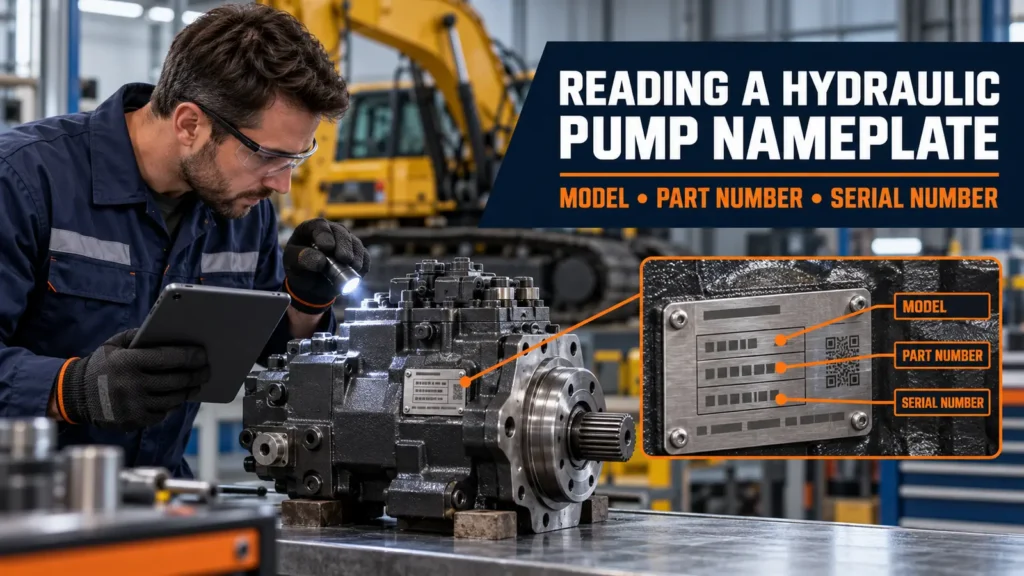
How to Read an Excavator Hydraulic Pump Nameplate
An excavator hydraulic pump nameplate may contain only a few lines of letters and numbers, but those details can determine whether a replacement pump fits the machine, connects correctly and works with the original hydraulic control system.
For equipment dealers, repair companies and excavator parts distributors, the nameplate is one of the most important sources of information when requesting a hydraulic pump quotation.
However, reading the nameplate is not always straightforward.
A plate may show a pump-manufacturer model code, an OEM part number, a serial number, a production code and other specifications. Additional numbers may also appear on the pump housing, regulator, pilot pump or solenoid. These numbers do not all identify the complete hydraulic pump.
Selecting a replacement pump from one incomplete number—or from the excavator model alone—can result in the wrong shaft, mounting flange, regulator, port arrangement or control configuration.
This guide explains how to read an excavator hydraulic pump nameplate, distinguish the different numbers and prepare the information a supplier needs to verify a replacement pump.
Why the Hydraulic Pump Nameplate Matters
The main hydraulic pump converts engine power into hydraulic flow for the excavator’s boom, arm, bucket, swing and travel functions.
A pump that looks similar to the original unit may still be incompatible internally or externally.
Possible differences include:
- Pump displacement
- Rotation direction
- Input-shaft diameter
- Spline count
- Mounting flange
- Main-port size
- Main-port position
- Pilot-pump arrangement
- Regulator type
- Solenoid voltage
- Sensor configuration
- Hydraulic control system
- Pressure or flow settings
The pump nameplate helps narrow the identification to the correct pump family and configuration.
Official hydraulic-component catalog systems may allow searches using a known product or material number, type code or technical characteristics. Bosch Rexroth, for example, explains that its type codes can distinguish characteristics such as series, size, rotation direction, drive shaft, front cover, line connection and sealing arrangement. boschrexroth.com
The nameplate should therefore be treated as technical identification data—not as a simple product label.
Where to Find the Nameplate
The nameplate is normally attached to the side, rear housing or regulator area of the pump.
Depending on the pump manufacturer and machine installation, it may be:
- A metal plate fixed with rivets
- A laser-marked metal label
- A printed adhesive label
- A stamped section of the pump housing
- A plate partially hidden behind hoses or covers
Before searching for the plate:
- Park the excavator safely.
- Lower the attachment.
- Stop the engine.
- Release stored hydraulic pressure according to the service procedure.
- Allow hot components to cool.
- Clean oil and dirt carefully from the pump surface.
Do not use aggressive grinding or scraping tools on the plate. These can remove shallow characters and make identification more difficult.
If access is limited, use a phone camera with a light, inspection mirror or flexible camera to capture the plate without removing hydraulic components unnecessarily.
What Information Is Usually Printed on the Nameplate?
The exact layout varies between manufacturers, but a hydraulic pump nameplate may include the following information.
| Nameplate field | What it may identify |
|---|---|
| Manufacturer | Original pump manufacturer |
| Model or type | Pump family and configuration |
| Part number | Manufacturer or OEM product reference |
| Serial number | Individual production or traceability number |
| Specification number | Detailed build specification |
| Production code | Date, batch or factory information |
| Displacement | Pump capacity, often shown in cc/rev |
| Rotation | Clockwise or counterclockwise |
| Pressure rating | Applicable pressure specification |
| Speed rating | Permitted operating-speed information |
Not every plate contains every field. Some information may be encoded inside the complete model code rather than printed separately.
The most important rule is:
Record every character exactly as it appears, including letters, zeros, dashes, slashes, spaces and suffixes.
Do not shorten the model code because the final letters or numbers may identify the regulator, shaft, rotation, porting or machine application.
Pump Model Code vs OEM Part Number
A common source of confusion is the difference between a pump-manufacturer model code and an equipment-manufacturer part number.
Pump-manufacturer model code
This identifies the hydraulic pump according to the pump manufacturer’s system.
Examples of broad pump-family formats include:
K3V...
K5V...
K7V...
HPV...
A10V...
A8V...
AP2D...
PSVD...
PVD...
These examples represent pump families, not complete replacement specifications.
A code such as K3V112 may indicate a general pump family and nominal size, but the complete nameplate code may contain additional characters defining the exact configuration.
OEM equipment part number
The excavator manufacturer may assign its own part number to the complete pump assembly used on a particular machine.
This number may appear in:
- The excavator parts catalog
- Dealer records
- Previous invoices
- Service documentation
- The pump label
- The machine owner’s parts database
The OEM part number and pump-manufacturer code may refer to the same installed assembly but belong to different catalog systems.
For accurate matching, send both numbers whenever possible.
Model Number vs Serial Number
The model number normally identifies the pump series and technical configuration.
The serial number usually identifies an individual unit or production record. Depending on the manufacturer, it may help confirm:
- Production period
- Manufacturing location
- Specification revision
- Original build information
- Warranty or service history
Do not use the serial number as though it were the replacement-pump model.
If the plate contains several lines and the labels are unclear, photograph the entire plate instead of sending only one number. The supplier may need the relative position of the numbers to determine which is the model, product number or serial number.
Manufacturers commonly use model and serial information as the basis for technical support and product identification. boschrexroth.com
Why the Complete Model Suffix Is Important
A buyer may request a quotation using only a familiar pump-family code, such as:
K3V112That information can help identify a pump family, but it may not identify the exact unit installed on the excavator.
The complete suffix may distinguish:
- Single or tandem-pump configuration
- Control system
- Regulator arrangement
- Input shaft
- Mounting flange
- Port orientation
- Rotation direction
- Pilot-pump installation
- Pressure specification
- Machine application
Two pumps from the same family may share a similar housing but use different regulators or internal settings.
Therefore, do not type only the first part of the code into an RFQ if the full code is visible.
For example:
Incomplete: K3V112
Better: complete model code exactly as printed
A single missing letter can change the configuration.
Do Not Confuse a Casting Number with a Pump Part Number
Numbers cast into the pump housing are often easy to see. This makes buyers assume that the largest visible number must be the pump part number.
In many cases, it is only a:
- Housing number
- Casting number
- Cover number
- Internal component reference
- Production tooling reference
The same housing can sometimes be used across several pump configurations.
A casting number is useful supporting evidence, especially when the nameplate is damaged, but it normally should not be used alone to order a complete replacement pump.
Send it together with:
- Pump nameplate
- Excavator model
- Machine serial number
- Complete pump photographs
- Shaft details
- Flange and port configuration
Regulator and Solenoid Numbers Are Not Main Pump Numbers
The pump regulator, pilot pump, sensor and solenoid may each have their own label or stamped number.
These references identify the attached component—not necessarily the complete main hydraulic pump.
This distinction matters when the buyer needs:
- A complete hydraulic pump
- A pump assembly without a regulator
- A replacement regulator
- A solenoid valve
- A pilot pump
- A rotating group
- Internal repair parts
Before sending an RFQ, clearly state which product is required.
For example:
Required part: Complete main hydraulic pumpor:
Required part: Hydraulic pump regulator onlyThen label each photograph:
Photo 1 – Main pump nameplate
Photo 2 – Regulator number
Photo 3 – Solenoid connector
This prevents the regulator number from being mistakenly quoted as the complete pump reference.
How to Photograph a Hydraulic Pump Nameplate
A clear photograph often saves several rounds of communication.
Use the following process.
1. Clean the plate
Remove oil and loose dirt with a suitable cloth and cleaner. Do not damage the printed or engraved characters.
2. Photograph it straight on
Avoid taking the photo from a sharp angle. Perspective distortion can make characters difficult to read.
3. Control glare
Metal plates often reflect workshop lighting or phone flashes.
Try:
- Turning off the direct flash
- Using light from the side
- Moving the camera slightly
- Shading the plate with your hand
- Taking photographs from two lighting angles
4. Keep the original resolution
Messaging applications can compress images. Where possible, send the original file by email, cloud link or as a document attachment.
5. Include context
Take one photograph showing where the nameplate is located on the pump and another close-up of the text.
6. Type the visible code
Along with the photograph, type every visible character in the message.
For example:
Visible pump code: K3V112DT-XXXX
Unclear character: position 8 may be B or 8
Do not guess silently. Mark uncertain characters so the supplier knows which part requires further checking.
Six Photographs to Send with a Pump RFQ
For efficient hydraulic pump identification, provide:
- Full pump from the drive-shaft side
- Full pump from the rear
- Left side showing the regulator and ports
- Right side showing attached components
- Full nameplate and close-up nameplate
- Excavator machine identification plate
Additional useful photographs include:
- Input shaft and splines
- Mounting flange
- Main suction and delivery ports
- Pilot-pump position
- Regulator label
- Solenoid connectors
- Sensors
- Hose arrangement before removal
Take the photographs before disassembling or returning the old pump. Once fittings and attached components are removed, important application evidence may be lost.
Match the Pump Nameplate with the Machine Plate
The pump nameplate should not be checked in isolation.
Also record the excavator’s:
- Brand
- Complete model
- Machine serial number or PIN
- Production year, if known
- Engine model, when relevant
- Market or country version
- Modification history
Two excavators with the same model designation may use different pumps across production periods or serial-number ranges.
This can happen because of changes in:
- Hydraulic control design
- Pump supplier
- Regulator specification
- Engine emissions configuration
- Regional machine version
- Factory production revision
The correct process is:
Machine model and serial number
                +
Complete pump nameplate
                +
Physical pump configuration
                =
Stronger replacement-pump verification
A parts catalog reference is useful, but the pump physically installed on an older machine may already have been replaced or converted.
Physical Details to Confirm After Reading the Plate
Even with a readable nameplate, compare the physical configuration before approving an aftermarket or replacement pump.
Input shaft
Check:
- Shaft type
- Diameter
- Spline count
- Exposed length
- Keyway, if applicable
Mounting flange
Check:
- Flange shape
- Pilot diameter
- Bolt quantity
- Bolt-hole spacing
- Mounting depth
Hydraulic ports
Check:
- Number of ports
- Port thread or flange type
- Port diameter
- Port direction
- Relative port positions
Regulator configuration
Check:
- Number of regulators
- Regulator position
- Mechanical or electronic control
- Solenoid quantity
- Connector shape
- Voltage marking
Pilot pump and sensors
Check:
- Pilot-pump position
- Drive arrangement
- Sensor quantity
- Pressure-port arrangement
- Electrical connector layout
Rotation direction
Rotation must be confirmed according to the manufacturer’s viewing convention, normally from a specified shaft end. Do not assume rotation based only on the pump’s visual appearance.
Common Nameplate Reading Mistakes
Mistake 1: Ordering from the excavator model only
A machine model is a starting point, not final confirmation.
Mistake 2: Sending only the pump-family code
A broad code may not contain the suffix needed to identify the exact control and mounting configuration.
Mistake 3: Using a casting number as the complete part number
Housing numbers may appear across multiple assemblies.
Mistake 4: Sending a regulator number instead of the pump number
The regulator is only one component of the main pump.
Mistake 5: Ignoring letters and suffixes
Letters, dashes and final digits may contain essential configuration information.
Mistake 6: Sending one blurred image
Glare, oil and image compression can hide one critical character.
Mistake 7: Ignoring the machine serial number
The same machine series may use different pumps during different production periods.
Mistake 8: Assuming a visually identical pump will fit
Internal control, pressure settings, regulator design and shaft configuration may differ.
What If the Nameplate Is Missing or Damaged?
A missing plate does not always make identification impossible, but additional evidence is required.
Provide:
- Excavator brand and complete model
- Machine serial number
- OEM parts-catalog reference
- Previous purchase records
- Complete pump photographs
- Casting numbers
- Regulator and pilot-pump numbers
- Shaft measurements
- Spline count
- Mounting-flange dimensions
- Port sizes and positions
- Connector photographs
- Rotation direction
- Hydraulic-system history
If characters are faint:
- Clean the plate carefully.
- Use light from different angles.
- Take several macro photographs.
- Increase contrast without altering the characters.
- Copy every readable section.
- Mark missing characters with question marks.
Example:
K3V112DT-1?R9Do not invent the missing character. A false complete code can be more misleading than an honestly incomplete code.
Information to Include in an Excavator Pump RFQ
Use the following template:
Machine brand:
Machine model:
Machine serial number/PIN:
Production year, if known:

Required product:
Complete pump / Regulator / Pilot pump / Internal parts

OEM pump part number:
Pump manufacturer:
Complete pump model code:
Serial or specification number:
All visible nameplate text:

Input shaft:
Spline count:
Mounting flange:
Main-port configuration:
Regulator configuration:
Solenoid voltage:
Rotation direction:

Condition required:
New aftermarket / Genuine / Remanufactured

Required quantity:
Destination country:
Required delivery date:

Attached photographs:
Pump nameplate / Machine plate / Complete pump /
Shaft / Ports / Regulator / Connectors
Providing this information in the first inquiry helps reduce repeated questions and makes discrepancies visible before quotation and shipment.
How TerraParts Global Supports Hydraulic Pump Matching
TerraParts Global supports distributors, equipment dealers, repair networks, mining companies and fleet operators sourcing excavator hydraulic parts from China.
Our verification process can include:
- Reviewing the pump nameplate
- Separating the pump code from casting and regulator numbers
- Checking the excavator model and serial-number range
- Comparing OEM and aftermarket references
- Reviewing shaft and mounting-flange details
- Comparing port and regulator positions
- Confirming sensors, solenoids and connectors
- Coordinating product photographs before shipment
- Checking packing and identification labels
- Consolidating hydraulic parts with other excavator components
We are a construction-equipment parts sourcing and supply-chain partner. We do not claim that every product is manufactured in one factory.
For mixed orders, we can coordinate hydraulic pumps, regulators, seal kits, filters, undercarriage parts, engine parts and electrical components through a single project workflow.
Final compatibility depends on the accuracy and completeness of the buyer’s machine information, nameplate details and photographs. When information conflicts, the discrepancy should be resolved before the order is approved.
Frequently Asked Questions
Can I identify an excavator hydraulic pump from the nameplate alone?
A complete, readable model code may identify a strong candidate, but final confirmation should also include the excavator model, machine serial number and physical configuration.
Which number is the hydraulic pump part number?
It may be an OEM equipment part number or a pump-manufacturer product number. Send the entire nameplate so the supplier can distinguish the model, product, serial and specification fields.
Is the number cast into the housing the pump model?
Usually it is a casting or housing reference. It should not normally be used alone to order a complete pump.
Why does the pump-code suffix matter?
The suffix may identify the regulator, control system, shaft, flange, port arrangement, rotation or machine application.
Can two identical excavator models use different pumps?
Yes. Production changes, serial-number ranges, regional versions and previous repairs can result in different installed pump configurations.
What if the nameplate is unreadable?
Send the machine model and serial number, parts-catalog reference, complete pump photographs, casting numbers, shaft measurements, flange pattern, regulator arrangement and port layout.
Should I send the machine identification plate too?
Yes. The machine plate confirms the complete excavator model and serial number, which helps identify production-range differences.
What is the fastest way to obtain an accurate quotation?
Send the machine model, serial number, complete pump nameplate, required quantity and six clear pump photographs in the first inquiry.
Final Recommendation
Reading an excavator hydraulic pump nameplate is not simply a matter of copying the largest visible number.
A reliable identification process separates:
- Pump model code
- OEM part number
- Serial number
- Production or specification number
- Casting number
- Regulator number
- Pilot-pump number
The information should then be checked against the excavator model, machine serial number and physical pump configuration.
The safest purchasing rule is:
Use the nameplate to begin identification, then use the machine data and physical interfaces to confirm compatibility.
If you need an excavator hydraulic pump, regulator or related hydraulic component, send TerraParts Global the complete nameplate, machine information, quantity and product photographs.
