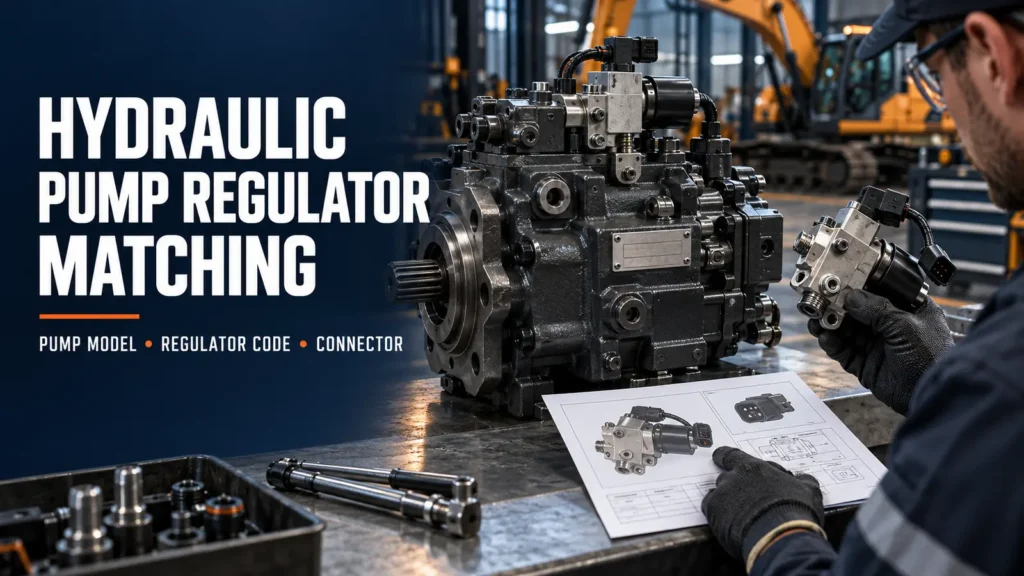
How to Match an Excavator Hydraulic Pump Regulator
An excavator hydraulic pump regulator may look like a relatively small assembly, but it has a major influence on how the main pump responds to load, engine power and operator input. When the wrong regulator is installed, the bolt pattern may appear correct while the machine still suffers from low power, slow functions, engine stalling, unstable pressure or overheating.
For that reason, professional buyers should not order a regulator only by appearance or excavator model. The correct replacement must be matched to the exact hydraulic pump, control strategy and machine configuration.
This guide explains how distributors, repair workshops, fleet owners and importers can identify and match an excavator hydraulic pump regulator before placing an order. It also shows what information a supplier needs to verify compatibility and reduce the risk of receiving the wrong part.
What Is an Excavator Hydraulic Pump Regulator?
The hydraulic pump regulator—also called a pump controller, pump control valve, compensator or control assembly—controls the displacement of a variable-displacement hydraulic pump. In practical terms, it tells the pump how much oil to deliver under changing operating conditions.
Depending on the machine and pump design, the regulator may respond to:
- Pilot pressure
- Main system pressure
- Engine speed or engine load
- Negative-flow or positive-flow control pressure
- Load-sensing signals
- Electrical current from the machine controller
- Power-shift or torque-control signals
These functions are not interchangeable. A regulator designed for one control system may physically mount to a similar pump but produce completely different machine behavior. Modern pump-control systems can regulate flow, pressure, torque and displacement through hydraulic or electrohydraulic signals, so the control specification is as important as the housing dimensions.
Why Regulator Matching Is More Difficult Than Visual Comparison
Many hydraulic pump regulator replacement errors begin with a photo search. A buyer sees a unit that looks similar, compares the mounting holes and assumes it will fit. That approach is risky because regulators in the same external housing can have different internal spools, springs, pressure settings, solenoids, connectors or calibration ranges.
Common differences include:
- Left-hand versus right-hand pump position
- Front-pump versus rear-pump regulator
- Positive-flow, negative-flow or load-sensing control
- Hydraulic-only versus electrohydraulic control
- Different solenoid voltage or resistance
- Different connector shape and pin layout
- Different lever, feedback link or adjustment-screw position
- Different pilot-port size and orientation
- Different pressure or horsepower-control setting
- Different pump series or displacement
This explains why an “almost identical” excavator pump controller can bolt onto the pump but still fail in operation.
The Five Identifiers Needed for Accurate Matching
The safest matching process uses several identifiers together. No single data point should be treated as conclusive unless it resolves to a verified manufacturer reference.
1. Complete Hydraulic Pump Model
Start with the main hydraulic pump nameplate. Record the entire model code exactly as shown, including all letters, numbers, slashes, hyphens and suffixes.
A partial pump family—such as K3V, K5V, HPV or A8V—is usually not enough. One pump family may include multiple displacements, shaft arrangements and control options. The suffix can identify a variation that changes the required regulator.
Good RFQ information:
Main pump model: K3V112DT-1XER-9N24-2V
Weak RFQ information:
Pump: K3V112
If the nameplate is dirty, photograph it before cleaning and again after gentle cleaning. Do not polish away stamped characters.
2. Regulator or Controller Part Number
Inspect the regulator body for a label, metal plate, ink marking, laser code or stamped number. Record every visible number, but distinguish between a true part number and a casting number.
A useful regulator identification photo should show:
- Full code in one sharp image
- Close-up of each stamped or printed line
- Manufacturer marking, if present
- Any revision letter or suffix
- Number on the solenoid or proportional valve
Casting numbers often identify only a housing. The same casting may be machined and assembled into several regulator versions. Therefore, a casting code by itself should be treated as supporting evidence—not final proof of compatibility.
3. Excavator Make, Model and Serial Number
Provide the complete machine identity:
- Equipment manufacturer
- Full model designation
- Machine serial number or PIN
- Approximate production year, if known
- Machine market or destination region
Do not assume all excavators with the same model name use the same hydraulic pump. Manufacturers may change pump suppliers or control specifications during a production run. Machines built for different markets may also have different emissions systems, engines or electronic controls.
The serial number helps determine the production range and should always be included in an excavator hydraulic pump regulator RFQ.
4. Regulator Photos and Physical Details
Photos are not a substitute for part numbers, but they are essential for confirming configuration. Send clear, well-lit photographs of:
- The complete main pump installed on the machine
- The pump nameplate
- The complete regulator from the top
- The regulator from both sides
- Mounting face and bolt-hole layout
- Pilot ports, hoses and fittings
- Solenoid label, connector and wire count
- Feedback lever or linkage position
Place a ruler beside the part when dimensions are requested. Avoid screenshots from messaging apps, which may compress the image and hide small characters.
5. Control Type and Electrical Specification
If the regulator contains a solenoid, buyers should confirm more than the plug shape. Record:
- Solenoid part number
- Rated voltage
- Coil resistance, when safely measurable
- Number of pins
- Connector keying and locking style
- Wire colors and harness arrangement
- Position of each solenoid on the regulator
Two connectors may look similar while using different pin assignments or control ranges. Connecting an incompatible coil can create fault codes, poor pump response or electrical damage.
Step-by-Step Hydraulic Pump Regulator Matching Process
Step 1: Identify the Exact Pump Assembly
Use the pump nameplate to establish the pump manufacturer, full model code and serial or production number. If the plate is missing, collect casting codes, port layout, shaft information and complete pump photographs.
The regulator should be matched to the pump first, then cross-checked against the machine. Searching only by excavator model can return multiple possible regulators.
Step 2: Record Every Number on the Existing Regulator
Make a written list rather than relying on one photograph. Note where each number appears: label, housing, solenoid, plug or cover. This helps the supplier decide which codes are meaningful.
Do not remove or adjust the regulator before recording its installed position. Photograph hose locations, shims, levers and adjustment screws so the workshop has a reference during installation.
Step 3: Determine the Pump-Control Method
Ask the technician how the machine controls pump output. The workshop manual or hydraulic schematic may describe the system as negative-flow control, positive-flow control, load sensing, constant-power control, pressure compensation or electronic power control.
This step matters because a regulator is a functional control component, not merely a mechanical cover. Official mobile-hydraulics documentation shows that variable pumps may be controlled for displacement, pressure, torque or flow, and those modes can be implemented hydraulically or electronically.
Step 4: Compare the Mechanical Interface
Verify:
- Mounting-hole count and center distance
- Dowel-pin position
- Mounting-face outline
- Feedback lever orientation
- Shaft or spool engagement
- Oil-port size, thread and position
- Overall height and interference points
A correct mounting pattern is necessary, but it does not prove the regulator is correctly calibrated for the pump.
Step 5: Compare Solenoids and Connectors
Match the label codes first, then verify plug shape, voltage, pin count and orientation. If a replacement regulator is supplied without solenoids, confirm whether the original solenoids can be transferred and whether their settings are compatible.
Step 6: Verify Supersessions and Alternative Numbers
Hydraulic pump parts may be listed under an original number, a revised number, an assembly number or a supplier cross-reference. Ask for written confirmation that the proposed number replaces or corresponds to the original reference.
The buyer should retain both numbers on the purchase order:
Requested reference: [original number]
Offered reference: [supplier number]
Compatibility confirmed for: [pump model + machine serial]
This creates a clearer approval trail for distributors and purchasing teams.
Step 7: Confirm Calibration and Installation Requirements
Before ordering, ask whether the regulator is:
- New, remanufactured or used
- Supplied complete or without solenoids
- Factory preset, bench tested or uncalibrated
- Intended for the front or rear pump section
- Supplied with seals and O-rings
- Covered by a test report or warranty
Installation may require pressure testing and adjustment according to the machine service manual. Adjustment screws should not be changed blindly. Incorrect settings can overload the engine, reduce hydraulic performance or create excessive system pressure.
Common Symptoms of a Mismatched Pump Regulator
A machine problem does not automatically prove the regulator is incorrect, but the following symptoms after replacement should trigger a compatibility and calibration review:
- Engine stalls when hydraulic functions are operated
- Excavator functions remain slow at normal engine speed
- Pump pressure is unstable
- One pump section works differently from the other
- Excessive hydraulic noise or heat
- Pump does not destroke correctly
- Travel or swing performance changes unexpectedly
- Electronic fault codes appear
- Fuel consumption increases
- Hydraulic response is too aggressive or too weak
Similar symptoms can also be caused by pilot-pressure faults, contamination, worn pump components, damaged wiring, sensor problems or incorrect installation. A technician should diagnose the system before replacing parts repeatedly.
Frequent Buying Mistakes
Ordering Only by Machine Model
“Regulator for a 20-ton excavator” is not a reliable specification. Even a complete excavator model may have more than one pump option.
Using Only a Casting Number
The housing number may be shared by several control variants. Always look for an assembly label or regulator-specific code.
Ignoring the Pump Suffix
The suffix can represent control, rotation, shaft or installation differences. Provide the complete model string.
Matching Only the Connector
Connector appearance does not confirm voltage, resistance, pin assignment or hydraulic calibration.
Treating Front and Rear Regulators as Interchangeable
Tandem pumps can use visually similar but functionally different regulators. Mark their installed position before removal.
Replacing the Regulator Without System Diagnosis
Low performance may originate from pilot pressure, wiring, sensors, valve leakage, contamination or internal pump wear. A regulator should be replaced only after proper diagnosis.
What to Include in Your Regulator RFQ
Use the following checklist when contacting an excavator spare parts supplier:
- Product required: hydraulic pump regulator / pump controller
- Excavator brand and complete model
- Machine serial number or PIN
- Main pump manufacturer
- Complete hydraulic pump model
- Pump serial number, if visible
- Regulator number and all secondary codes
- Solenoid number, voltage and connector photos
- Front-pump or rear-pump position
- Quantity required
- Required condition: new or remanufactured
- Destination country and postal code
- Required delivery date
- Eight or more clear identification photos
Also describe the reason for replacement and the machine symptoms. This information does not replace part-number verification, but it may reveal a control-system mismatch before shipment.
How TerraParts Supports Regulator Matching
TerraParts Global supports international distributors, repair networks, mining operations and fleet owners that need construction equipment replacement parts from China. We are a parts sourcing and supply-chain partner—not the original equipment manufacturer—and our role is to organize the identification, supplier verification, inspection and shipment process.
For an excavator hydraulic pump regulator inquiry, our workflow can include:
- Reference review: checking the pump model, regulator code, machine information and available cross-references.
- Photo-based configuration check: comparing mounting layout, ports, levers, solenoids and connectors.
- Supplier confirmation: requesting written compatibility details and clarifying whether the unit is complete, preset or requires adjustment.
- Pre-shipment inspection: checking visible markings, connector configuration, general workmanship, packaging and ordered quantity against the approved reference.
- Mixed-parts consolidation: combining regulators with hydraulic pump parts, seal kits, filters, undercarriage parts, engine parts or electrical parts in one coordinated shipment when practical.
- Export support: organizing commercial documents, protective packing and delivery options for international B2B orders.
This process cannot replace installation and hydraulic testing by a qualified technician, but it gives buyers a more complete identification record and reduces avoidable wrong-part orders.
Questions to Ask Before Approving a Supplier’s Offer
Before issuing a purchase order, ask the supplier to answer these questions in writing:
- Which exact pump model does the offered regulator fit?
- Does it match the complete original regulator number, including suffix?
- Is it for the front or rear pump?
- Are the solenoids included?
- What are the solenoid voltage and part numbers?
- Is the unit new, remanufactured or used?
- Has it been preset or bench tested?
- Are seals and mounting O-rings included?
- What information was used to confirm compatibility?
- What is the procedure if the supplied configuration differs from the approved photos?
Clear answers are more valuable than a simple statement that the part “should fit.”
Frequently Asked Questions
Can I match a hydraulic pump regulator by excavator model alone?
Usually not. The same excavator model may use different pump versions across serial-number ranges or regional configurations. Use the full pump model, regulator code, machine serial number and photos together.
Is a pump regulator the same as a pump controller?
The terms are often used interchangeably in the replacement-parts market. However, terminology varies by manufacturer. Confirm the exact assembly and function rather than relying on the product name alone.
Can I reuse the original solenoids?
Sometimes, but only when the solenoid specification, condition, connector, voltage and control range are compatible with the replacement regulator. Ask the supplier and technician to confirm before transferring them.
Does a new regulator need adjustment?
It may. Some units are preset for a specific pump configuration, while others require machine-level pressure or power adjustment. Installation and calibration should follow the applicable service information and be performed by a qualified hydraulic technician.
What if the regulator label is missing?
Send the complete pump nameplate, machine model and serial number, detailed photographs, dimensions, port layout, connector details and any casting codes. Matching is possible in some cases, but the uncertainty should be stated clearly before ordering.
What is the fastest way to obtain an accurate quotation?
Send one complete RFQ package containing the pump nameplate, regulator markings, machine plate, solenoid labels, connector photos, installed-position photos, quantity and delivery destination. Complete information reduces repeated questions and speeds up verification.
Final Buyer’s Checklist
Before purchasing an excavator hydraulic pump regulator, confirm all of the following:
- Full hydraulic pump model matches
- Regulator part number or verified cross-reference matches
- Excavator model and serial range are confirmed
- Control method is compatible
- Front or rear position is correct
- Mounting face, lever and ports match
- Solenoid voltage, number and connector match
- Included parts and condition are stated
- Calibration requirements are understood
- Pre-shipment inspection points are agreed
The most reliable order is built from evidence, not appearance. A complete pump model, regulator code, machine serial number and clear photographs allow the buyer and supplier to evaluate the same configuration before the part leaves the warehouse.
If you need help sourcing an excavator hydraulic pump regulator or other mixed construction equipment parts, send TerraParts Global the available identification information. Our team can organize reference review, supplier coordination, visual inspection and consolidated international delivery for B2B buyers.
