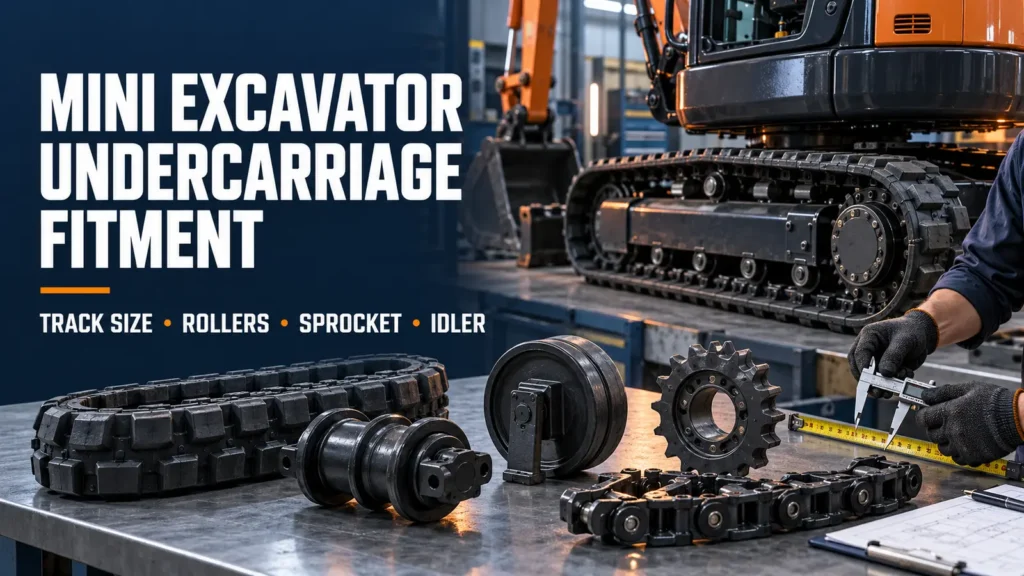
Mini Excavator Undercarriage Parts: How to Confirm the Correct Fit
Mini excavators are often grouped by operating weight, but two machines in the same weight class can use completely different undercarriage components. Even machines carrying the same model name may have different track widths, roller arrangements, sprocket specifications or serial-number breaks.
For distributors, repair workshops, rental fleets and importers, this creates a common purchasing risk: a part looks correct in a catalogue photo but does not fit when it reaches the machine.
The safest way to order mini excavator undercarriage parts is to combine the machine identity, original part reference and physical measurements. This guide explains how to verify rubber tracks, track chains, rollers, idlers and sprockets before approving an order.
What Is Included in a Mini Excavator Undercarriage?
The undercarriage supports the upper structure, transfers travel power to the ground and absorbs impact from uneven working surfaces. A typical mini excavator undercarriage includes:
- Rubber tracks or steel track assemblies
- Track chains or track link assemblies
- Track shoes or rubber pads
- Drive sprockets
- Front idlers
- Bottom rollers or track rollers
- Top rollers or carrier rollers
- Track adjusters and recoil springs
- Track frames and guards
- Final-drive mounting components
These parts operate as a system. The pitch of the track or chain must correspond with the sprocket, while the rollers and idler must guide the track at the correct height and width. A mismatch in one component can accelerate wear in the others.
Why the Machine Model Alone Is Not Enough
A buyer may request “tracks for a 3-ton mini excavator” or provide only a model such as a popular compact excavator series. That information is useful, but it may not identify one unique undercarriage.
Variations can occur because of:
- Machine serial-number range
- Standard or retractable undercarriage
- Rubber-track or steel-track specification
- Narrow, standard or wide track option
- Different blade or track-frame configuration
- Regional production version
- OEM engineering revision
- Previous replacement of the complete track frame
- Aftermarket conversion from rubber to steel tracks
Some compact excavators use a variable-width or retractable undercarriage for access to confined work areas. This makes it especially important to verify the actual installed components rather than relying only on published machine width.
The Information Required Before Matching Parts
For an accurate mini excavator parts quotation, collect the following information before removing or discarding the worn component.
1. Machine Manufacturer and Full Model
Record the complete model designation from the machine identification plate. Include all letters, numbers and model suffixes. A suffix may identify a different generation or market version.
2. Machine Serial Number or PIN
The serial number helps identify production changes. Photograph the complete machine plate so the supplier can see the model and serial number together.
Do not send only the last four digits unless the supplier specifically requests them. The complete number provides a more reliable record.
3. Original Part Number
Check the parts book, service records, dealer quotation or markings on the old component. If an OEM part number is available, include it in the RFQ even when requesting an aftermarket mini excavator part.
An original reference is valuable, but it should still be checked against the machine serial number and physical configuration. Parts can be incorrectly recorded during earlier repairs.
4. Clear Photographs
Send wide and close-up photographs showing:
- Complete machine from both sides
- Machine identification plate
- Entire left and right undercarriage
- Worn component in its installed position
- Mounting holes and contact surfaces
- Any stamped, cast or printed numbers
- Sprocket teeth and track engagement
- Track adjuster and idler connection
Images should be original, well lit and high resolution. Messaging-app screenshots often hide important markings.
5. Physical Measurements
Use a steel ruler, tape measure or caliper where appropriate. Photograph the measuring tool against the component so the supplier can verify how the dimension was taken.
How to Match Mini Excavator Rubber Tracks
Rubber tracks are commonly identified by three values:
Width × Pitch × Number of Links
A track marked 300 × 52.5 × 80, for example, indicates a nominal width of 300 mm, a pitch of 52.5 mm and 80 links. Buyers must still verify the internal guide pattern because tracks with the same three basic values are not always interchangeable.
Track Width
Measure across the full outside width of the rubber track. Do not measure only the inner metal core.
Track Pitch
Pitch is the center-to-center distance between successive embedded metal links. For more reliable measurement, measure across several links and divide by the number of spaces.
For example, measure from the center of one link to the center of the fifth link, then divide by four.
Number of Links
Mark one link with chalk and count every link around the complete track. Do not confuse the number of tread blocks with the internal link count.
Guide and Lug Pattern
Photograph the inside of the rubber track. Confirm:
- Number and shape of guide lugs
- Guide-lug width and height
- Spacing between guides
- Sprocket engagement profile
- Roller path width
Tread Pattern
Different tread patterns may fit the same machine but provide different traction, vibration and surface protection. The buyer should specify the working conditions, such as landscaping, concrete, mud, demolition or mixed surfaces.
How to Match Steel Track Chains and Link Assemblies
Steel undercarriage components require more than an overall length measurement. The most important specifications include:
- Chain pitch
- Number of links
- Bushing outside diameter
- Link height and width
- Shoe-bolt hole pattern
- Bolt-hole diameter
- Track-shoe width
- Sealed, greased or lubricated chain specification
Measuring Chain Pitch
Measure from the center of one track pin to the center of the next pin. Because wear can distort a single measurement, measure across several pitches and divide the total distance by the number of spaces.
The chain pitch must correspond to the sprocket tooth spacing. An incorrect combination will not engage smoothly and can rapidly damage the sprocket, bushings and links.
Counting Track Links
Mark one link and count around the complete chain. If the chain has already been removed, lay it straight without excessive tension. Confirm whether the quoted link count refers to each side or a pair.
Checking Track Shoes
For replacement shoes, provide:
- Shoe width
- Number of bolt holes
- Center-to-center hole spacing
- Hole diameter
- Shoe profile and grouser type
- Bolt and nut specification
A wider shoe is not automatically better. Excessive shoe width can increase leverage and stress on links, rollers and final-drive components, particularly on hard or uneven surfaces.
How to Match Track Rollers and Carrier Rollers
Mini excavator track rollers often look similar in photographs. Accurate matching requires the mounting and running dimensions.
For a bottom roller, measure or provide:
- Overall body length
- Running-surface width
- Flange arrangement: single or double flange
- Flange outside diameter
- Shaft or mounting style
- Number of mounting holes
- Center-to-center bolt-hole distance
- Bolt-hole diameter or thread size
- Mounting height
- Distance between mounting faces
Also photograph the roller from the top, bottom, front and side. A difference of only a few millimeters in bolt spacing or mounting height may prevent installation or affect track alignment.
For a carrier roller, confirm the bracket style, shaft diameter, flange profile and mounting orientation. Some smaller excavators do not use an upper carrier roller, while others use different versions across serial-number ranges.
How to Match a Mini Excavator Sprocket
The drive sprocket transfers torque from the final drive to the rubber track or steel track chain. Matching requires both the mounting interface and the tooth geometry.
Record:
- Number of teeth
- Sprocket outside diameter
- Pitch diameter if available
- Number of mounting holes
- Bolt-hole diameter
- Bolt-circle diameter
- Center-bore diameter
- Overall thickness
- Offset or dish direction
- Final-drive model or reference
Do not approve a sprocket because the bolt holes appear similar. The tooth count and tooth profile must match the track pitch and link design. Also check whether the sprocket is mounted with a specific inward or outward offset.
If the old sprocket is severely worn, tooth-tip measurements may be unreliable. In that case, prioritize the machine serial number, track specification, original reference and an unworn sample or technical drawing.
How to Match the Front Idler and Track Adjuster
The front idler guides the track and moves with the tensioning system. Key information includes:
- Idler outside diameter
- Running-surface width
- Flange width and profile
- Shaft diameter and length
- Fork or bracket dimensions
- Connection to the recoil spring or adjuster
- Left/right orientation, if applicable
When ordering an idler with a track adjuster, also confirm:
- Total retracted and extended length
- Cylinder or rod diameter
- Mounting-end shape
- Grease-valve position
- Spring outside diameter
- Spring length
- Bracket and pin dimensions
An idler may fit the track but fail to connect correctly to the existing tensioner. Send photographs showing how the two assemblies join.
Should Undercarriage Parts Be Replaced Individually or as a Set?
This depends on the wear pattern and operating economics. Replacing one damaged roller can be reasonable when the rest of the system is in good condition. However, installing a new chain on heavily worn sprockets—or new sprockets against badly worn bushings—may shorten the life of the replacement parts.
Before ordering, inspect both sides of the machine for:
- Uneven roller wear
- Sharp or hooked sprocket teeth
- Stretched chain pitch
- Cracked rubber tracks
- Damaged guide lugs
- Idler flange wear
- Oil leakage from rollers or idlers
- Bent track guards
- Incorrect track tension
- Misalignment between sprocket, rollers and idler
Ask the repair technician whether mating components should be replaced together. For fleet buyers, compare the cost of repeated downtime and freight with the cost of a coordinated undercarriage replacement package.
Common Reasons the Correct-Looking Part Does Not Fit
The Machine Has More Than One Serial-Number Range
The same model designation can cover several production revisions.
Rubber-Track Size Was Read Incorrectly
The buyer may count tread blocks instead of internal links or measure pitch between the wrong points.
The Part Number Is a Casting Number
A cast number may identify a raw housing rather than the complete finished component.
A Previous Owner Modified the Undercarriage
The installed track frame, final drive or roller system may differ from the original factory specification.
Left and Right Components Were Assumed to Be Identical
Many parts are interchangeable between sides, but brackets, guards or adjuster assemblies may not be.
Only One Dimension Was Compared
The same roller diameter can be used with different bolt spacing and mounting heights.
Rubber and Steel Configurations Were Mixed
A machine converted from rubber to steel tracks may require compatible sprockets, rollers, guards and shoes—not only a different track assembly.
Mini Excavator Undercarriage Parts RFQ Checklist
Include the following in your request for quotation:
- Product required and quantity
- Machine manufacturer and complete model
- Full machine serial number or PIN
- Original part number, if available
- Rubber or steel track configuration
- Track width, pitch and link count
- Sprocket tooth count and mounting dimensions
- Roller dimensions and bolt-hole spacing
- Idler and adjuster connection details
- Photos of the machine plate and installed parts
- Photos of all markings and measurements
- Required condition: new OEM, genuine or aftermarket
- Destination country and postal code
- Required delivery schedule
- Packaging or pallet requirements
For a mixed order, provide a separate line for each component and label photographs with matching item numbers. This prevents images from different machines being mixed during quotation.
How TerraParts Supports Fitment Verification
TerraParts Global supports B2B buyers sourcing construction equipment replacement parts from China. We are a supply-chain and parts sourcing partner rather than the original equipment manufacturer. Our role is to coordinate identification, supplier verification, inspection and export delivery.
For mini excavator undercarriage parts, our process can include:
- Machine and reference review — checking the model, serial number, original reference and requested configuration.
- Measurement review — organizing track size, pitch, link count, tooth count, bolt pattern and key component dimensions.
- Photo comparison — comparing mounting faces, guide profiles, roller flanges, sprocket offset and idler connections.
- Supplier confirmation — obtaining written confirmation of the offered part number and compatible machine information.
- Pre-shipment inspection — checking quantity, visible dimensions, markings, workmanship and packaging against the approved order.
- Mixed-parts consolidation — combining undercarriage components with filters, seal kits, hydraulic parts, engine parts or electrical parts where practical.
- Export coordination — organizing protective packing, commercial documents and international delivery options.
No remote matching process can replace installation checks by a qualified technician. However, collecting complete evidence before production or shipment substantially reduces preventable wrong-part orders.
Questions to Ask Before Approving an Offer
Before issuing a purchase order, ask the supplier:
- Which exact machine model and serial range does the part fit?
- Which original number or verified cross-reference was used?
- Are the quoted dimensions confirmed against my measurements?
- Is the price for one piece, one side or a complete pair?
- Are mounting bolts, nuts, seals or brackets included?
- Is the product new, remanufactured or used?
- What material or heat-treatment information is available?
- Can the supplier provide inspection photos before shipment?
- How will heavy parts be packed and protected from corrosion?
- What happens if the delivered specification differs from the approved drawing or dimensions?
Written answers create a clearer purchasing record than a simple statement that the part “fits the model.”
Frequently Asked Questions
How do I identify my mini excavator rubber track size?
Confirm the track width, center-to-center pitch and number of internal links. Also send photographs of the guide-lug pattern and sprocket engagement profile.
Can I order undercarriage parts using only the excavator model?
Sometimes a model leads to one clear option, but it is safer to include the serial number, original part number, photographs and measurements. Several specifications may exist under one model name.
Are aftermarket mini excavator undercarriage parts interchangeable with genuine parts?
They may be suitable replacements when their reference, dimensions, material specification and application are correctly verified. “Aftermarket” alone does not guarantee compatibility or quality; evaluate the specific product and supplier.
Should I replace both tracks at the same time?
If one track failed because of age and the other is similarly worn, replacing the pair may provide more balanced traction and tension. The correct decision depends on remaining condition, hours, wear measurements and operating budget.
Why does my new sprocket not engage the track smoothly?
Possible causes include incorrect pitch, wrong tooth profile, mismatched link design, excessive chain wear, reversed sprocket offset, misalignment or incorrect track tension. Stop operation and verify the complete system before damage increases.
What is the fastest way to get an accurate quotation?
Send one organized RFQ containing the machine plate, full model and serial number, original reference, part photographs, dimensions, quantity and destination. Label every image with the corresponding item number.
Final Fitment Checklist
Before approving mini excavator undercarriage parts, confirm:
- Machine model and serial number
- Original or verified cross-reference number
- Rubber or steel track configuration
- Track width, pitch and link count
- Guide-lug or link profile
- Roller flange and mounting dimensions
- Sprocket tooth count, bolt circle and offset
- Idler dimensions and adjuster connection
- Quantity per piece, side or pair
- Included hardware and packaging
- Inspection method before shipment
The most reliable fitment decision is based on several matching points—not one photograph or one model name. A complete identification package allows the buyer, supplier and technician to evaluate the same component specification before the order is shipped.
If you need mini excavator track parts, rubber tracks, rollers, sprockets, idlers or mixed construction equipment spare parts, send TerraParts Global the machine and component information available. We can help organize reference matching, supplier coordination, inspection and consolidated international delivery for professional B2B buyers.
