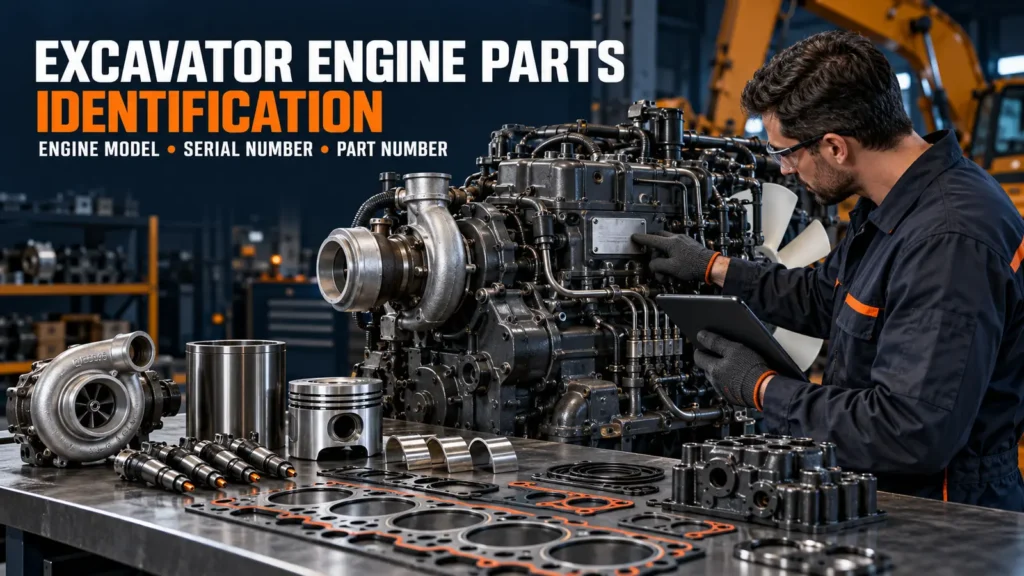
How to Identify Excavator Engine Parts by Engine Model and Serial Number
Ordering an excavator engine part by machine model alone can produce an expensive mistake. The same excavator model may have been manufactured with different engines, emission levels, fuel systems or engine arrangements. A water pump, injector, piston, gasket or turbocharger may look nearly identical to another version but use different mounting points, connectors, dimensions or calibration.
The correct identification process starts with the engine—not only the excavator. Professional buyers should record the full engine model, engine serial number and any build-specific identifier before requesting a quotation.
This guide explains how distributors, repair workshops, fleet owners and importers can identify excavator engine parts accurately, prepare a complete RFQ and reduce wrong-part orders.
Why the Excavator Model Is Not Enough
An excavator manufacturer may use different engine suppliers across production years or regional markets. Even when the engine brand remains unchanged, its configuration may vary because of:
- Machine serial-number range
- Emission standard or destination market
- Engine power rating
- Mechanical or electronic fuel system
- Turbocharged or naturally aspirated specification
- Different cooling package
- Engine arrangement or build list
- Revised cylinder block, head or front gear housing
- Previous engine replacement
- Remanufactured engine installation
For example, an excavator listed with one general engine family may contain several build specifications. Those versions can require different pistons, injectors, pumps, sensors, wiring harnesses or gasket sets.
The excavator model is therefore a useful starting point, but it should not be the final purchasing reference.
The Four Identification Levels
Reliable engine-parts matching uses four information levels together.
1. Machine Identity
Record:
- Excavator manufacturer
- Complete machine model
- Machine serial number or PIN
- Approximate production year
- Destination market, if known
The machine data helps check whether the installed engine is consistent with the original equipment specification.
2. Engine Identity
Record:
- Engine manufacturer
- Complete engine model
- Engine serial number
- Arrangement number, build list, CPL or specification number
- Power and speed rating where shown
The terminology depends on the engine manufacturer. Cummins commonly uses an Engine Serial Number and may show a Critical Parts List number. Caterpillar parts identification may use the engine model, machine serial prefix and engine arrangement. Perkins engines can be identified with an engine serial number and build-list information. DEUTZ parts systems use the individual engine number.
3. Component Identity
Record every number on the part itself, including:
- OEM part number
- Supplier number
- Casting number
- Serial number
- Calibration code
- Revision suffix
- Connector or sensor number
Do not assume every visible number is an orderable part number. A casting code may identify only the unfinished housing shared by several completed assemblies.
4. Physical Configuration
Confirm:
- Dimensions
- Mounting pattern
- Port positions
- Gear or pulley specification
- Connector shape and pin count
- Hose and pipe orientation
- Left/right or front/rear installation position
Physical details are important supporting evidence, but they should be compared after identifying the exact engine build.
Where to Find the Engine Model and Serial Number
Start with the engine data plate. It may be attached to the valve cover, rocker housing, timing-gear housing or side of the cylinder block. Location varies by engine family.
Take two photographs:
- A wider image showing where the plate is located on the engine.
- A close-up showing every line of text without glare.
If the plate is damaged or missing, look for a serial number stamped directly into the engine block. Do not aggressively grind or polish the surface, because this can remove shallow characters.
Official identification practices differ by brand:
- Kubota Engine serial-number identification explains that serial numbers are stamped into the engine block and that their location changes by engine series.
- Cummins Genuine Parts supports parts lookup using identifiers including the Engine Serial Number and part number.
- DEUTZ Service Portal provides parts lookup based on the individual engine number.
- Cat engine rebuild-kit guidance uses the machine serial prefix, engine model and engine arrangement to identify applicable kits.
These official references reinforce one practical rule: record the full identifier before ordering engine parts.
Engine Model vs. Engine Serial Number
The engine model identifies a family or technical series. The serial number identifies an individual engine and links it to its production specification.
Two engines sharing the same model can have different:
- Pistons and compression ratios
- Cylinder liners
- Main and connecting-rod bearings
- Fuel injectors
- Injection pumps or common-rail systems
- Turbochargers
- Water pumps
- Oil pumps
- Sensors and electronic control units
- Cylinder-head gaskets
- Emission-control components
That is why an engine serial number lookup is often more reliable than searching only by model.
Serial-number breaks are especially important. A manufacturer may change a component after a particular production number while keeping the engine model name unchanged. Kubota’s official guidance specifically notes that the serial number helps determine correct service parts and changes based on serial-number breaks.
What Are Arrangement Numbers, Build Lists, CPLs and Spec Numbers?
Different engine manufacturers use additional codes to describe the exact build.
Engine Arrangement Number
An arrangement number identifies how an engine is configured for a particular machine or application. It can affect major and auxiliary components. Cat notes that rebuild kits can be specific to the engine model and engine arrangement.
Build List
A build list identifies the configuration in which an engine was produced. It may distinguish components used in different applications even when the base engine family is the same.
Critical Parts List
Cummins data plates may include a CPL number. This groups important components or performance specifications used in a particular engine configuration. The Engine Serial Number remains the strongest lookup reference, but the CPL is useful supporting information.
Specification or Option Number
Some engines show specification, option or application codes. Photograph all codes rather than deciding which one is important before contacting the supplier.
Step-by-Step Engine-Parts Identification Process
Step 1: Photograph the Machine Plate
Capture the excavator model and complete machine serial number. This provides the original machine context.
Step 2: Photograph the Engine Data Plate
Make sure the engine model, serial number and other build codes are readable. If the engine has been replaced, note that the engine plate does not match the original machine records.
Step 3: Record the Required Component
Use a clear, specific description such as:
- Complete cylinder-head assembly
- Bare cylinder head
- Six-hole water pump
- Oil pump with drive gear
- Complete turbocharger
- Fuel injector with calibration code
- Piston and ring set
- Full engine-overhaul kit
Avoid vague descriptions such as “engine accessory” or “engine repair parts.”
Step 4: Find the Number on the Old Part
Clean the component carefully and photograph every label, stamp and casting. State where each number appears. Suppliers can then distinguish an assembly number from a casting reference.
Step 5: Compare the Parts Catalogue
When an illustrated parts list is available, confirm the reference against the engine serial number or build specification. Pay attention to quantity, superseded numbers and notes describing serial-number ranges.
Step 6: Confirm Dimensions and Configuration
Use physical comparison as a final check. Provide photographs with a caliper or ruler when dimensions matter.
Step 7: Obtain Written Compatibility Confirmation
Ask the supplier to state:
- Offered part number
- Original reference or cross-reference
- Applicable engine model
- Applicable serial or arrangement range
- Included components
- New, remanufactured or used condition
Keep this confirmation with the quotation and purchase order.
Identifying Common Excavator Engine Parts
Engine Overhaul Kits
“Overhaul kit” is not a universal package. One supplier may include pistons, rings, liners, pins, clips, bearings and a gasket set, while another may include only pistons, liners and rings.
Confirm:
- Engine model and serial number
- Piston diameter and combustion-bowl design
- Liner type and flange dimensions
- Piston-pin diameter
- Standard or oversize bearings
- Main- and rod-bearing sizes
- Full or partial gasket set
- Valve seals and crankshaft seals
- Quantity per cylinder and per engine
Ask for a written packing list rather than relying on a generic kit photograph.
Pistons, Liners and Rings
Engines within one family can use different piston crowns, ring grooves or compression heights. Provide the engine serial number and piston markings. If measuring old parts, remember that wear can affect the result.
Main and Connecting-Rod Bearings
Confirm whether the crankshaft is standard or has been reground. Bearing markings may indicate standard, 0.25 mm, 0.50 mm or another repair size. Never assume the required bearing size from the engine model alone.
Cylinder Heads and Head Gaskets
For a cylinder head, verify:
- Bare or complete assembly
- Valve and spring configuration
- Injector-hole type
- Sensor and plug positions
- Intake and exhaust manifold mounting
- Head casting and assembly numbers
For a head gasket, compare thickness, cylinder-bore diameter, oil and coolant passages, identification notches and applicable serial range.
Fuel Injectors
Record the complete injector part number, including suffix and calibration code. Also provide the fuel-system type and connector photographs for electronic injectors.
Injectors that physically fit may have different flow, pressure or calibration specifications. A mismatched injector can cause poor performance, smoke, excessive fuel consumption or engine damage.
Fuel-Injection Pumps and Common-Rail Pumps
Provide the pump manufacturer, complete part number, engine serial number and photographs of ports, drive gear, flange and control connections. Electronic pumps may also require calibration or programming.
Turbochargers
Use the turbocharger nameplate or tag whenever possible. Record:
- Turbo manufacturer
- Assembly number
- Customer or OEM number
- Serial number
- Wastegate or actuator specification
- Oil and coolant port orientation
- Compressor and turbine housing positions
A casting number from one housing is rarely enough to identify the complete turbocharger.
Water Pumps and Oil Pumps
Compare mounting-hole count, bolt spacing, housing profile, impeller or gear specification, inlet/outlet orientation and pulley connection. Engines with the same displacement can use different front housings and pumps.
Sensors, Solenoids and Electronic Parts
Record the number printed on the component, connector keying, pin count, voltage where applicable and wire length. Electronic engine parts often change with emission level and control-system generation.
Common Identification Mistakes
Using the Emissions Label as the Engine Serial Number
An emissions label may identify an engine family rather than the individual engine. Kubota explicitly advises that the emissions label does not contain the serial number or model information required to identify parts correctly.
Sending Only the Excavator Model
The same machine model may contain several engine configurations.
Providing a Partial Engine Model
Suffixes and arrangement codes can change the required component.
Ordering by Casting Number
One casting may be machined or assembled into several finished parts.
Ignoring a Replacement Engine
The currently installed engine may differ from the engine originally listed for the excavator serial number.
Assuming a Kit Contains Everything
Always request a written kit-content list and quantities.
Comparing Only Photographs
Appearance can confirm configuration, but it does not replace serial-number and part-number verification.
Excavator Engine Parts RFQ Checklist
Include:
- Excavator manufacturer and complete model
- Machine serial number or PIN
- Engine manufacturer
- Complete engine model
- Engine serial number
- Arrangement, build list, CPL or specification number
- Required part name and quantity
- Original part number, if available
- All markings from the old component
- Clear engine-plate and component photographs
- Dimensions or connector details where relevant
- New, genuine, OEM, aftermarket or remanufactured preference
- Destination country and postal code
- Required delivery schedule
- Packaging and consolidation requirements
For several items, number every RFQ line and give the photographs matching filenames, such as Item-01-engine-plate.jpg and Item-01-water-pump-number.jpg.
How TerraParts Supports Engine-Parts Sourcing
TerraParts Global supports international distributors, equipment dealers, repair networks, mining operations and fleet owners sourcing construction equipment replacement parts from China. We are a B2B sourcing and supply-chain partner—not the original engine manufacturer.
Our engine-parts support can include:
- Identification review: organizing the machine model, engine model, serial number, build codes and original references.
- Cross-reference coordination: comparing available supplier references with the buyer’s approved information.
- Configuration checks: reviewing photographs, dimensions, connectors and kit contents.
- Supplier verification: clarifying product condition, brand, specification, included components and warranty terms.
- Pre-shipment inspection: checking markings, quantity, visible dimensions, workmanship and packaging against the approved order.
- Mixed-order consolidation: combining engine parts with filters, seal kits, hydraulic parts, electrical parts or undercarriage components where practical.
- Export coordination: arranging protective packing, commercial documents and international delivery options.
This process cannot replace diagnosis and installation by a qualified engine technician. It does, however, create a clearer identification record and reduce preventable purchasing errors.
Questions to Ask Before Approving a Supplier’s Offer
- Which exact engine model and serial range does the part fit?
- Which engine arrangement, build list or CPL was checked?
- Is the offered number an original reference, supersession or aftermarket cross-reference?
- Is the part new, remanufactured or used?
- What components are included?
- Is the quotation per piece, per cylinder or per engine set?
- Are standard and repair-size options clearly identified?
- Can markings and dimensions be checked before shipment?
- What packaging will protect precision surfaces and electronic components?
- What information supports the compatibility statement?
Frequently Asked Questions
Can I identify engine parts using only the excavator serial number?
The machine serial number can help identify the original engine installation, but the engine may have been replaced. Whenever possible, collect both machine and engine identification information.
Where can I find the engine serial number?
Look for the engine data plate on the valve cover, rocker housing, timing housing or engine block. The number may also be stamped directly into the block. Location varies by engine series.
Is the engine model enough for an overhaul kit?
Not always. Confirm the serial number, arrangement or build list, piston specification, liner type and bearing sizes. Also request the exact kit-content list.
Is a casting number the same as a part number?
Usually not. A casting number often identifies a base housing, while the complete assembly may have another orderable number.
Can aftermarket engine parts replace genuine parts?
They can be suitable when the application, reference, dimensions, materials and supplier quality are properly evaluated. The word “aftermarket” alone does not establish fit or quality.
