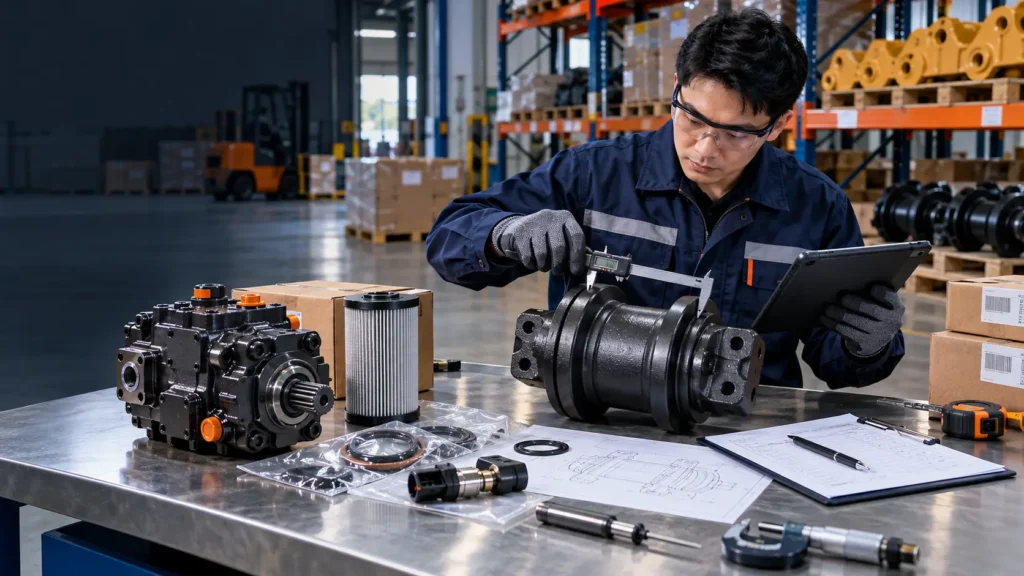
Construction Equipment Parts Inspection Checklist for Importers and Distributors
Receiving the wrong construction equipment part is expensive. Receiving the correct part number with unacceptable dimensions, damaged surfaces, missing accessories or inadequate export packaging can be just as costly.
For an importer or heavy equipment parts distributor, a quality problem rarely ends with the value of the defective item. It may also cause emergency airfreight, customs charges, machine downtime, customer claims, technician delays and damage to the distributor’s reputation.
A practical construction equipment parts inspection checklist helps buyers define what must be checked before shipment. However, inspection should not be treated as a final visual check performed after the order is packed. It begins with accurate technical information, continues through supplier confirmation and ends with documented verification of the finished goods.
This guide explains how distributors, equipment dealers, repair companies, mining operators and rental fleets can inspect excavator and heavy-equipment spare parts more effectively when sourcing from China.
Why Construction Equipment Parts Need a Specialized Inspection Process
General consumer-product inspection methods are not enough for many construction machinery components. A part can look clean and well finished but still fail because of a small difference in pitch, bore diameter, shaft profile, port position, connector layout or pressure setting.
The inspection process must therefore answer three different questions:
- Is it the part that the buyer ordered?
- Does it match the required machine or component application?
- Does the supplied part meet the agreed quality and packaging requirements?
These questions are related, but they are not identical. A visually acceptable track roller with the wrong mounting distance is still unusable. A correctly dimensioned hydraulic pump may remain incompatible if the control regulator or rotation direction is different.
This is why professional spare parts quality control combines documentation, compatibility evidence, measurements, workmanship checks and shipment records.
Step 1: Review the Purchase Order and Approved Specification
An inspector needs a controlled reference before checking the goods. The purchase order should be supported by the latest approved technical information.
Review the following documents:
- Purchase order number and revision
- Customer’s submitted part number
- Confirmed supply part number
- Product description and supply scope
- Equipment manufacturer and complete model
- Machine serial number or serial-number range
- Engine or component model
- Approved drawing or dimension sheet
- Approved sample or reference photographs
- Material, hardness or performance requirements where applicable
- Required quantity
- Packaging and labeling instructions
- Destination-country requirements
If the quotation was conditionally approved, include the customer’s written confirmation of the drawing, connector, flange, dimensions or other critical features.
The inspection should use the approved version—not an old email attachment or an earlier quotation. Revision control matters when part numbers have been superseded or technical details have changed.
Step 2: Verify Part Numbers and Product Identity
OEM part number verification is one of the most important stages of a construction machinery parts inspection.
Check:
- Part number on the product
- Part number on the individual box
- Part number on the master carton
- Part number on the packing list
- Purchase order line number
- Product description
- Manufacturer or supplier reference
- Batch or production code when required
- Left-hand or right-hand designation
- Assembly or subassembly status
Do not assume that every number marked on a metal component is an orderable part number. It may be a casting number, housing number, manufacturing code or subcomponent reference.
When several number systems are involved, the inspection report should distinguish between the customer’s OEM reference, the confirmed replacement number and the supplier’s internal stock code.
For parts with no permanent marking, agree on label content before production. Traceability becomes difficult if unmarked parts from several suppliers are consolidated into one shipment.
Step 3: Confirm Machine and Component Compatibility
A machine model alone may not be enough to establish compatibility. Construction equipment manufacturers often use different components across serial-number ranges, production years or regional configurations.
The compatibility review should compare as many of the following as possible:
- Machine make and full model
- Machine serial number
- Engine make, model and serial number
- Component manufacturer and model code
- Original installed-part number
- Current superseded number
- Installation position
- Product drawing
- Critical dimensions
- Connector, port, shaft or mounting configuration
Official parts systems commonly use equipment model and serial-number information to narrow the applicable parts. This reflects an important purchasing principle: part-number matching and machine application should be verified together.
If compatibility remains uncertain, the inspection status should state additional confirmation required. A shipment deadline should not turn an unverified assumption into a confirmed order.
Step 4: Check Quantity and Supply Scope
Quantity errors are common in mixed orders, especially when similar-looking products are packed in several cartons.
Confirm:
- Total ordered quantity
- Inspected quantity
- Quantity per individual box
- Quantity per master carton
- Number of cartons or pallets
- Spare pieces or agreed overage
- Included mounting hardware
- Included gaskets, seals and O-rings
- Included sensors, solenoids or connectors
- Included repair accessories
- Any excluded items clearly stated in the quotation
The phrase “complete assembly” should be defined. For example, a final drive quotation may refer to the gearbox only, the travel motor only or the complete combined unit. A repair kit may or may not include every seal, bearing, washer and gasket needed for rebuilding.
The inspector should verify the agreed supply scope rather than relying on a broad product name.
Step 5: Conduct a Workmanship and Visual Inspection
Visual inspection can identify damage and manufacturing problems that affect installation, service life or customer acceptance.
Look for:
- Cracks, fractures or welding defects
- Corrosion or inadequate rust prevention
- Burrs and sharp edges
- Damaged threads
- Dents and impact marks
- Porosity or obvious casting defects
- Oil leakage
- Missing plugs or protective caps
- Uneven coating or paint contamination
- Machined surfaces covered with paint
- Damaged seals
- Incorrect assembly orientation
- Loose fasteners
- Contaminated hydraulic ports
- Illegible or incorrect labels
Cosmetic acceptance criteria should depend on the product. A minor paint variation on a cast component may not affect use, while a scratch on a sealing or bearing surface can be critical.
Inspectors should classify findings as critical, major or minor according to the agreed specification and actual application risk.
Step 6: Measure Critical Dimensions
Dimensions should be selected according to the product category, not copied from a generic inspection form.
Useful measuring tools may include:
- Vernier caliper
- Micrometer
- Depth gauge
- Height gauge
- Thread gauge
- Tape measure
- Bore gauge
- Hardness tester
- Weight scale
- Coating-thickness gauge
Before inspection, confirm that the equipment is suitable for the required tolerance and, where necessary, has valid calibration status.
Record the nominal specification, tolerance and actual measurement. A photograph of a caliper display is helpful, but it should not replace a structured measurement table.
Undercarriage parts inspection
For track rollers, carrier rollers, idlers, sprockets, track chains and shoes, inspect relevant points such as:
- Track-chain pitch
- Number of links
- Shoe width
- Bolt-hole quantity, diameter and spacing
- Roller flange arrangement
- Roller body dimensions
- Mounting width and hole centers
- Idler diameter and guide dimensions
- Sprocket tooth quantity and profile
- Segment quantity and bolt pattern
- Oil leakage and rotation condition
Hydraulic pump inspection
For pumps and hydraulic motors, verify:
- Complete model code and nameplate
- Rotation direction
- Displacement or agreed configuration
- Shaft type, diameter and spline count
- Mounting flange and pilot diameter
- Port quantity, size and position
- Regulator or control type
- Solenoid voltage
- Drain and pilot connections
- Protective caps and internal cleanliness
- Test record when functional testing is required
Hydraulic pump inspection must focus on configuration, not appearance alone. Two pumps from the same family may use different shafts, regulators or port arrangements.
Filter inspection
For engine-oil, fuel, air, hydraulic and pilot filters, inspect:
- Cross-reference number
- Overall height
- Outer and inner diameter
- Thread size
- Gasket dimensions
- Sealing condition
- Filtration specification when documented
- Bypass or anti-drainback configuration where applicable
- Cleanliness and protective packaging
Seal-kit inspection
For cylinder, valve, pump and motor seal kits, verify:
- Kit part number
- Application or component model
- Seal quantity
- Individual seal types
- Inner and outer diameters where specified
- Material and color where relevant
- Damage, deformation and contamination
- Identification of separate sub-kits
- Packaging that prevents loss or mixing
Engine and electrical parts inspection
For engine components, check engine model, arrangement number, standard or oversize condition, critical dimensions and included installation items.
For sensors, controllers, starters, alternators and wiring components, verify voltage, connector shape, pin count, pin arrangement, mounting pattern and any programming or calibration requirement.
Step 7: Review Materials and Test Evidence
Not every order requires laboratory testing, but the buyer should define which evidence is necessary for the component and risk level.
Possible records include:
- Material certificate
- Chemical-composition report
- Hardness results
- Heat-treatment record
- Dimensional report
- Pressure or leakage test
- Electrical test
- Functional bench-test report
- Coating-thickness result
- Supplier outgoing-inspection report
- Third-party inspection report
Documents must be connected to the inspected item or batch. A generic test report for a similar product is not the same as evidence for the actual order.
For high-value or safety-relevant parts, agree on the test method and acceptance criteria before ordering. Testing requirements introduced only after completion may be impractical or create unnecessary disputes.
Step 8: Use an Appropriate Sampling Plan
Importers sometimes request an “AQL inspection” without defining the product risk or inspection scope. Acceptance sampling frameworks such as ANSI/ASQ Z1.4 or the ISO 2859 series use sample sizes and acceptance criteria to decide whether a lot should be accepted based on the selected plan.
However, sampling is not appropriate for every characteristic.
Consider 100% verification for:
- Part-number and label accuracy in small mixed orders
- Left- and right-hand designation
- High-value hydraulic components
- Customer-specific marking
- Quantity and accessory checks
- Critical connector or configuration differences
- Previously identified recurring defects
Sampling may be more practical for repeated, lower-risk characteristics in a larger homogeneous batch.
The buyer and supplier should agree on inspection level, sample size, defect classification and acceptance criteria before inspection. “AQL passed” is not meaningful if the tested characteristics and limits are unknown.
Step 9: Inspect Packaging for Export Shipment
Correct parts can still arrive unusable if they are poorly protected.
Check whether packaging provides:
- Rust prevention for bare metal surfaces
- Caps for hydraulic and fuel ports
- Protection for shafts, threads and machined faces
- Moisture protection where required
- Strong individual cartons
- Internal cushioning and movement control
- Reinforced export cartons or wooden cases
- Suitable pallets for the product weight
- Separation of parts that could strike each other
- Clear carton numbers and labels
- Accurate gross and net weights
- Accurate carton dimensions
- Legible shipping marks
Heavy components should not rely on thin cartons or weak pallets. The packaging design must consider lifting, inland transportation, warehouse handling, container loading and final delivery.
If wood packaging is used for international shipment, confirm applicable treatment and marking requirements for the destination.
Step 10: Control Mixed Parts Consolidation
A mixed construction equipment parts order may contain products from several suppliers, including undercarriage parts, filters, seal kits, pumps, engine components and electrical items.
Consolidation reduces fragmented freight, but it requires stronger warehouse controls.
Before loading, verify:
- Every purchase-order line has arrived
- Supplier labels are linked to the buyer’s line numbers
- Similar parts have not been mixed
- Carton numbers match the packing list
- Small seal kits and sensors are protected from loss
- Heavy parts cannot damage lighter cartons
- Photographs identify the contents before cases are closed
- Total weights and dimensions are updated
- Missing, damaged or rejected items are isolated
Use a master packing list that shows purchase-order line, part number, description, quantity and carton number. This helps the importer receive and distribute the shipment efficiently.
Step 11: Build a Complete Inspection Report
A useful report should allow someone who was not present to understand what was checked and what evidence supports acceptance.
Include:
- Buyer and supplier details
- Purchase order and inspection date
- Product and part-number list
- Production and packing status
- Sampling method
- Inspection quantity
- Reference documents
- Measurement results
- Visual findings
- Test results or reviewed certificates
- Quantity and packaging results
- Clear photographs
- Nonconformity descriptions
- Corrective-action status
- Final result: passed, conditionally passed, pending or failed
Photographs should show overall goods, labels, nameplates, dimensions, defects, individual packaging, master cartons, pallets and container loading where applicable.
Avoid reports that contain dozens of unorganized photographs but no link between the image and the purchase-order item.
Step 12: Resolve Nonconformities Before Shipment
When a problem is found, record:
- Affected part number
- Quantity affected
- Defect description
- Specification or approved reference
- Photographic evidence
- Suspected cause
- Proposed correction
- Reinspection requirement
- Responsible party and completion date
Possible dispositions include rework, replacement, sorting, concession approval or rejection.
Do not allow defective parts to be mixed back into accepted stock. After corrective action, verify the affected characteristic again and update the report.
How TerraParts Global Supports Parts Quality Control
TerraParts Global supports construction equipment parts distributors, dealers, repair businesses, mining companies and fleet operators with sourcing and order coordination in China.
We operate as a specialized sourcing and supply-chain partner rather than claiming that every category comes from one factory. This allows us to coordinate suitable supply resources across undercarriage, filtration, sealing, hydraulic, engine and electrical product categories.
Depending on the product and order requirements, our support can include:
- Review of part numbers and available machine information
- Collection of supplier drawings and product photographs
- Confirmation of supply scope and accessories
- Coordination of dimensional or visual inspection
- Review of nameplates, labels and packaging
- Pre-shipment photo and document records
- Separation and consolidation of mixed parts orders
- Export packing and shipping-mark coordination
- Packing-list and delivery-document support
- Follow-up on identified nonconformities
Inspection scope should always be agreed for the specific order. Visual inspection cannot prove every internal material or performance characteristic, and no responsible supplier should promise that every possible failure can be eliminated. The objective is to identify foreseeable mismatches and visible nonconformities before they become expensive destination claims.
Downloadable Quick Checklist
Before approving shipment, confirm:
- Purchase order and latest specifications reviewed
- OEM and replacement part numbers verified
- Machine or component application checked
- Product markings match carton labels
- Ordered quantities and accessories confirmed
- Critical dimensions measured
- Product-specific configuration checked
- Workmanship and visible condition accepted
- Required test records reviewed
- Nonconformities corrected and reinspected
- Rust prevention and protective caps applied
- Export packaging accepted
- Carton numbers match the packing list
- Inspection photographs and report completed
- Consolidated shipment checked before loading
Frequently Asked Questions
What information is needed before inspecting excavator spare parts?
Provide the purchase order, confirmed part number, equipment model, machine serial number, component model, approved drawings or dimensions, quantity, supply scope and packaging requirements. The inspector cannot reliably verify compatibility without an approved technical reference.
Is pre-shipment inspection enough to guarantee compatibility?
No. Pre-shipment inspection can verify agreed characteristics of the supplied goods, but compatibility should first be established during the inquiry and quotation stages using part numbers, serial numbers, nameplates, photographs and dimensions.
Should every construction equipment part receive 100% inspection?
Not necessarily. The inspection level should reflect the value, quantity, repeatability and risk of the item. High-value, mixed or configuration-sensitive products may require 100% checks for critical characteristics, while larger homogeneous batches may use an agreed sampling plan.
What is the most important check for hydraulic pumps?
There is no single sufficient check. Inspect the complete model code, nameplate, rotation, shaft, flange, ports, regulator and electrical control configuration against the approved application.
Can TerraParts Global consolidate parts from different suppliers?
Yes. Mixed-parts consolidation can combine suitable products from different supply sources. Accurate line-item labeling, receiving inspection, packaging control and a carton-linked packing list are essential.
Final Advice for Importers and Distributors
The best inspection begins before production. A clear RFQ, verified part number, complete machine information and approved specification create the foundation for effective quality control.
Before shipping any construction equipment parts order, verify identity, compatibility evidence, quantity, workmanship, dimensions, configuration, documentation and export packaging. For mixed orders, add strict consolidation and carton-traceability controls.
If you are sourcing undercarriage parts, filters, seal kits, hydraulic components, engine parts or electrical parts from China, send TerraParts Global the available part numbers, machine details, photographs, quantities and destination. Our team can review the information, coordinate appropriate supply options and define an inspection scope for your order.
