How to Consolidate Spare Parts from Multiple Chinese Suppliers
Construction equipment parts distributors rarely purchase every product from one supplier. An undercarriage specialist may provide track rollers and sprockets, while another supplier handles hydraulic pumps, a third supplies filters and seal kits, and several smaller vendors provide sensors, engine parts or repair components.
This sourcing structure gives importers access to wider product coverage and more competitive supply options. It also creates a logistics problem: different factories finish at different times, use different labels, prepare different documents and pack goods to different standards.
If every order ships separately, the buyer may pay repeated domestic pickups, minimum freight charges, customs entries and destination handling fees. If everything is sent to one warehouse without a proper control process, cartons can be mixed, part numbers can be lost and one delayed supplier can hold the entire shipment.
Effective multiple supplier shipment consolidation is therefore more than combining cartons. It is a controlled process of supplier coordination, warehouse receiving, part-number verification, inspection, repacking, documentation and export planning.
This guide explains how distributors and importers can consolidate construction equipment spare parts from multiple Chinese suppliers while reducing mistakes, delays and avoidable logistics costs.
What Is Spare Parts Consolidation?
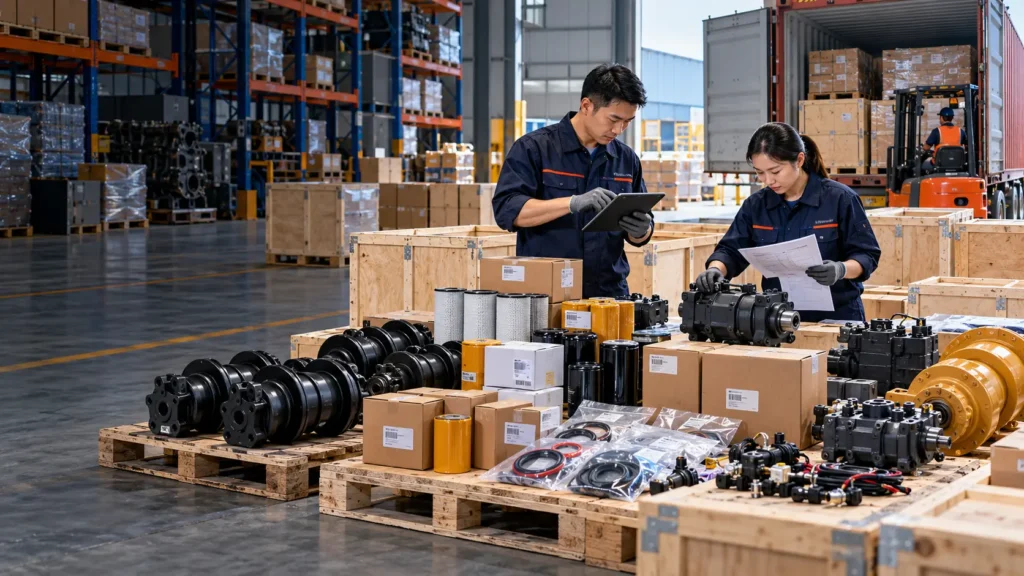
Spare parts consolidation means directing products from several suppliers to one designated warehouse in China, checking and organizing the goods, and then exporting them as one planned shipment.
A typical consolidated order might include:
- Track rollers, carrier rollers and sprockets
- Hydraulic pumps, motors and seal kits
- Engine filters and hydraulic filters
- Cylinder components and repair kits
- Electrical sensors, switches and solenoids
- Engine overhaul parts
- Customer labels and packaging materials
The consolidation warehouse acts as a control point between suppliers and international shipping. Goods should not simply arrive and wait. Every delivery needs to be linked to a purchase-order line, supplier, part number, quantity and final carton location.
When Consolidation Makes Commercial Sense
A spare parts consolidation service in China can be useful when an importer:
- Buys small or medium quantities from several suppliers
- Cannot fill a container with one factory’s products
- Wants to reduce repeated international freight minimums
- Needs one coordinated packing list
- Wants goods checked before they leave China
- Requires standardized labels and export packaging
- Manages a mixed construction equipment parts order
- Needs LCL or FCL shipment planning
- Wants one communication point for order progress
However, consolidation does not automatically reduce total cost. Warehousing, handling, inspection, repacking and waiting time also cost money. Buyers should compare the complete landed-cost structure rather than looking only at the international freight rate.
Consolidation is most effective when the savings from fewer shipments, improved packing and stronger order control exceed the additional coordination and warehouse costs.
Step 1: Build One Master Purchase-Order List
Before any supplier ships to the warehouse, create a master order file covering every line from every vendor.
Recommended fields include:
| Field | Purpose |
|---|---|
| Internal line number | Provides one unique reference across suppliers |
| Supplier name | Identifies the source of each item |
| Supplier PO number | Links the line to the original purchase |
| Customer part number | Matches the buyer’s system |
| OEM or replacement number | Supports technical identification |
| Product description | Clarifies the required item |
| Machine or component model | Supports compatibility review |
| Ordered quantity | Controls receiving and packing |
| Unit and total weight | Supports freight planning |
| Carton dimensions | Supports CBM estimates |
| Expected completion date | Controls the consolidation schedule |
| Inspection status | Shows whether goods can be released |
| Final carton number | Supports destination receiving |
Do not rely on supplier descriptions such as “pump,” “seal kit” or “excavator parts.” The same name may refer to different assemblies or applications. Each line should have a unique identification reference.
Step 2: Issue Standard Warehouse Instructions
Every supplier should receive the same delivery instructions before dispatching goods domestically.
The instructions should state:
- Warehouse address and contact person
- Required booking or delivery notice
- Buyer name and consolidation project number
- Supplier PO and line-number labeling requirements
- Packing-list format
- Carton marking rules
- Photograph requirements before dispatch
- Restrictions on mixed part numbers in one carton
- Packaging requirements for heavy or fragile components
- Documents to accompany the delivery
Ask suppliers not to send unidentified cartons. A warehouse receiving dozens of boxes cannot safely identify goods from informal messaging history alone.
Each carton should show at least the project number, supplier, purchase-order reference, carton sequence and main contents. Small components should also have individual part-number labels.
Step 3: Coordinate Different Production Schedules
One supplier may finish in seven days while another requires five weeks. This creates a choice between shipping early items first or holding them for consolidation.
Create a supplier schedule covering completion, inspection, corrective action, domestic delivery, warehouse cutoff and international departure. Add a realistic buffer: one failed inspection or late document can affect the whole shipment. Classify lines as critical, flexible or optional so a delayed low-priority item does not automatically hold an entire container.
Step 4: Receive and Identify Every Delivery
The warehouse should record each inbound delivery when it arrives.
The receiving record should include:
- Arrival date and supplier
- Domestic tracking or delivery number
- Number of cartons or pallets
- External packaging condition
- Supplier packing list
- Purchase-order and project reference
- Photographs before unpacking
- Visible damage or shortage
- Assigned warehouse location
Goods should be placed in a clearly identified receiving area until quantity and identity checks are completed. They should not be mixed immediately with approved stock.
If a carton arrives without a valid reference, quarantine it until the supplier confirms the contents. Guessing can create serious problems when several similar filters, seal kits or sensors are being consolidated.
Step 5: Verify Part Numbers, Quantity and Supply Scope
OEM part number verification is essential for construction machinery parts sourcing. Check the part number on the product, individual package, master carton, supplier packing list and buyer’s master order.
Also confirm:
- Ordered and received quantity
- Left-hand or right-hand position
- Assembly versus subassembly
- Included hardware, seals and accessories
- Superseded or replacement number
- Machine or component application where required
- Supplier’s internal SKU versus the buyer’s reference
A casting number should not automatically be treated as an orderable assembly number. Similarly, a “complete” final drive may mean a gearbox, travel motor or combined assembly depending on the supplier.
Record discrepancies before the product is repacked. Once several suppliers’ goods are combined, identifying responsibility becomes more difficult.
Step 6: Define the Inspection Scope by Product Risk
A pre-shipment inspection in China should reflect the product category and risk—not use one generic checklist for every part.
For undercarriage parts, inspection may include pitch, mounting dimensions, hole spacing, shoe width, flange arrangement, leakage and rotation.
For hydraulic pumps and motors, check the complete model code, nameplate, shaft, flange, port arrangement, regulator, rotation and electrical control configuration.
For filters, verify the cross-reference number, thread, height, diameters, gasket and packaging condition.
For seal kits, check the kit number, component application, seal count, dimensions, material identification and protection from mixing or contamination.
For electrical parts, check voltage, connector shape, pin quantity, mounting position and any calibration requirement.
Inspection can include:
- Visual workmanship review
- Critical-dimension measurement
- Quantity and accessory checks
- Part-number and label checks
- Test-report review
- Packaging inspection
- Photographic evidence
High-value or configuration-sensitive parts may need 100% verification of critical characteristics. Large, homogeneous batches may use an agreed sampling plan for suitable characteristics.
Step 7: Standardize Labels and Traceability
Different suppliers use different label formats. A consolidated shipment needs a common identification structure so the importer can receive and distribute goods efficiently.
A standardized label should include the customer or project code, PO and line number, customer part number, confirmed replacement number, description, quantity and carton number. Add country-of-origin information or a barcode when required.
Do not cover permanent manufacturer markings that the customer needs for technical identification or warranty review.
Traceability is especially important when the shipment contains visually similar seal kits, filters or sensors. Separate packaging prevents small items from being lost inside cartons containing larger components.
Step 8: Repack for International Transport
Domestic factory packaging may not be suitable for repeated warehouse handling, LCL transfer or long-distance ocean freight.
Review whether the goods need rust prevention, protective port caps, shaft and machined-surface protection, stronger cartons, internal blocking, moisture control, wooden cases, heavy-duty pallets or separation between heavy and delicate parts.
Heavy track components should not be stacked on filters, sensors or seal kits. Hydraulic ports must remain clean and sealed. Sharp metal edges should not contact cartons that contain small parts.
Repacking should improve protection and space utilization without removing necessary technical identification.
Step 9: Build a Carton-Level Packing List
A commercial packing list showing only total quantities is not enough for a complex consolidated order.
Create a carton-level record containing:
- Carton or case number
- Purchase-order line
- Part number
- Description
- Quantity
- Supplier source
- Net and gross weight
- Carton dimensions
- Pallet or case reference
This document helps the buyer locate urgent parts immediately after arrival. It also supports shortage investigation and customs or carrier inquiries.
Photograph the contents before closing each wooden case or consolidated carton. For large projects, connect the photographs to carton numbers rather than sending an unorganized image folder.
Step 10: Choose LCL or FCL Based on Total Cargo
When using LCL shipping from China, the importer pays for the cargo’s chargeable volume or weight and shares container space with other shipments. LCL can suit smaller consolidated orders, but cargo usually receives more handling and may face additional origin and destination charges.
FCL gives the buyer exclusive use of a container and may provide better control for dense, heavy or fragile spare parts. It does not require the container to be completely full, but the economics depend on route, volume, weight and local charges.
Compare:
- Total CBM and gross weight
- Cargo density
- Packaging strength
- Handling sensitivity
- Origin charges
- Destination charges
- Sailing schedule and transit time
- Customs-entry requirements
- Risk of waiting for additional suppliers
Do not delay critical repair parts for weeks merely to improve container utilization. Emergency items may be separated for airfreight while routine stock is consolidated by sea.
Step 11: Align Export and Customs Documents
Multiple suppliers may use different product names, HS-code suggestions and invoice descriptions. Before export, review documents for consistency.
Review the commercial invoice, packing list, declaration information, transport instructions, certificate of origin, wooden-packaging evidence and requested product records for consistency.
Product descriptions should be accurate and commercially understandable. Do not use misleading customs descriptions to hide the identity or value of the goods.
The importer remains responsible for confirming destination-country classification, duty, licensing and compliance requirements with an appropriate customs professional.
Common Consolidation Mistakes
Frequent mistakes include sending unidentified cartons, operating without a master PO list, mixing inspected and unapproved goods, removing useful original labels, packing heavy and fragile parts together, confirming freight from estimated dimensions and waiting indefinitely for a low-priority supplier. A reliable process connects the purchase order, inspection result, warehouse location, packing list and shipping documents.
How TerraParts Global Supports Multi-Supplier Consolidation
TerraParts Global supports construction equipment parts distributors, dealers, repair companies, mining operators and rental fleets sourcing from China.
We operate as a specialized sourcing and supply-chain partner. We do not claim that undercarriage, hydraulic, filtration, engine and electrical products all come from one factory. Instead, we help coordinate suitable supply resources and bring the order under one control process.
Depending on the project, our support can include reviewing parts lists and machine information, coordinating quotations, tracking supplier schedules, issuing warehouse instructions, receiving goods, checking part numbers and quantities, coordinating inspection, standardizing labels, improving export packing, preparing carton-level packing lists and arranging consolidated LCL or FCL delivery.
Our objective is not simply to put several suppliers’ cartons into one shipment. It is to maintain traceability from the buyer’s inquiry through receiving, inspection, packing and export handover.
Inspection and consolidation scope should be agreed for each order. Visual checks cannot prove every internal material or performance characteristic, and final import compliance depends on the destination market and product.
Frequently Asked Questions
Can I combine shipments from suppliers in different Chinese cities?
Yes. Suppliers can deliver to one designated warehouse, but domestic transport time, cost and packaging risk must be included.
Does consolidation always reduce shipping cost?
No. Compare savings from fewer export shipments with receiving, storage, inspection and repacking costs.
Can the warehouse inspect the goods?
Yes, when it has the approved references, tools and inspection scope. Specialized functional tests may still need to be performed at the supplier’s facility.
What if one supplier is late?
Use a cutoff date and priority classification, then hold the shipment, exclude the delayed line or ship urgent goods separately.
Final Checklist Before Export
- Master PO list is complete
- All inbound cartons are identified
- Part numbers and quantities are verified
- Inspection results are approved
- Nonconforming goods are isolated or corrected
- Labels follow one agreed format
- Heavy and fragile goods are separated
- Hydraulic ports and machined surfaces are protected
- Carton-level packing list is complete
- Final CBM and weights are confirmed
- LCL, FCL or airfreight decision is approved
- Export documents use consistent descriptions
- Loading and closed-case photographs are retained
Consolidate with Technical Control, Not Just Freight Control
Multi-supplier consolidation can reduce repeated shipping charges, simplify receiving and give importers one control point in China. Its real value, however, comes from combining logistics with accurate product identification, inspection, traceability and export packing.
If you purchase undercarriage parts, filters, seal kits, hydraulic components, engine parts or electrical parts from several Chinese suppliers, send TerraParts Global your parts list, supplier status, quantities and destination.
We can help organize the sourcing and consolidation plan, identify missing technical information, coordinate inspection requirements and prepare one traceable export shipment.
Contact TerraParts Global to discuss a mixed construction equipment spare parts order from China.
