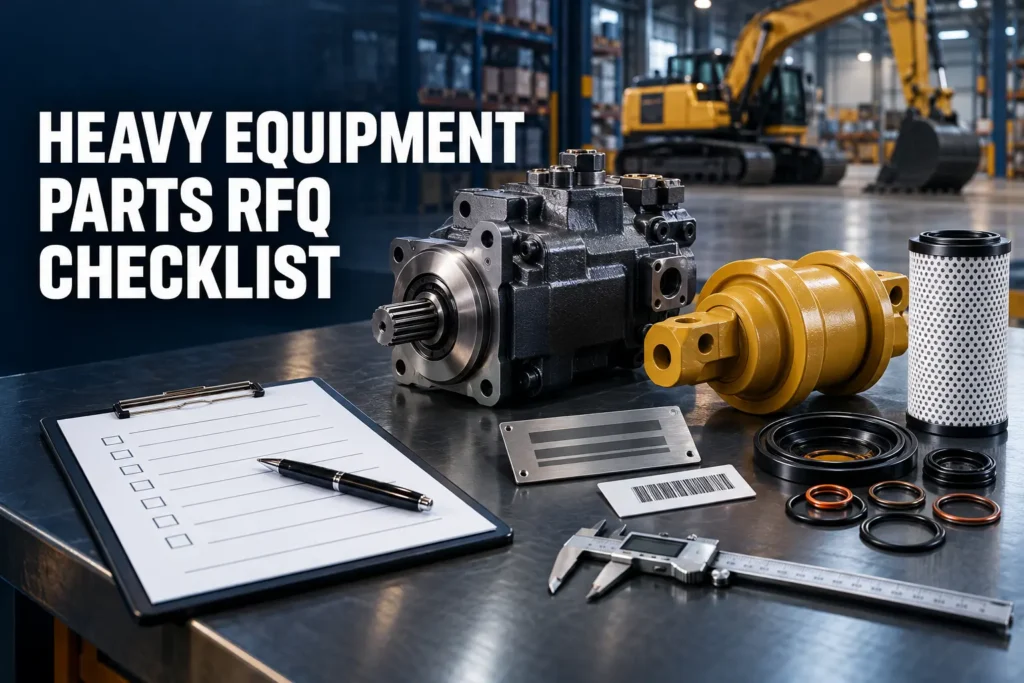
What Information to Include in a Heavy Equipment Parts RFQ
Requesting a quotation for heavy equipment parts is not the same as asking for a price on a standardized consumer product. A description such as “excavator hydraulic pump,” “track roller for Komatsu,” or “engine parts for CAT” may refer to many different configurations. Machines within the same model family can use different components according to serial-number range, production year, engine arrangement, regional specification or previous repair history.
For importers, distributors, repair companies, mining operators and fleet owners, an incomplete RFQ can lead to repeated emails, slow quotations and—more seriously—the wrong part being ordered. A well-prepared heavy equipment parts RFQ gives the supplier enough technical and commercial information to identify the item, verify compatibility, compare alternatives and calculate a realistic landed purchasing plan.
This guide explains what buyers should include when requesting heavy equipment replacement parts, whether the requirement involves excavator undercarriage parts, filters, seal kits, hydraulic components, engine parts, electrical parts or a mixed shipment from China.
Why Detailed RFQ Information Matters
In heavy equipment sourcing, the visible appearance of a component is rarely enough to confirm fitment. Two pumps may have similar housings but different rotation directions, shaft dimensions, regulator settings or mounting interfaces. Two track rollers may look identical while using different flange dimensions or bolt-hole spacing. Even a filter with the same thread can have a different bypass pressure or filtration specification.
A detailed RFQ allows a supplier to answer four essential questions:
- What exact part does the buyer need?
- Which machine and configuration must it fit?
- What quality level and commercial terms are expected?
- What evidence is required before shipment?
The more clearly these questions are answered, the easier it becomes to compare quotations from different construction equipment spare parts suppliers. A low price is not useful if one supplier quotes a genuine part, another quotes an OEM-equivalent unit, and a third quotes an unverified replacement without explaining the difference.
1. Provide the Part Name and Its Function
Start with the common part name and, where possible, the system in which it operates. Examples include:
- excavator track roller
- carrier roller
- front idler
- sprocket segment
- hydraulic main pump
- swing motor
- final drive assembly
- fuel injector
- engine overhaul kit
- boom cylinder seal kit
- oil, fuel, air or hydraulic filter
- controller, monitor or wiring harness
Avoid descriptions such as “pump,” “sensor,” “roller” or “engine part” without further context. If the terminology is uncertain, explain where the component is installed and what it does. A photo showing the installation position can help a technical team distinguish between similarly named parts.
For a mixed RFQ, organize items by machine, system or product category. This reduces the risk of quantities, photos and part numbers being matched to the wrong line.
2. Include Every Available Part Number
The reference part number is normally the fastest starting point for identification. Buyers should provide all numbers visible on the old part, packaging, service manual, dealer quotation or equipment parts catalogue.
Useful identifiers may include:
- OEM part number
- superseded or previous part number
- manufacturer part number
- casting number
- assembly number
- customer’s internal SKU
- filter cross-reference number
- hydraulic pump or motor model code
- engine arrangement number
Do not assume that every number cast into a housing is an orderable part number. Some markings identify only a casting, production batch or subcomponent. Label the source of each number whenever possible—for example, “number from machine parts book” or “number stamped on old pump.”
A professional part number cross-reference process should compare the number with the machine information, product dimensions and application. TerraParts Global uses part-number matching as one input rather than treating a single number as automatic proof of compatibility.
3. State the Equipment Manufacturer and Exact Machine Model
Include the full equipment manufacturer and model designation. “Komatsu excavator” is too broad; “Komatsu PC200-8” is much more useful. Likewise, specify whether the machine is a crawler excavator, wheel loader, bulldozer, motor grader, dump truck or other earthmoving unit.
For earthmoving equipment parts, one letter or suffix can represent a different series. Write the model exactly as shown on the machine nameplate, including suffixes such as LC, L, XL, -6, -7 or -8.
If the RFQ covers several machines, use a separate column for each model. This makes the quotation suitable for later purchasing approval and helps warehouse teams allocate parts correctly after arrival.
4. Add the Machine Serial Number or Product Identification Number
The machine serial number, PIN or chassis number is often essential because manufacturers revise components during a model’s production life. A serial-number break can change the hydraulic configuration, engine arrangement, undercarriage dimensions, electrical connector or control software.
Send:
- complete machine serial number or PIN
- clear photo of the machine nameplate
- approximate production year, if known
- country or region where the machine was originally sold
If the supplier requests the complete serial number, do not provide only its first few characters unless confidentiality rules prevent disclosure. When necessary, ask whether the supplier can verify fitment using a partial serial range plus photos and measurements.
For buyers seeking OEM excavator parts or accurately matched aftermarket alternatives, serial-number verification is one of the strongest ways to reduce wrong-part risk.
5. Provide Engine and Component Identification
Machine model information may not be sufficient for engine, fuel-system and hydraulic components. Include the engine manufacturer, engine model, serial number and arrangement number when available.
For hydraulic pumps, travel motors, swing motors and control valves, photograph the complete identification plate. A useful hydraulic pump part number inquiry may include:
- pump manufacturer and model code
- machine model and serial number
- number stamped on the regulator
- shaft type and spline count
- mounting pattern
- port location
- rotation direction
- photos from several angles
For electronic controllers, displays and sensors, include the voltage, connector photographs, pin count, software number and label details. Electrical parts can share similar housings while having incompatible programming or pin layouts.
6. Attach Clear Photos and Useful Measurements
Photos are most valuable when they document identification features instead of showing only the general shape. Attach:
- A full view of the removed part
- The identification plate or stamped number
- Connectors, ports, shafts and mounting points
- Damaged or worn areas
- The part installed on the machine, when practical
- A ruler or caliper visible beside critical dimensions
Use original-resolution images rather than screenshots compressed by messaging applications. Make sure labels are in focus and readable. For dimensions, state the unit—millimetres or inches—and identify exactly where the measurement was taken.
Typical dimensions may include overall length, outside diameter, flange width, bolt spacing, thread size, shaft diameter, spline count and hose-port size. Measurements should support identification, not replace the machine and part numbers when those numbers are available.
7. Specify Quantity and Purchasing Pattern
Every RFQ should include the required quantity for each line. Quantity affects unit price, packaging, production planning and shipping method.
Also explain whether the requirement is:
- an urgent one-time replacement
- a sample order before approval
- regular inventory replenishment
- a distributor stock order
- a project-based requirement
- an annual forecast or blanket order
If you are a distributor, provide estimated repeat demand where commercially appropriate. The supplier may be able to recommend economical order quantities or consolidate several product categories into one shipment.
For mixed construction equipment parts, a spreadsheet is usually better than a long email. Use one row per item and assign a unique line number that also appears in each photo filename.
8. Define the Required Quality Level
The words genuine, OEM and aftermarket should not be used interchangeably. Tell the supplier which options may be quoted:
- genuine branded part in original packaging
- OEM-produced part, where legitimately available
- verified aftermarket replacement
- remanufactured assembly
- repair kit or individual replacement components
If more than one option is acceptable, ask the supplier to quote them separately and clearly identify the manufacturer, warranty and included components. This helps procurement teams compare like with like.
For aftermarket heavy equipment parts, request information relevant to the product: material specification, heat treatment, hardness, seal brand, bearing brand, filtration rating, test method, dimensional inspection or performance test. The appropriate evidence depends on whether the item is a track component, hydraulic assembly, filter, engine component or electrical part.
TerraParts Global does not treat “aftermarket” as one universal quality grade. We coordinate sourcing according to the application, operating conditions, target service life, budget and verification requirements supplied by the buyer.
9. Describe the Application and Operating Conditions
Application details can affect product selection. A machine operating intermittently on a construction site may have different demands from one working long shifts in a mine, quarry or demolition project.
Useful information includes:
- operating environment: mining, quarry, roadwork, construction or forestry
- normal daily working hours
- climate and ambient temperature
- dust, moisture or corrosive exposure
- material being handled
- recurring failure symptoms
- expected service life
For filters, state the fluid, filtration requirement and service interval. For seal kits, identify the cylinder or valve application. For undercarriage parts, describe ground conditions and machine usage. These details help an experienced excavator parts supplier identify risks that may not be visible from the part number alone.
10. State Packaging, Labeling and Documentation Requirements
Importers and distributors may require more than standard export packaging. Include any expectations for:
- neutral or branded packaging
- part-number labels
- barcodes or QR codes
- country-of-origin marking
- moisture protection
- wooden cases or reinforced cartons
- pallet dimensions
- packing-list format
- photos before dispatch
Also list required commercial or quality documents, such as the commercial invoice, packing list, certificate of origin, inspection report, material report or product-specific test record. Requirements should be confirmed before the order, not after production or consolidation has been completed.
11. Give the Delivery Destination and Trade Terms
A quotation cannot be compared properly unless suppliers use the same delivery basis. State:
- destination country
- destination city, port or airport
- preferred Incoterm, such as EXW, FOB, CIF, CFR, DAP or DDP where available
- required delivery date
- acceptable shipping method
- consignee or import restrictions that affect documentation
For urgent downtime parts, ask for separate airfreight and courier options. For larger stock orders, request packing dimensions and gross weight so the freight plan can be evaluated.
When combining undercarriage, hydraulic, engine, filter and electrical items, ask whether the supplier can provide mixed-order consolidation. Consolidation can simplify supplier coordination and documentation, but packing compatibility, lead times and inspection status must be managed carefully.
12. Clarify the Commercial Terms You Need Compared
A complete excavator spare parts quotation should show more than unit price. Ask suppliers to state:
- quoted brand or manufacturer
- quality category
- unit price and currency
- quantity and total amount
- MOQ
- stock status
- production lead time
- quotation validity
- payment terms
- warranty
- packaging
- Incoterm
- estimated weight and dimensions
- exclusions or assumptions
This structure allows the purchasing team to compare technical compliance, risk and total cost—not simply choose the lowest line-item price.
A Practical Heavy Equipment Parts RFQ Template
Buyers can copy the following structure into an email or spreadsheet:
Buyer information
- Company name:
- Contact person:
- Country and destination:
- Business type: distributor / repair company / fleet / mining / rental
Item information
- Line number:
- Part name:
- OEM/reference part number:
- Equipment manufacturer:
- Machine model:
- Machine serial number/PIN:
- Engine or component model:
- Quantity:
- Preferred quality: genuine / OEM / aftermarket / open to options
- Dimensions or specifications:
- Required delivery date:
Attachments
- Machine nameplate photo
- Existing-part label photo
- Full component photos
- Connector, mounting and interface photos
- Drawings or measurement sheet
Commercial requirements
- Destination port/city:
- Incoterm:
- Packaging and labeling:
- Inspection documents:
- Preferred shipping method:
- Warranty expectation:
Common RFQ Mistakes That Delay a Quotation
The most common mistakes are sending only a machine model, using a generic product description, attaching blurred label photos, omitting quantity, mixing several items without line numbers and requesting “best price” without defining the quality level.
Another frequent mistake is assuming that the old part installed on the machine is necessarily the original specification. Equipment may have been rebuilt, adapted or repaired with a substitute assembly. When the existing component conflicts with the parts catalogue, provide both sets of information and explain the repair history if known.
Finally, avoid sending the same unstructured message to many suppliers and comparing only the lowest number returned. A technically incomplete quotation can create costs through rework, return freight, customs delays and machine downtime.
How TerraParts Global Supports Parts RFQs
TerraParts Global supports international distributors, equipment dealers, repair networks, fleets, mines and rental companies with construction equipment parts sourcing and order coordination. Our process is designed for buyers who need accurate identification and practical supply-chain support rather than a retail checkout experience.
Depending on the RFQ, our work may include:
- organizing multi-line requirements
- checking reference numbers and supersessions
- reviewing machine, engine and component identification
- comparing genuine, OEM-equivalent and aftermarket options
- coordinating photos, measurements and technical clarification
- arranging product-appropriate inspection
- consolidating mixed parts from suitable supply sources
- preparing export packing and shipment information
We do not rely on a part name alone. The objective is to build a clear identification trail before order confirmation and communicate any remaining uncertainty to the buyer.
Frequently Asked Questions
Can I request a quote without a part number?
Yes, but identification may require the machine model, complete serial number, component nameplate, clear photos and dimensions. The more technical evidence provided, the better the chance of an accurate match.
Is the machine model enough to identify excavator parts?
Not always. Machines within the same model can use different parts according to serial-number range, engine arrangement or regional configuration. Include the full serial number whenever possible.
Should I request genuine or aftermarket parts?
That depends on availability, criticality, budget, warranty requirements and operating conditions. Ask for options to be identified separately so your team can make an informed comparison.
Can several brands and product categories be included in one RFQ?
Yes. A structured spreadsheet with one line per item is recommended. Mixed orders may be consolidated after lead times, inspection requirements and packing compatibility are reviewed.
What photos are most useful for parts matching?
Send the complete component, all identification labels, stamped numbers, mounting points, ports, connectors and critical measurements. Include a machine nameplate photo as well.
Send a More Accurate RFQ
An effective heavy equipment parts RFQ does not need to be complicated, but it must connect the required component to the correct machine, quality expectation and delivery requirement. Providing the part number, machine model, serial number, component identification, photos, dimensions, quantity and commercial terms enables suppliers to respond faster and makes quotations easier to compare.
If you are sourcing construction machinery parts, excavator components or a mixed list of replacement parts, send TerraParts Global the information you already have. Our team can organize the request, identify missing details and coordinate the next steps for parts matching, inspection, consolidation and international delivery.
Call to action: Submit Your Heavy Equipment Parts RFQ
