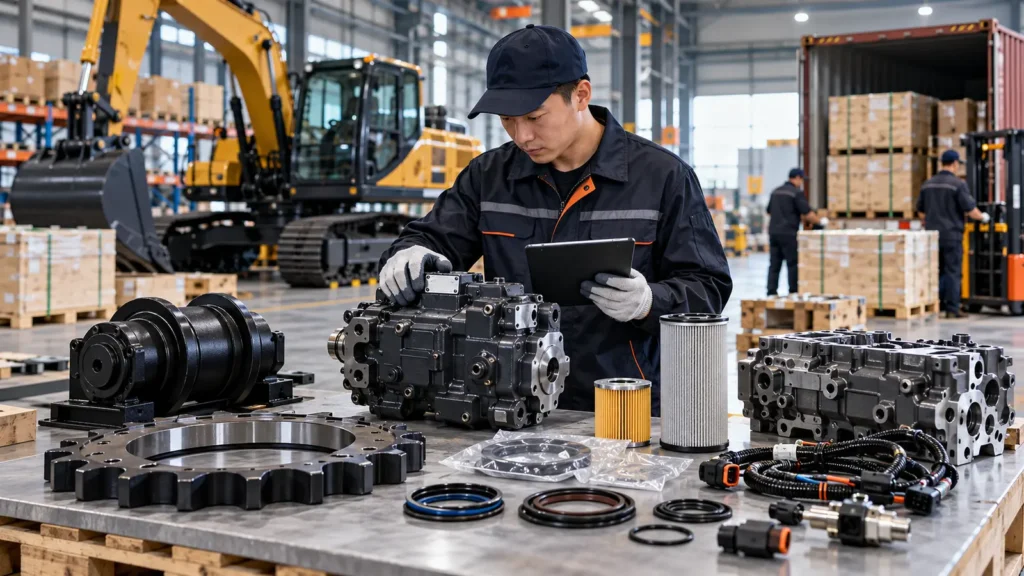
Excavator Parts Supplier in China: A Buyer’s Verification Checklist
China is one of the world’s largest sourcing markets for excavator spare parts. Buyers can find everything from undercarriage components and hydraulic pumps to seal kits, filters, engine parts and electrical components. The challenge is not simply finding a supplier—it is determining whether that supplier can consistently deliver the correct parts, acceptable quality and reliable export service.
A product photo and a competitive quotation are not enough to confirm compatibility. Two excavators with similar model names may use different pumps, engines, controllers or undercarriage dimensions. A small identification error can lead to installation delays, return freight, machine downtime and damage to a buyer’s reputation.
For distributors, repair workshops, mining contractors and equipment fleet operators, supplier verification should therefore happen before the first purchase order.
This checklist explains how to evaluate an excavator parts supplier in China and how TerraParts Global helps buyers reduce wrong-part orders, consolidate mixed products and manage international deliveries.
1. Confirm the Supplier’s Actual Product Scope
Many companies describe themselves as a complete excavator spare parts supplier, but their actual capabilities may be limited to one or two product groups.
Before requesting prices, ask the supplier to define its core categories. A dependable construction machinery parts supplier should be able to explain which products it handles directly and which products are sourced through partner factories.
Common excavator parts categories include:
- Undercarriage parts: track rollers, carrier rollers, idlers, sprockets, track chains, track shoes and track adjusters
- Hydraulic parts: main pumps, travel motors, swing motors, final drives, control valves and hydraulic pump parts
- Seal kits: boom cylinder, arm cylinder, bucket cylinder, center joint, control valve and hydraulic pump seal kits
- Filters: engine oil, fuel, air, hydraulic and pilot filters
- Engine parts: pistons, liners, bearings, gasket kits, injectors, turbochargers, water pumps and fuel pumps
- Electrical parts: controllers, monitors, sensors, solenoid valves, wiring harnesses, starters and alternators
A broad catalog can be useful, but range alone does not prove capability. The supplier must also understand part-number cross-references, machine configurations and the technical differences between replacement options.
TerraParts Global supports mixed excavator parts sourcing across these product categories. Instead of treating every inquiry as a simple price request, we organize the available machine, component and reference information before matching products.
2. Verify the Company’s Legal and Commercial Identity
Before sending a deposit, verify who will receive the payment and who is responsible for the order.
Ask for:
- Full registered company name
- Business registration information
- Company address
- Corporate email domain
- Bank beneficiary name
- Export experience
- Main product categories
- Primary export markets
- Quotation and invoice details
The beneficiary on the bank account should normally correspond with the company shown on the commercial documents. If payments must be sent to an unrelated individual or company, request a clear written explanation.
A professional China excavator spare parts supplier should also provide consistent company information across its website, email signature, quotation, proforma invoice and shipping paperwork.
Buyers should be especially careful when a supplier changes bank information shortly before payment. Confirm any change through a previously verified communication channel.
3. Evaluate the Supplier’s Identification Process
Correct identification is one of the most important capabilities in excavator parts procurement.
Searching for “PC200 hydraulic pump” or “320 excavator final drive” may produce many possible products. The machine model alone is often insufficient because manufacturers can use different components within the same model series.
A capable supplier should request some combination of:
- Equipment manufacturer
- Complete machine model
- Machine serial number
- Original part number
- Engine model
- Hydraulic pump model
- Final-drive or travel-motor identification code
- Dimensions
- Connector or port details
- Photos of the nameplate
- Photos of the existing part
- Required quantity
- Delivery destination
For example, an excavator hydraulic pump supplier should not confirm a main pump solely from a general machine description when a pump nameplate or original reference number is available.
Likewise, an electrical controller can have the same housing as another version but use different software, connectors or voltage specifications.
TerraParts Global uses available reference numbers, machine information, nameplates, dimensions and photographs to check compatibility before quotation. If the information is incomplete, we identify the missing data instead of presenting an uncertain match as confirmed.
4. Check Part-Number Cross-Reference Capability
International buyers frequently search for excavator parts by part number because it is more precise than searching by product name.
However, part-number matching still requires care. A reference may be:
- An original equipment number
- A manufacturer replacement number
- A superseded number
- A component maker’s number
- A casting number
- A distributor’s internal stock code
- A number belonging to an assembly rather than an individual component
Ask the supplier to state whether the quoted reference is:
- An exact match
- A verified replacement
- A superseded reference
- An aftermarket cross-reference
- A rebuild option
- A used or remanufactured component
The quotation should not casually use terms such as OEM, genuine and original interchangeably. Genuine parts are supplied in the equipment manufacturer’s authorized packaging. OEM-origin components may be produced by a manufacturer involved in an original supply chain, while aftermarket excavator parts are independently manufactured replacement products.
A credible supplier explains the offered quality level instead of relying on ambiguous terminology.
5. Confirm Compatibility Beyond the Part Number
Even when a reference number appears correct, additional technical confirmation may be necessary.
For undercarriage parts, verify:
- Roller dimensions
- Bolt-hole spacing
- Flange configuration
- Track-chain pitch
- Link count
- Shoe width
- Sprocket teeth
- Idler dimensions
For hydraulic parts, verify:
- Pump or motor model
- Shaft type and spline count
- Mounting dimensions
- Port position
- Rotation direction
- Regulator configuration
- Displacement
- Relief-valve settings where applicable
For seal kits, confirm:
- Cylinder or component model
- Rod and bore dimensions
- Seal material
- Application position
- Kit contents
For filters, check:
- Full reference number
- Thread size
- Outside diameter
- Height
- Filtration application
- Bypass or anti-drainback requirements
For electrical parts, confirm:
- Voltage
- Connector shape
- Pin count and layout
- Software or program requirements
- Machine serial range
This technical verification is particularly important for buyers sourcing parts for multiple excavator brands or consolidating products for several customers.
6. Ask for Clear Product Photographs
Generic catalog pictures are useful for initial searches but should not be the only evidence used to approve an order.
Before shipment, request clear images showing:
- Overall product appearance
- Nameplate or engraved number
- Connector, shaft, port or mounting face
- Critical dimensions
- Packaging
- Labels
- Quantity
- Any accessories included with the part
For high-value components such as excavator hydraulic pumps, final drives, travel motors, controllers and engine assemblies, identification photographs should be compared with the purchase order before dispatch.
TerraParts Global can organize product and packing images as part of pre-shipment verification. This helps buyers review visible details before goods leave China.
7. Review the Supplier’s Quality-Control Process
“High quality” is not a measurable inspection standard. Buyers should ask what the supplier actually checks.
Inspection requirements depend on the product category. A practical process may include:
Visual inspection
The inspector checks castings, surfaces, threads, connectors, welds, labels, corrosion protection and visible damage.
Dimensional inspection
Critical mounting points, diameters, lengths, hole spacing and interfaces are compared with specifications or approved samples.
Identification inspection
Part numbers, models, nameplates, quantities and product descriptions are checked against the order.
Functional or pressure testing
When relevant and available, hydraulic, electrical or mechanical components may require functional testing, pressure testing or test reports.
Packaging inspection
The supplier checks internal protection, moisture resistance, carton strength, wooden cases, labels and shipping marks.
Not every component can be fully performance-tested after production, so the supplier should explain what has and has not been verified. Honest inspection scope is more valuable than an unsupported claim that every product is perfect.
TerraParts Global selects inspection requirements according to the product type, purchase value and customer specifications. The objective is to identify preventable discrepancies before shipment.
8. Verify Material and Manufacturing Specifications
For wear parts and safety-critical components, price comparisons are meaningful only when specifications are comparable.
When sourcing excavator undercarriage parts, ask about:
- Material grade
- Heat-treatment process
- Surface hardness
- Hardened depth
- Applicable dimensions
- Product weight
- Warranty conditions
For hydraulic seal kits, ask about materials such as NBR, polyurethane, PTFE and FKM where relevant. The correct material depends on pressure, temperature, hydraulic fluid and operating conditions.
For filters, purchasing decisions should consider filtration performance and construction—not only external dimensions.
For engine parts, verify the engine family, arrangement or serial information and determine whether the offer is genuine, OEM-origin, branded aftermarket or unbranded aftermarket.
The supplier should be willing to describe the specification level being quoted. Buyers should avoid comparing a premium verified replacement with an unidentified low-cost product as if they were identical.
9. Test the Supplier With a Sample or Trial Order
For a new supplier, a controlled trial order is usually safer than immediately placing a large mixed shipment.
A trial order can help evaluate:
- Identification accuracy
- Response time
- Quotation clarity
- Product quality
- Labeling
- Packing
- Export documentation
- Delivery reliability
- Handling of technical questions
Choose products that represent the intended cooperation. Testing only a simple filter may not demonstrate whether the supplier can manage hydraulic pumps, controllers or mixed undercarriage components.
Keep a record of approved samples, inspection results, packaging requirements and any corrective actions. These records make repeat ordering more consistent.
10. Assess Mixed-Order Consolidation Capability
Distributors and repair businesses rarely need only one type of part. A purchase order may contain track rollers, seal kits, filters, solenoid valves, sensors and engine components for several machines.
Managing each product through a different exporter increases:
- Communication workload
- Domestic shipping costs
- Documentation
- Customs-clearance complexity
- Risk of missing cartons
- Difficulty coordinating delivery dates
A supplier offering mixed excavator parts consolidation should be able to:
- Organize products by purchase-order line.
- Receive items from approved partner suppliers.
- Check references and quantities.
- Replace weak or inconsistent packaging.
- Apply unified labels and shipping marks.
- Prepare a consolidated packing list.
- Coordinate one export shipment.
TerraParts Global supports mixed-order consolidation for distributors, dealers, workshops and fleet operators. This service is especially useful when a buyer needs several low-volume product categories but wants to avoid many separate international shipments.
11. Inspect Packaging and Export Preparation
Excavator parts can be heavy, oily, fragile or sensitive to moisture. Packaging must reflect the product’s actual transport risk.
Examples include:
- Rust protection for steel parts
- Shaft and port protection for hydraulic components
- Anti-static protection for electronic parts
- Reinforced cartons for dense components
- Wooden cases or pallets for heavy assemblies
- Internal separation for mixed items
- Waterproof wrapping where appropriate
- Clear labels and shipping marks
Ask whether wooden packaging complies with destination requirements and whether the supplier can provide packing dimensions and gross weights before shipment.
Poor packaging can turn a correct, high-quality part into an unusable delivery. Packaging should therefore be reviewed as part of quality control rather than treated as an afterthought.
12. Confirm Export Documents and Shipping Support
A reliable heavy equipment parts supplier should understand basic export documentation.
Depending on the order and destination, documents may include:
- Commercial invoice
- Packing list
- Bill of lading or air waybill
- Certificate of origin
- Product certificates where applicable
- Insurance documents
- Inspection photographs or reports
Confirm the Incoterm—such as EXW, FOB, CIF or DAP—and establish which party is responsible for domestic transport, export clearance, freight, insurance and destination charges.
The lowest freight quotation is not necessarily the lowest landed cost. Oversized packages, remote destinations, customs duties and destination handling fees can materially affect the final cost.
TerraParts Global supports international shipment coordination and provides packing data so buyers can compare delivery options more accurately.
13. Review Communication and After-Sales Procedures
Supplier performance becomes most visible when a problem occurs.
Before ordering, ask:
- Who handles technical confirmation?
- How quickly are inquiries reviewed?
- What evidence is required for a claim?
- What is the claim-reporting period?
- How are shortages or incorrect parts handled?
- Are replacement, credit and refund procedures documented?
- Are warranty exclusions clearly explained?
A buyer should preserve the purchase order, invoice, packing list, part labels, installation information, photos and videos. Claims are easier to resolve when both parties work from traceable evidence.
Professional after-sales service does not mean approving every claim automatically. It means reviewing the evidence promptly, identifying the cause and proposing a commercially reasonable solution.
14. Watch for Common Supplier Red Flags
Proceed carefully when a potential supplier:
- Confirms every inquiry without requesting technical information
- Refuses to provide clear product photographs
- Uses inconsistent company or bank details
- Offers an unusually low price without defining quality
- Describes every product as genuine or OEM
- Cannot explain the difference between similar references
- Provides incomplete quotations
- Avoids written warranty terms
- Cannot provide packing information
- Pressures the buyer to pay before compatibility is checked
No supplier can eliminate every procurement risk. However, a disciplined verification process can substantially reduce avoidable mistakes.
A Practical Pre-Order Checklist
Before approving an excavator parts order from China, confirm that you have:
- Verified the supplier’s company identity
- Defined whether the part is genuine, OEM-origin or aftermarket
- Supplied the machine model and serial number
- Confirmed the original or cross-reference part number
- Submitted component nameplate and product photos
- Checked dimensions, connectors, ports or mounting details
- Approved the quoted brand and specification
- Confirmed inspection requirements
- Reviewed product and packaging photographs
- Agreed on warranty and claim procedures
- Confirmed Incoterms and delivery destination
- Checked invoice and bank information
- Approved the packing list and shipping marks
Why Buyers Work With TerraParts Global
TerraParts Global supports international buyers sourcing replacement parts for excavators and other construction equipment.
Our service focuses on the areas that matter most to professional procurement teams:
- Part-number and machine-information matching
- Compatibility review using available nameplates and photographs
- Sourcing across multiple excavator parts categories
- Genuine, OEM-origin and aftermarket option clarification
- Product-specific inspection coordination
- Mixed-parts order consolidation
- Packaging and labeling review
- Global B2B delivery support
We do not assume that a machine model alone guarantees compatibility. Our team reviews the information available and identifies additional details required for a more reliable match.
Whether you need excavator undercarriage parts, hydraulic pumps, final drives, seal kits, filters, engine parts or electrical components, send us your reference numbers, machine details, quantities and destination.
Request an Excavator Parts Quotation
To receive a more accurate quotation, include:
- Equipment brand and model
- Machine serial number
- Required part name
- Original reference number
- Component nameplate photos
- Existing-part photos
- Required quantity
- Delivery country and city
- Preferred quality level
- Required delivery date
TerraParts Global will review the information and help identify suitable sourcing options for your application.
Send your excavator parts RFQ to TerraParts Global for compatibility review, mixed-order consolidation and international delivery support.
