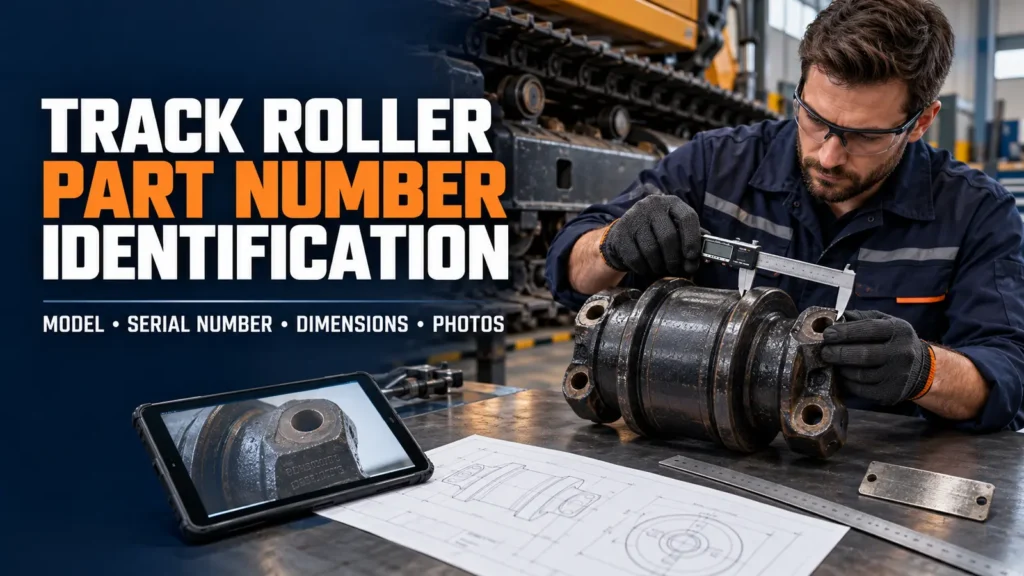
How to Identify Excavator Track Roller Part Numbers
Ordering an excavator track roller may appear straightforward, but matching the correct replacement requires more than knowing the machine brand and general model. Excavators within the same model family may use different roller designs, mounting dimensions or undercarriage configurations. Parts can also change according to the machine serial-number range, production year, track-frame design and country specification.
For distributors, repair workshops, fleet operators and heavy equipment dealers, an incorrect track roller can create more than a minor inconvenience. It may cause installation delays, additional freight costs, unexpected machine downtime and customer claims.
The safest purchasing process combines the original part number with machine information, roller dimensions and clear photographs.
This guide explains how to identify an excavator track roller part number, what information to include in an RFQ and how TerraParts Global reviews undercarriage parts inquiries before quotation.
What Is an Excavator Track Roller?
A track roller is an undercarriage component installed along the lower section of the track frame. It supports the machine’s operating weight and guides the track chain as the excavator travels.
Track rollers are also commonly called:
- Bottom rollers
- Lower rollers
- Lower track rollers
- Undercarriage rollers
- Crawler rollers
- Track chain rollers
These terms are often used interchangeably in international purchasing. However, a track roller should not be confused with a carrier roller.
A track roller runs below the track frame and carries the machine’s weight. A carrier roller—also called a top roller or upper roller—supports the upper section of the track chain.
When sending an inquiry, clearly specify whether you need a bottom track roller or an upper carrier roller. If there is any uncertainty, include photographs showing the roller’s installation position.
Why the Excavator Model Is Not Always Enough
A buyer may submit an inquiry such as:
We need ten track rollers for a PC200 excavator.
This is a useful starting point, but it may not be sufficient for accurate identification.
A model designation can cover multiple machine generations and serial-number ranges. Different versions may have changes in:
- Roller body width
- Flange configuration
- Bolt-hole spacing
- Mounting height
- Shaft diameter
- Oil-seal structure
- Track-chain pitch
- Track-frame dimensions
- Installation position
- Number of rollers used per side
Some replacement catalogs also group several models together even though individual machines require different mounting details.
For this reason, a professional excavator bottom roller supplier should not rely solely on a short machine model when additional identification information is available.
1. Start With the Original Track Roller Part Number
The original part number is generally the fastest route to identification.
It may appear on:
- The old roller body
- A metal tag
- The original packaging
- A previous purchase invoice
- A machine parts manual
- A dealer quotation
- A workshop maintenance record
- An equipment fleet-management system
Clean the component before looking for stamped, cast or engraved numbers. Dirt, grease, corrosion and paint can make the identification marks difficult to read.
Take several close photographs under good lighting. If only part of the number is visible, photograph the complete marking area rather than sending only the readable characters. The position and format of the marking can provide useful context.
Do not assume that every number found on the roller is the service part number. It may instead be:
- A casting number
- A production-batch number
- A factory code
- A subcomponent number
- A patent or material marking
- An internal supplier reference
When possible, compare the number with the equipment parts manual or an established cross-reference source.
2. Record the Complete Machine Model
Provide the full model exactly as shown on the machine nameplate.
Small suffixes can matter. For example, a base model, a dash-series model and a region-specific version may not use the same undercarriage component.
Avoid shortening the information. Instead of submitting only a general family such as “200 excavator,” send the complete designation displayed on the identification plate.
The model should also be copied carefully. Common errors include:
- Confusing zero with the letter O
- Omitting a dash or suffix
- Reversing two digits
- Using the engine model as the excavator model
- Using the hydraulic-pump model instead of the machine model
- Relying on a sales description rather than the nameplate
A clear photograph of the machine identification plate is normally more reliable than manually typing the information.
3. Provide the Machine Serial Number
The machine serial number is one of the most important details for excavator track roller identification.
Manufacturers may revise an undercarriage during a model’s production life. A parts catalog may therefore divide compatibility into different serial-number ranges.
The serial number may be found:
- On the machine identification plate
- On the main frame
- Inside or near the operator cab
- In registration or ownership records
- In the service manual
- In dealer maintenance records
Send the complete serial number and a photograph of the nameplate whenever possible.
Do not publish the serial number publicly on an online forum if equipment security is a concern. It can be sent directly to the supplier as part of a private RFQ.
TerraParts Global uses the machine model and serial information to narrow the possible configurations before confirming a replacement track roller.
4. Identify the Roller Installation Position
Some excavators use more than one lower-roller design.
Depending on the machine and undercarriage arrangement, the front or rear roller may differ from the rollers installed in the center positions. Certain models may use single-flange and double-flange rollers in specific locations.
When requesting a quotation, state:
- Left or right side, if relevant
- Front, center or rear position
- Quantity used per side
- Single-flange or double-flange design
- Whether all rollers on the machine appear identical
A photograph of the complete track frame can help the supplier understand the roller arrangement.
If one damaged roller has already been removed, mark its original position before taking photographs.
5. Determine the Flange Configuration
Track-roller flanges guide the track chain and help maintain alignment.
Common configurations include:
- Single-flange track roller
- Double-flange track roller
- Center-flange variation
- Special guide configuration
A single-flange roller has one guiding flange, while a double-flange roller normally has a flange on both sides of the running surface. The exact profile and spacing may vary.
Do not identify a roller only as “single flange” or “double flange.” This information should be combined with dimensions, mounting details and the machine serial number.
Take photographs from:
- The side
- The front
- The mounting surface
- The top
- The opposite side
These views allow the supplier to compare the roller profile more accurately.
6. Measure the Track Roller
If the OEM excavator part number cannot be found, physical measurements become essential.
Use a reliable steel ruler, vernier caliper or measuring tape, depending on the required dimension. Record the units clearly—preferably millimetres for international parts matching.
Important track roller dimensions may include:
Overall length
Measure the complete roller from one end to the other.
Roller body diameter
Measure the external diameter of the running surface. If the surface is severely worn, explain that the measurement was taken from a used component.
Tread width
Measure the section that contacts or guides the track-chain links.
Flange diameter
Measure the maximum external diameter across the flange.
Distance between flanges
For a double-flange roller, measure the relevant internal and external spacing.
Mounting-hole spacing
Measure from the centre of one bolt hole to the centre of the next. Do not measure only the empty space between the holes.
Bolt-hole diameter
Record the diameter and, if possible, the required bolt specification.
Base width and length
Measure the mounting base that attaches to the track frame.
Mounting height
Measure from the mounting surface to the appropriate roller centreline or external surface.
Measurement methods can differ between suppliers. A photograph showing the measuring tool positioned on the part helps prevent misunderstandings.
Do not round dimensions unnecessarily. A difference of several millimetres may indicate a different track roller.
7. Check the Track-Chain Information
The track roller operates together with the track chain. Chain information can therefore provide additional confirmation.
Where available, record:
- Track-chain pitch
- Link width
- Number of links
- Track-shoe width
- Track-shoe bolt pattern
- Chain assembly part number
- Sprocket part number
- Idler part number
This does not mean that every RFQ requires a complete undercarriage survey. However, the information can be valuable when the original roller number is missing or when the machine uses a non-standard undercarriage.
For an undercarriage overhaul, provide the references for all required components at the same time. TerraParts Global can organize inquiries covering track rollers, carrier rollers, sprockets, idlers, track chains and related hardware.
8. Photograph the Existing Track Roller Correctly
Good photographs can substantially improve identification accuracy.
Before taking pictures:
- Remove loose soil and grease.
- Place the roller on a clean surface.
- Use natural light or bright workshop lighting.
- Avoid strong shadows.
- Include a ruler or measuring tape for scale.
- Photograph every side.
- Take separate close-ups of markings and mounting points.
- Send the original files instead of compressed screenshots where possible.
Recommended photographs include:
- Complete side view
- Opposite side view
- Front profile
- Top view
- Bottom mounting surface
- Bolt holes
- Flange profile
- Part-number marking
- Roller installed on the machine
- Machine nameplate
A photograph alone cannot always prove compatibility, but it is highly valuable when combined with technical information.
9. Distinguish OEM Numbers From Aftermarket References
Buyers searching for an excavator track roller part number may encounter several different references for apparently similar products.
These may include:
- Original equipment service number
- Superseded OEM number
- Manufacturer production number
- Aftermarket supplier number
- Distributor stock code
- Casting number
- Cross-reference number
Ask the supplier to state whether the quotation is based on:
- An exact OEM reference
- A superseded replacement number
- A verified aftermarket cross-reference
- A dimensional match
- A machine-model application
- A physical sample
An aftermarket excavator track roller does not necessarily carry the original manufacturer’s number on the component. The quotation should nevertheless show which original reference or application the replacement is intended to match.
TerraParts Global distinguishes between the buyer’s reference, the offered product reference and the compatibility basis used for quotation.
10. Understand Superseded Part Numbers
Equipment manufacturers may replace an older service number with a newer one. This is called a superseded part number.
A supersession does not always mean that two parts are visually identical. The newer component may include a design revision while remaining suitable for the specified application.
When a supplier proposes a different number, ask:
- Is this an official supersession or an aftermarket cross-reference?
- Which machine models and serial ranges does it cover?
- Are the mounting dimensions identical?
- Does the revised roller require different bolts or hardware?
- Is the product interchangeable without modification?
The answer should be documented in the quotation or order confirmation.
Avoid approving an alternative only because the product photograph looks similar.
11. Check for Previous Undercarriage Modifications
Used excavators may no longer have their original undercarriage configuration.
During previous repairs, an owner may have installed:
- A replacement track frame
- A complete aftermarket undercarriage
- Different track chains
- Modified mounting brackets
- Rollers from another machine application
- Custom spacers or hardware
In this situation, the machine model and serial number may point to the original specification but not necessarily the components currently installed.
If the undercarriage has been modified, tell the supplier. Physical measurements, photographs and the existing roller reference become especially important.
For heavily modified equipment, sending an old sample for comparison may be safer than relying only on a catalog reference.
12. Verify the Proposed Replacement Before Ordering
Before approving a purchase order, compare the supplier’s quotation with your RFQ.
Check:
- Product name
- Offered part number
- Cross-reference number
- Machine model
- Serial-number range
- Single- or double-flange design
- Dimensions
- Mounting-hole arrangement
- Required quantity
- Quality level
- Brand or manufacturer
- Warranty terms
- Packing method
- Unit weight
- Delivery time
For larger orders, request product drawings, dimensional sheets or pre-shipment photographs where available.
If the quotation says only “track roller for excavator” without showing the matching basis, request clarification before payment.
Common Track Roller Identification Mistakes
Ordering from the excavator model alone
The model is useful but may not identify production changes or alternative configurations.
Confusing track rollers with carrier rollers
Bottom rollers and top rollers perform different functions and usually have different references.
Using a casting number as the service part number
A visible number on the roller may identify only the casting or production batch.
Measuring a severely worn surface
Wear can reduce the apparent diameter and alter the flange profile. Inform the supplier that the measurement comes from a used roller.
Measuring between bolt-hole edges
Mounting-hole spacing is normally compared centre to centre.
Sending screenshots instead of original photographs
Compressed images may hide numbers and small structural details.
Ignoring the machine serial number
The serial range may determine which roller version is correct.
Assuming similar appearance means interchangeability
Small differences in height, flange spacing or mounting dimensions can prevent installation.
Information to Include in a Track Roller RFQ
For faster and more accurate matching, send the following:
- Equipment manufacturer
- Complete excavator model
- Machine serial number
- Track roller or bottom roller description
- Original part number
- Quantity required
- Installation position
- Single- or double-flange configuration
- Roller dimensions
- Bolt-hole spacing
- Photographs of the old roller
- Photograph of the machine nameplate
- Track-chain information, if available
- Required quality level
- Delivery country and city
- Target delivery date
A useful RFQ example is:
We require 24 replacement bottom rollers for an excavator fleet. Machine model: [model]. Serial number: [serial]. Existing roller reference: [number]. Double-flange design. Attached are the machine nameplate, old roller photographs and dimensional sheet. Please quote a verified aftermarket option, packing details, gross weight and delivery to [destination].
How TerraParts Global Supports Track Roller Matching
TerraParts Global provides construction equipment spare parts sourcing and aftermarket support for distributors, repair companies, equipment dealers, mining operations and fleet owners.
For excavator undercarriage inquiries, our process may include:
- Reviewing the submitted machine model and serial number.
- Checking the original or cross-reference part number.
- Comparing photographs and visible design details.
- Reviewing supplied dimensions and mounting information.
- Clarifying the required quality level.
- Coordinating sourcing across suitable production partners.
- Checking references, quantity and visible condition before shipment.
- Organizing labels, packaging and mixed-order consolidation.
- Supporting international B2B delivery.
We do not treat a general machine model as automatic proof of compatibility. When the available information is incomplete, we request additional details before presenting the match as confirmed.
Buyers can combine replacement track rollers with carrier rollers, idlers, sprockets, track chains, seal kits, filters, hydraulic parts, engine components and electrical parts in a consolidated order.
Track Roller Quality Checks Before Shipment
Inspection requirements depend on the order specification and available documentation. Relevant checks may include:
- Part-number confirmation
- Dimensional comparison
- Flange configuration
- Mounting-hole arrangement
- Roller rotation
- Oil leakage or visible seal damage
- Casting and surface condition
- Weld appearance where applicable
- Quantity
- Labels
- Rust protection
- Packaging strength
- Shipping marks
Product photographs and packaging records can be organized before dispatch so the buyer can review visible order details.
Inspection does not replace correct installation or machine maintenance, but it helps identify avoidable discrepancies before international shipment.
Frequently Asked Questions
Where can I find an excavator track roller part number?
The number may be stamped, cast or engraved on the old roller. It may also appear in the machine parts manual, previous invoice, original packaging or dealer records. Because markings can be production codes rather than service numbers, confirm the reference against the machine model and serial number.
Are track rollers and bottom rollers the same?
In most international parts inquiries, “track roller” and “bottom roller” refer to the lower undercarriage rollers. A carrier roller or top roller is a different component.
Can I order a track roller using only the excavator model?
Sometimes, but it is not the safest approach. The complete model, serial number, part number, flange design, dimensions and photographs provide a more reliable match.
What if the part number is no longer visible?
Send the machine nameplate, roller photographs, installation position and measured dimensions. Track-chain or related undercarriage references may also help.
Can an aftermarket roller replace the original roller?
A properly matched aftermarket excavator track roller may be used as a replacement, but its application, dimensions, quality specification and mounting details must be verified.
Should I replace only one damaged roller?
That depends on the condition of the remaining undercarriage, operating hours and wear pattern. Ask a qualified technician to inspect the complete system. Uneven wear among rollers, chains, sprockets and idlers can reduce component life.
Does TerraParts Global manufacture every track roller?
TerraParts Global operates as a construction equipment parts sourcing, verification and export-support partner. We coordinate products through suitable supply-chain partners according to the required application, quality level and order specification.
Request Track Roller Part-Number Matching
If you need help identifying an excavator track roller part number, send TerraParts Global:
- Machine brand and complete model
- Serial number
- Existing part number
- Old roller photographs
- Roller dimensions
- Required quantity
- Delivery destination
Our team will review the available information, identify missing details and coordinate suitable replacement options.
Send your track roller inquiry to TerraParts Global for part-number matching, compatibility review, quality inspection, mixed-order consolidation and global B2B delivery support.
