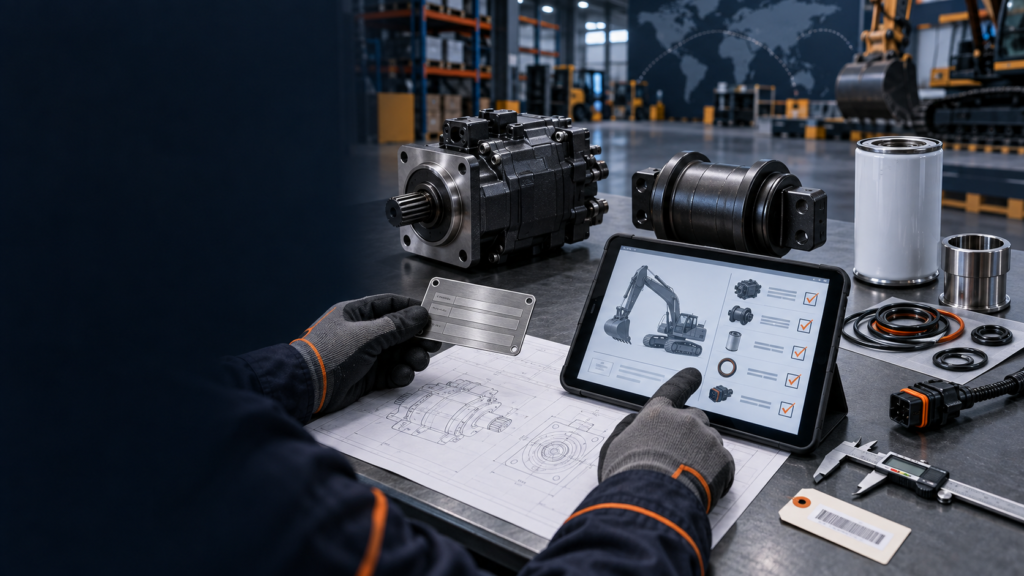
Information Required for Accurate Construction Equipment Parts Matching
Ordering construction equipment spare parts is not simply a matter of finding a component that looks similar. Two excavators from the same manufacturer may use different pumps, seal kits, sensors or undercarriage components because of differences in production year, serial-number range, engine configuration or regional specification.
For importers, distributors, repair companies, mining operators and equipment fleet managers, an incorrect part can create more than a return problem. It can delay a repair, stop a machine, increase international freight costs and affect commitments made to the final customer.
Accurate construction equipment parts matching begins with complete and reliable information. A part number is usually the fastest starting point, but it is not always sufficient. Machine model, serial number, nameplate photos, component dimensions and application details may all be needed before compatibility can be confirmed.
This guide explains what information buyers should provide when requesting aftermarket construction equipment parts and how TerraParts Global uses those details to support identification, cross-reference, sourcing, inspection and consolidated B2B delivery.
Why Accurate Parts Matching Matters
Heavy equipment often remains in service for many years. During that time, manufacturers may update components, change suppliers, introduce improved assemblies or assign new replacement numbers.
As a result, the same machine model may include several component variations.
For example, a buyer may request a hydraulic pump for a particular excavator model. However, that model may have been produced across multiple serial-number ranges and fitted with more than one pump configuration. The mounting pattern, shaft design, port position, displacement or controller may differ.
Similar risks apply to:
- Hydraulic pumps and motors
- Main control valves
- Engine overhaul kits
- Turbochargers
- Starter motors and alternators
- Sensors and electrical components
- Track rollers and carrier rollers
- Idlers, sprockets and track chains
- Cylinder seal kits
- Filters and filter assemblies
- Final drives and travel motors
- Cooling-system components
A low quotation is not useful if the supplied component cannot be installed. For professional buyers, correct identification should therefore come before price comparison.
1. Original Part Number
The original part number is normally the most useful piece of information for a heavy equipment parts supplier.
It may be found on:
- The original component
- A metal identification plate
- Packaging or labels
- A parts manual
- A service manual
- A previous invoice
- A dealer quotation
- An equipment maintenance record
Provide the complete reference exactly as printed, including letters, spaces, hyphens and suffixes.
For example, references such as 708-2L-00300 and 708-2L-00310 may appear similar but can represent different components or revisions. Omitting one digit can lead to an incorrect cross-reference.
If several numbers appear on the component, photograph all of them. One may be an assembly number, while another may identify the casting, manufacturer, production batch or subcomponent.
A professional supplier should not assume that every visible number is the ordering number. The number must be checked against the machine and application.
2. Equipment Manufacturer and Machine Model
Always provide the equipment brand and complete machine model.
Instead of submitting only:
Excavator hydraulic pump
Provide:
Hydraulic pump for Komatsu PC200-7 excavator
The machine model helps narrow the application, but it should not automatically be treated as proof of compatibility. A model can include different engine types, serial ranges and hydraulic-system configurations.
Useful information includes:
- Equipment manufacturer
- Complete machine model
- Machine type
- Approximate production year
- Operating market or region
- Any suffix shown after the model
Examples of machine types include excavators, wheel loaders, bulldozers, motor graders, mining trucks, compact equipment and other construction machinery.
Manufacturer names and model references should be used for identification purposes only. They do not by themselves indicate that a replacement part is genuine OEM or approved by the original manufacturer.
3. Machine Serial Number
The serial number is one of the most important details for construction equipment spare parts identification.
Manufacturers frequently introduce component changes during the production life of a machine. Two units carrying the same model designation may require different parts if they belong to different serial-number ranges.
Send:
- The complete machine serial number
- A clear photo of the machine nameplate
- The product identification number, if available
- The frame or chassis number where applicable
Do not crop the photograph too tightly. A wider image showing the nameplate location can help distinguish the machine plate from an engine or component plate.
If the serial number is difficult to read, provide several photos under different lighting conditions. Typing the number into a message is useful, but the original photo helps prevent transcription errors.
4. Engine Model and Engine Serial Number
Engine-related parts often require separate engine identification.
A machine model alone may not establish which engine version is installed, particularly when equipment was produced for several markets or when the original engine has been replaced.
For engine parts, provide:
- Engine manufacturer
- Full engine model
- Engine serial number
- Arrangement or specification number
- Engine nameplate photo
- Original part number, if available
This information is particularly important when requesting:
- Pistons and cylinder liners
- Bearings
- Gasket sets
- Fuel injectors
- Fuel pumps
- Water pumps
- Oil pumps
- Turbochargers
- Starter motors
- Alternators
- Complete engine overhaul kits
For an excavator engine parts supplier, the engine nameplate is frequently more valuable than the machine model alone.
5. Clear Photos of the Existing Component
When the original part number is unavailable, component photos become essential.
Provide multiple photographs rather than one general image. Recommended views include:
- Complete component from the front
- Complete component from the rear
- Left and right sides
- Mounting points
- Connections and ports
- Shafts, splines or gears
- Electrical plugs and pin arrangement
- Labels, stamped numbers and casting marks
- Damaged area
- Component installed on the machine, if possible
Photos should be clear, well-lit and taken at a high enough resolution to enlarge. Clean dirt, oil or paint from stamped areas where this can be done safely.
Avoid sending only a screenshot from an online catalogue. A supplier needs to examine the actual component being replaced, especially when performing aftermarket parts compatibility verification.
6. Nameplate and Label Information
A nameplate can contain information that is not visible in the component shape.
Depending on the component, the plate may show:
- Manufacturer
- Model code
- Assembly number
- Serial number
- Production code
- Voltage
- Pressure
- Displacement
- Flow specification
- Rotation direction
- Software or controller version
Photograph the complete plate and then take a close-up of the text. Make sure reflections do not cover the numbers.
For pumps, motors, valves, controllers and electrical parts, nameplate data can be decisive. A component with the same external housing may have a different internal configuration.
7. Dimensions and Mounting Details
Measurements are useful when numbers are missing, unreadable or uncertain.
The required dimensions depend on the product. They may include:
- Overall length, width and height
- Mounting-hole spacing
- Shaft diameter and length
- Spline count
- Thread diameter and pitch
- Port diameter and position
- Flange dimensions
- Seal inner diameter, outer diameter and thickness
- Roller diameter and width
- Track-chain pitch
- Number of teeth on a sprocket
- Connector dimensions and pin count
Place a ruler, calliper or measuring tape next to the component in the photo. Include a simple drawing if the geometry is difficult to explain.
Dimensions should support identification rather than replace the part number and machine details whenever those references are available.
8. Connector, Port and Interface Details
Parts may look identical in a catalogue image but use different interfaces.
For electrical parts, provide:
- Connector shape
- Number of pins
- Pin arrangement
- Cable length
- Voltage
- Plug orientation
- Label information
For hydraulic components, provide:
- Number and position of ports
- Thread type
- Port diameter
- Flange type
- Rotation direction
- Control method
- Hose or pipe connection arrangement
For mechanical parts, show:
- Mounting surfaces
- Bolt-hole positions
- Shaft or spline design
- Gear-tooth count
- Rotation direction
- Related mating components
Interface details are particularly important for a hydraulic pump replacement, travel motor, final drive, sensor, solenoid valve or control unit.
9. Part Description and Function
Do not rely only on an informal product name. Different markets and workshops may use different terminology for the same item.
Describe:
- What the component does
- Where it is installed
- Which system it belongs to
- How it connects to surrounding parts
- Why it is being replaced
- Whether the old component is available for comparison
For example:
Hydraulic pilot pump mounted behind the main pump, required for a PC200-7 excavator. The existing unit has low pressure and the original plate is damaged.
This description gives the technical team more context than simply writing “pump”.
10. Required Quantity
Quantity affects sourcing, production planning, packing and quotation.
State whether the request is for:
- One replacement unit
- A trial order
- Regular stock replenishment
- A mixed-parts purchasing list
- A project order
- Long-term distribution
For multiple items, an Excel purchasing list is usually the most efficient format. Use one row per product and include columns for:
- Item number
- Part number
- Description
- Machine model
- Serial number
- Required quantity
- Photo filename
- Additional notes
Avoid sending several unlabelled photographs without connecting them to the corresponding items in the list.
TerraParts Global can review mixed requirements across hydraulic, engine, electrical, filtration, sealing and undercarriage categories before coordinating consolidated purchasing.
11. Quality and Replacement Requirements
Clarify the required product level and acceptance criteria before quotation.
Useful information includes:
- Genuine OEM required, if applicable
- Aftermarket replacement accepted
- New, remanufactured or rebuilt condition
- Material requirement
- Preferred brand
- Inspection requirement
- Packaging specification
- Private label requirement
- Required documents
- Target market
The word “aftermarket” covers a wide range of products. Buyers should compare compatibility, specification, inspection scope and supplier accountability—not price alone.
If a specific material grade, finish, hardness, dimension tolerance or test record is required, include it in the initial request.
12. Application and Operating Conditions
Operating conditions may affect part selection and service expectations.
Tell the supplier if the equipment operates in:
- Mining environments
- Quarry operations
- Road construction
- Demolition
- High-temperature regions
- Extremely cold regions
- Dusty or abrasive conditions
- High-humidity or coastal areas
- Extended working shifts
- Rental fleets with intensive utilisation
For filters, seals, cooling components, undercarriage parts and hydraulic components, application conditions can influence the recommended specification.
If a previous replacement failed earlier than expected, explain the failure mode. This does not automatically mean the part was defective; contamination, installation, lubrication, alignment, pressure or surrounding-component wear may also contribute.
13. Delivery Destination and Packing Requirements
International quotations should include the delivery country and preferred trade arrangement.
Provide:
- Destination country
- Destination city or port
- Preferred Incoterm
- Required delivery date
- Whether shipment will be by courier, air or sea
- Whether consolidation with other products is required
- Carton-mark or label requirements
- Import documentation requirements
These details allow the supplier to evaluate packing method, shipment size and delivery coordination.
For mixed orders, item-level packing lists and clear carton identification are especially important. They help distributors, warehouses and maintenance teams receive and sort products efficiently.
What to Send When the Part Number Is Unknown
Not having a part number does not always prevent identification.
If the number is unavailable, send as many of the following as possible:
- Machine brand and model
- Machine serial number
- Machine nameplate photo
- Engine model and serial number
- Component nameplate
- Photos from all sides
- Dimensions
- Mounting-hole positions
- Connector or port details
- Description of function
- Required quantity
A machine model alone is rarely the strongest basis for confirming a technical component. The more evidence available, the lower the risk of an incorrect match.
TerraParts Global can review the available information and identify which additional detail is still required before sourcing proceeds.
How TerraParts Global Handles a Parts-Matching Request
Our process is designed for overseas B2B buyers who need technical coordination across multiple product categories.
Step 1: Requirement Review
We organise the buyer’s part numbers, machine information, quantities, photos and delivery requirements. Missing or conflicting information is identified before confirmation.
Step 2: Part-Number Cross-Reference
Available references are compared with applicable machine and component information. Superseded or alternative numbers are reviewed where relevant.
Step 3: Machine Compatibility Check
The machine model, serial-number range, engine information and physical interfaces are checked to reduce the risk of an incorrect replacement.
Step 4: Supplier Coordination
Requirements are communicated to appropriate suppliers according to product category, technical capability, quantity and quality expectations.
Step 5: Confirmation Before Order
The proposed reference, specification, product condition and unresolved technical points are presented for buyer confirmation. Compatibility should be confirmed before production or shipment rather than assumed after delivery.
Step 6: Inspection and Consolidation
Depending on the agreed order requirements, inspection may cover identity, quantity, visible condition, dimensions, interfaces, labels and packing. Mixed parts can be coordinated into a consolidated shipment with item-level records.
Step 7: Worldwide B2B Delivery
Export packing, packing lists and shipment coordination are arranged according to the order and delivery destination.
This approach gives importers and distributors one coordination point for part identification, sourcing, quality review and delivery.
Common Mistakes That Delay a Quotation
Buyers can improve quotation speed by avoiding several common problems:
- Sending only the machine model
- Omitting the machine serial number
- Providing an incomplete part number
- Sending blurred or heavily compressed photos
- Photographing only one side of the component
- Failing to show plugs, ports or mounting points
- Mixing photos from several items without labels
- Omitting required quantities
- Not stating the destination country
- Assuming similar appearance means compatibility
- Requesting a final quotation while technical details remain unconfirmed
A quick quotation is not necessarily an accurate quotation. For technical parts, a responsible supplier may need to ask additional questions before confirming price and availability.
Parts-Matching Checklist for Importers
Before sending an RFQ, check whether you have included:
- Original part number
- Equipment manufacturer
- Complete machine model
- Machine serial number
- Machine nameplate photo
- Engine model and serial number
- Existing component photos
- Component nameplate or stamped numbers
- Dimensions and mounting details
- Connector, spline or port information
- Required quantity
- Quality requirement
- Destination country
- Requested delivery method
- Purchasing list for multiple items
Providing these details at the beginning helps reduce repeated communication and improves the reliability of the quotation.
Submit Your Construction Equipment Parts Requirements
Whether you have a complete part number, a machine serial number, a component photo or a mixed purchasing list, TerraParts Global can help organise the information required for parts matching.
Our service supports construction equipment parts importers, distributors, equipment dealers, repair networks, mining companies and fleet operators that need:
- Part-number matching
- Machine compatibility verification
- Aftermarket construction equipment parts sourcing
- Multi-supplier purchasing coordination
- Pre-shipment inspection
- Mixed-parts consolidation
- Export packing and worldwide B2B delivery
Submit your part numbers, machine information, photos or Excel list through our Request a Quote page.
The more complete the information, the more efficiently we can review compatibility and prepare an appropriate sourcing proposal.
All manufacturer names, machine models, part numbers and trademarks are used for reference and identification purposes only. Product compatibility, availability, inspection scope and delivery terms are confirmed individually for each order.
